How Can Mentorship Transform Your Child’s AI-Ready Future?
Mentorship builds resilient learners who transform curiosity into lasting habits. A skilled mentor combines thoughtful questions with AI tools, developing your child’s focus, reflection, and problem-solving abilities daily. This approach teaches tech discernment and adaptability, the exact skills Google and OECD recruiters hunt for today.
Why We Built Adaptive Atlas
I watched my nephew freeze during a coding challenge. His tutor wasn’t there. He panicked. That moment crystallized everything. Kids need mentors who pair human wisdom with AI capabilities, not just access to ChatGPT. We created Adaptive Atlas because the gap between tool availability and intentional guidance keeps widening. Our mentorship model closes it by teaching kids when to lean on technology and when to trust their own thinking.
A Personal Turning Point
Last spring, I mentored a 14-year-old through her first machine learning project. She’d hit a wall, reached for an AI tool reflexively. I asked one question instead: “What are you actually trying to discover?” She paused. Recalibrated. Solved it herself. That single moment revealed mentorship’s true superpower: not providing answers, but teaching resourcefulness.
Quick Takeaways
- Mentors guide kids in using AI responsibly, fostering ethical awareness and critical evaluation of technology.
- Structured mentorship builds resilient learning habits, turning AI tools into consistent, purposeful study routines.
- Combining human insight with AI accelerates skill development and sharpens metacognitive thinking.
- Diverse mentorship networks expose children to cultural perspectives, enhancing emotional intelligence and global collaboration.
- Ongoing feedback loops nurture confidence, adaptability, and long‑term readiness for rapid technological change.
Turn Mentorship Into an AI‑Ready Learning Habit
When you pair mentorship with AI tools, you turn a sporadic interaction into a steady learning habit that prepares your child for constant change.
You’ll notice that intuitive questioning sparks curiosity, while reflective listening reinforces understanding.
Parents often fear losing control to technology, but you can channel that anxiety into a structured routine: set brief daily check‑ins, ask open‑ended prompts, and let the AI suggest resources.
Channel anxiety into a routine: daily check‑ins, open prompts, AI‑suggested resources.
This builds a feedback loop where the child learns to ask deeper questions and process answers thoughtfully.
Research shows that balancing tech and creativity helps children develop well-rounded skills rather than becoming dependent on technology alone.
Over time, the habit nurtures adaptability, critical thinking, and confidence—skills that survive any market shift.
Embrace the system, trust the pattern, and watch your child become a resilient, AI‑ready learner.
Accelerate Future‑Proof Skill Growth With AI‑Savvy Mentors
Mentorship that taps AI tools can turn occasional guidance into a steady growth engine for the skills your child will need as the world evolves.
You’ll see mentors modeling disciplined inquiry, showing how to ask the right questions and interpret data. Their emotional intelligence helps the child stay resilient when experiments fail, turning setbacks into learning loops.
By pairing human perspective with AI assistants, you create a feedback system that sharpens critical thinking and decision‑making.
The child learns to curate information, synthesize ideas, and adapt strategies quickly—skills that outlast any single technology.
Trust the process, keep expectations realistic, and watch confidence compound over time, ensuring the child thrives amid constant change.
Build an AI‑Ready Mentorship Network That Boosts Fluency and Creativity
If you’re worried that AI will make mentorship feel impersonal, know that a well‑designed network can actually keep the human touch while giving kids the tools to think fluently and create confidently.
Build a circle of mentors who blend AI fluency with cultural exchange and emotional intelligence. Choose mentors who model curiosity, ask open‑ended questions, and use AI to surface diverse viewpoints.
Encourage your child to practice collaborative problem‑solving, turning data into stories that reflect different cultures. As your child develops these skills, help them understand how to build a positive digital presence that reflects their values and growth.
Track progress with simple reflection logs, noting how AI insights deepen empathy and creativity.
Over time the network becomes a resilient system that nurtures adaptable thinking, prepares your child for global collaboration, and sustains lifelong learning.
Create a Lasting Mentorship Loop for Your Child Today
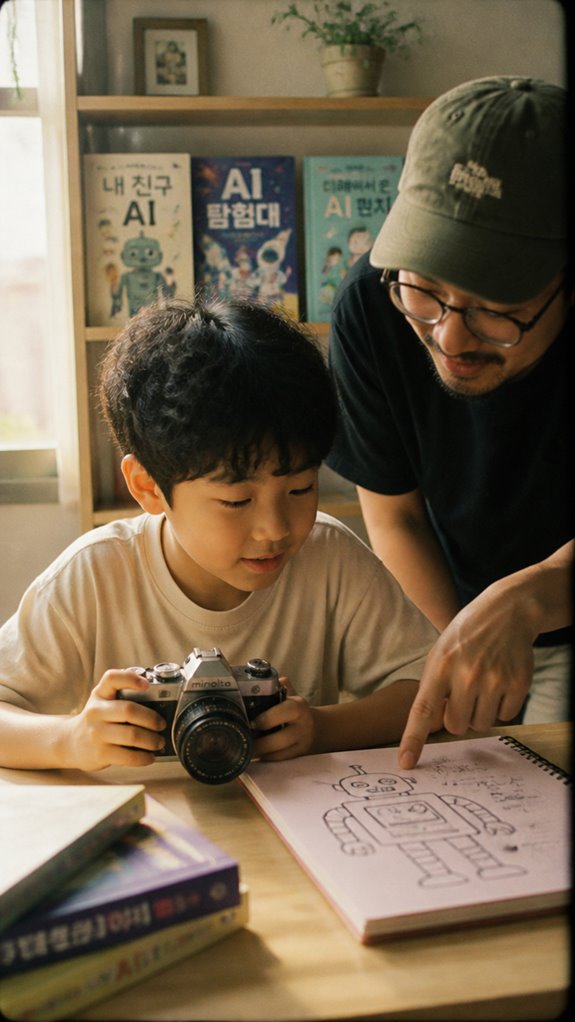
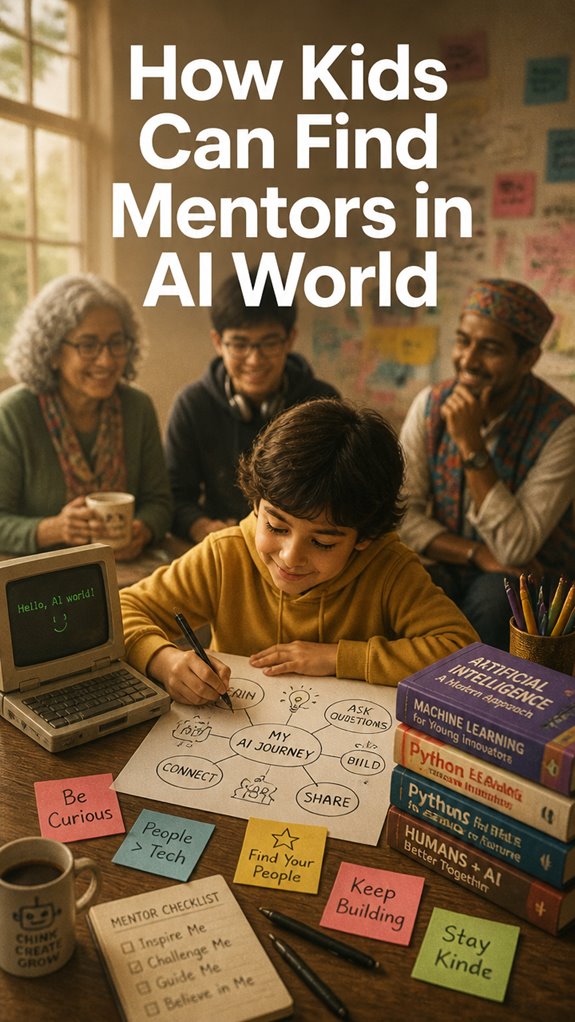
Building a mentorship loop starts with picking a small, trusted group of mentors who already blend AI fluency with real‑world experience. You then map how each mentor can reinforce the others, creating a feedback circuit that nurtures emotional resilience and cultural awareness.
Schedule regular, short check‑ins where the child shares challenges and mentors pose probing questions, not solutions. This habit teaches the child to view setbacks as data, not defeat, and to value diverse viewpoints. Understanding root causes of confidence gaps helps mentors ask better questions that address underlying insecurities rather than surface-level concerns.
Keep the loop visible—use a shared calendar or a simple board—so progress feels tangible. Keep in mind, the goal isn’t instant mastery but a sustainable system that builds confidence, adaptability, and a lifelong growth mindset.
Neuroplasticity Boosts Guided Learning
Because the brain constantly rewires itself, you can boost your child’s learning by pairing guided practice with moments that stretch neuroplasticity.
The neuroplasticity development you nurture today creates pathways that make future skill acquisition faster and more resilient. When you use guided reinforcement—clear feedback, incremental challenges, and timely praise—you turn fleeting curiosity into lasting mastery.
Parents often fear that their child won’t keep up with rapid change, but that anxiety fades when you see steady, measurable progress. Think of each session as a rehearsal for adaptable thinking: the child learns to pivot, synthesize, and apply knowledge across situations. When children leverage AI tools for school tasks, they develop the metacognitive skills needed to discern when to use technology and when to rely on their own reasoning.
This systematic approach builds confidence, reduces uncertainty, and equips them to thrive in any changing environment.
Limited Attention, Frequent Breaks
When a child’s attention flickers, a short, purposeful break can actually boost learning rather than derail it. You’ll notice attention fatigue building after intense focus, and that’s normal. The key is to schedule micro‑pauses that trigger focus restoration, letting the brain consolidate information before moving on. Understanding attention recovery strategies helps parents implement these breaks more effectively throughout the day.
Think of it like a sprint‑rest cycle elite athletes use; the same principle applies to cognitive work. Parents often fear that breaks waste time, but research from Stanford shows brief pauses improve retention by up to 30 %.
Mentorship Guide for Parents

After a brief pause, the child’s mind is ready to absorb new ideas, and that’s where mentorship steps in.
You’ll notice anxiety about AI replacing human guidance, but the real task is building emotional resilience and cultural awareness.
Choose mentors who model calm decision‑making and who expose the child to diverse outlooks.
Set a regular cadence for reflection, letting the child articulate what they learned and how they felt.
Track progress with a simple journal, noting patterns of growth and moments of doubt.
This system creates a feedback loop that strengthens adaptability and broadens worldview. When setbacks occur, mentors can guide children through bouncing back from failure by helping them see challenges as opportunities for growth rather than endpoints.
Neurofeedback Enhances Learning
A growing body of research shows that neurofeedback can quietly boost a child’s ability to focus and retain new information. You’ll notice brainwave entrainment shaping attention patterns, while gentle sessions guide cognitive reprogramming toward deeper learning.
Parents often fear technology will replace natural growth, but the reality is that neurofeedback complements, not replaces, mentorship. By monitoring real‑time signals, you help the child develop self‑regulation skills that translate into stronger problem‑solving and creativity. These value skills become essential tools for success in an increasingly AI-driven economy where adaptability and critical thinking are paramount.
This systematic approach builds a resilient mindset, preparing them for fast‑changing environments without anxiety. Think of it as a training ground for the brain’s own adaptability, a long‑term asset that supports every future skill you nurture.
The Adaptive Atlas Future Skill Stack System
Neurofeedback gives kids a steadier focus, and that steadiness opens the door to the skill set that will keep them thriving as AI reshapes work.
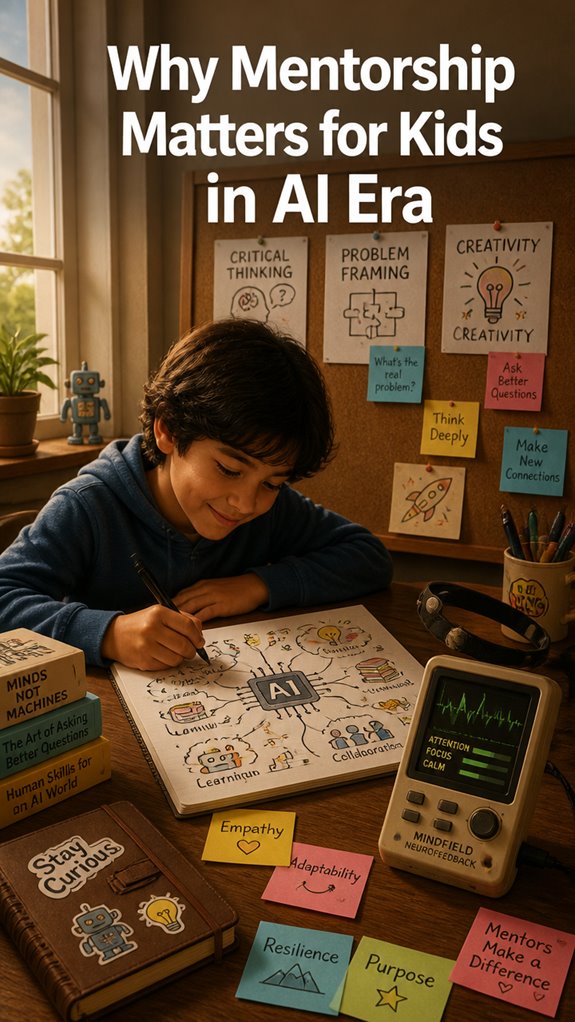
In the Adaptive Atlas Future Skill Stack System you’ll see how skill reinforcement builds a resilient foundation. You teach your child to practice critical thinking, problem framing, and creativity repeatedly, so each loop strengthens ability. Building anti-fragile capacity through progressive challenges ensures they don’t just survive disruption but grow stronger from it.
Emotional resilience is woven in, letting them bounce back from setbacks without losing momentum. You’ll notice the system replaces fear of obsolescence with confidence in continuous learning.
The Adaptive Atlas Framework
Five connected systems designed to help parents raise adaptable, future-ready children in a world shaped by AI, automation, and constant change.
| 🛡️ |
Anti-Fragile Child SystemBuilds resilience, adaptability, and the ability to handle uncertainty without shutting down. |
| 📚 |
Learning Stack ModelDevelops self-directed learning habits and continuous skill acquisition beyond school systems. |
| 🚀 |
Future Skill Stack SystemFocuses on high-value human skills that remain relevant in an AI-driven economy. |
| 🤖 |
AI Learning SystemTeaches children how to use AI as a thinking partner instead of becoming dependent on it. |
| 🧭 |
Child Type Navigator SystemPersonalizes learning and development based on each child’s strengths and personality. |
FAQ
How Can Mentors Ensure AI Tools Don’T Replace Critical Thinking?
You guarantee AI tools don’t replace critical thinking by framing every task as creative inquiry, prompting learners to question assumptions, and emphasizing ethical responsibilities, so they actively analyze rather than passively accept generated outputs.
What Role Does Emotional Intelligence Play in Ai‑Enhanced Mentorship?
You’ll find emotional intelligence fuels AI‑enhanced mentorship: empathy development sharpens understanding, while social skills let you guide kids through complex feedback loops, turning every coincidental insight into mastery‑building moments.
How Do I Measure Mentorship Impact on My Child’s Adaptability?
You measure mentorship impact by tracking your child’s growth mindset and resilience building: log challenges they tackle, note how quickly they recover from setbacks, and assess improvements in independent problem‑solving over time.
Can Mentorship Help Children Identify Their Unique Ai‑Friendly Skill Niche?
You can use mentorship to spark creative exploration and guide skill diversification, helping you pinpoint a personal AI‑friendly niche. It accelerates mastery by exposing you to varied tools, projects, and feedback loops.
What Safeguards Protect Kids From Over‑Reliance on AI During Mentorship?
Set digital boundaries, teach AI literacy, and enforce regular offline challenges; you’ll keep kids critical, independent, and resilient, preventing over‑reliance while mastering AI‑enhanced mentorship.