How do you teach kids to navigate relationships in a world that moves faster than ever? You build emotional skills through consistent, intentional practices that transform how they connect with others.
Teaching Emotional Intelligence Through Real Connection
Last spring, I watched my nephew freeze during a group project disagreement. His classmates wanted one approach; he had another. Instead of shutting down, he named what he felt: frustrated, unheard, maybe a little scared. That moment sparked something. He asked clarifying questions. They listened back. The project shifted. That’s when I realized naming feelings isn’t soft stuff; it’s the foundation for everything else.
This is exactly why we built Adaptive Atlas. Kids need frameworks that meet them where they are, not lecture halls about “feelings.” They need to practice conflict resolution with stakes that matter but won’t derail them. To role-play with AI partners who don’t judge. To journal without performance anxiety. Real relationships demand real skill-building.
Practical Skills That Stick
I once sat across from a teenager who couldn’t articulate why group work felt suffocating. We worked through digital collaboration tools together, mapping out communication norms. She discovered she needed explicit turn-taking, not endless chat threads. Suddenly, group projects didn’t feel like chaos anymore. One small structure changed everything about how she showed up.
Quick Takeaways
- Teach emotional literacy daily by naming feelings, journaling, and practicing calm breathing to build self‑awareness and regulation.
- Model active listening and empathy through open‑ended questions, validation, and reflective pauses, turning these into strategic collaboration skills.
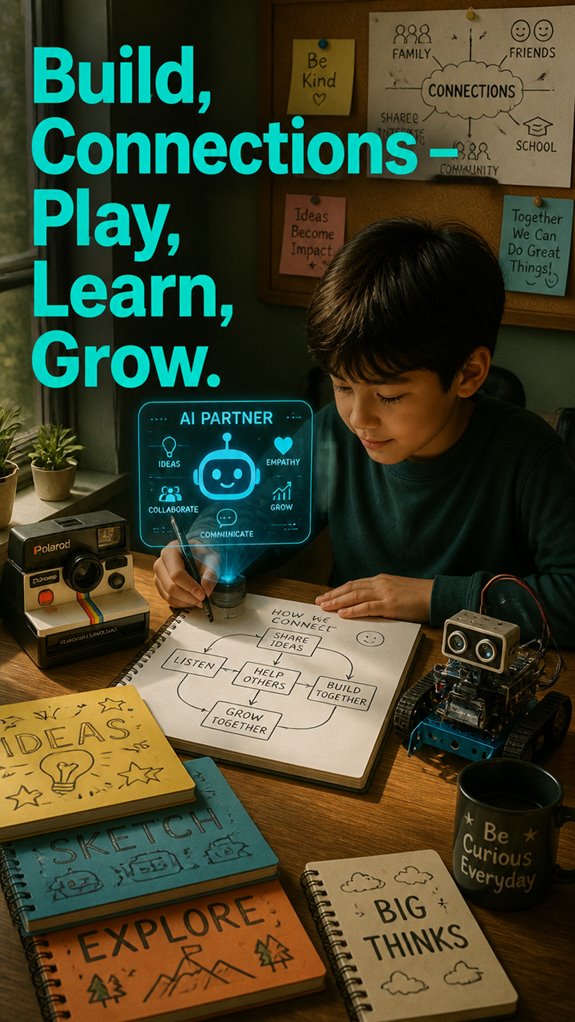
- Use AI tools as supportive partners for role‑playing conflict‑resolution scenarios, guiding children to articulate emotions and explore solutions.
- Foster anti‑fragile resilience: encourage saying “no,” staying calm under pressure, and bouncing back from setbacks to thrive amid disruption.
- Integrate digital collaboration platforms with respectful etiquette, reinforcing teamwork, communication, and adaptive confidence for future environments.
How to Give Kids the Core Skills They Need to Thrive in the AI Era
When you think about the skills kids need for the AI era, the first thing to recall is that the world will keep changing, so the ability to adapt is more important than any specific tool.
Adaptability outshines any tool; thriving in the AI era means learning to pivot, not just master tech.
You’ll notice parents worry about tech overload, but that fear can be reframed as a chance to build emotional resilience and social intuition.
Teach your child to pause, label feelings, and recover quickly from setbacks; this habit fuels confidence when algorithms shift.
Pair that with exercises that read facial cues and tone, sharpening intuition for collaborative environments.
Encourage regular reflection on what worked and what didn’t, turning each experience into a data point.
Over time, these habits become a reliable system, allowing the child to thrive amid constant innovation.
Empathy, Listening, and Trust: Adaptive‑Learning Skills for Kids
Since children learn best when they feel truly heard, building empathy, listening, and trust becomes the foundation of any adaptive‑learning system.
You can model emotional intelligence by naming feelings, pausing, and reflecting back what you hear. This simple act sharpens social awareness and shows the child that their inner world matters.
Parents often fear that “soft” skills won’t count in a tech‑driven future; reframe that fear as a strategic advantage—trust and empathy are the glue for collaboration with any tool, AI included.
Encourage daily “listen‑first” moments: ask open‑ended questions, validate responses, and celebrate honest sharing. When children feel safe to make mistakes in these conversations, they develop learning resilience that strengthens both their relationships and their growth mindset.
Over time, these patterns create a resilient habit loop, preparing the child to navigate change with confidence and relational agility.
Step‑by‑Step Guide to Using AI as a Social‑Learning Partner
Prompt your child to describe a feeling, then ask the AI to suggest three ways to respond. Next, introduce a conflict‑resolution scenario: have the AI present two opposing viewpoints and ask your child to negotiate a compromise.
Review the dialogue together, highlighting the empathy cues and problem‑solving steps. Gradually increase complexity, adding role‑play with virtual peers. As traditional jobs disappear, teaching relationship skills becomes even more critical for children’s future success in an increasingly interconnected world.
Neurodevelopmental Empathy pathwaysNeurodevelopmental Empathy Pathways
Because empathy develops along distinct neurodevelopmental pathways, you can nurture it by understanding how the brain’s social circuits mature. Neural pathways for mirroring, theory of mind, and affect sharing each emerge at predictable stages.
When you map a child’s progress, you can target Emotional regulation drills that reinforce those pathways, turning fleeting feelings into stable social skills. Parents often fear that empathy is innate and unchangeable; the science shows it’s plastic, so consistent practice reshapes circuitry. Children can also explore social understanding through creative AI-guided activities that help them visualize different perspectives and emotional scenarios.
Encourage reflective pauses after conflict, label emotions, and model calm breathing. Over time, these habits cement the underlying neural routes, giving your child a resilient capacity for connection that will serve every future relationship.
Limited Empathy Training Resources
Even when you’ve mapped a child’s empathy pathways, you’ll quickly notice that quality training tools are scarce. You may fear the gap between desire and supply, but you can transform that scarcity into a systematic advantage. Focus on building empathy emotionality through intentional play, reinforce connection vulnerability with guided reflection, and treat each resource as a building block for a resilient skill set. As children navigate an uncertain future, they develop deeper empathy when given opportunities to explore their own sense of purpose through these targeted practices.
| Resource | How to Use |
|---|---|
| Storybooks with diverse characters | Pause, ask what the character feels, link to the child’s own experience |
| Role‑play scenarios | Model a vulnerable moment, then invite the child to respond |
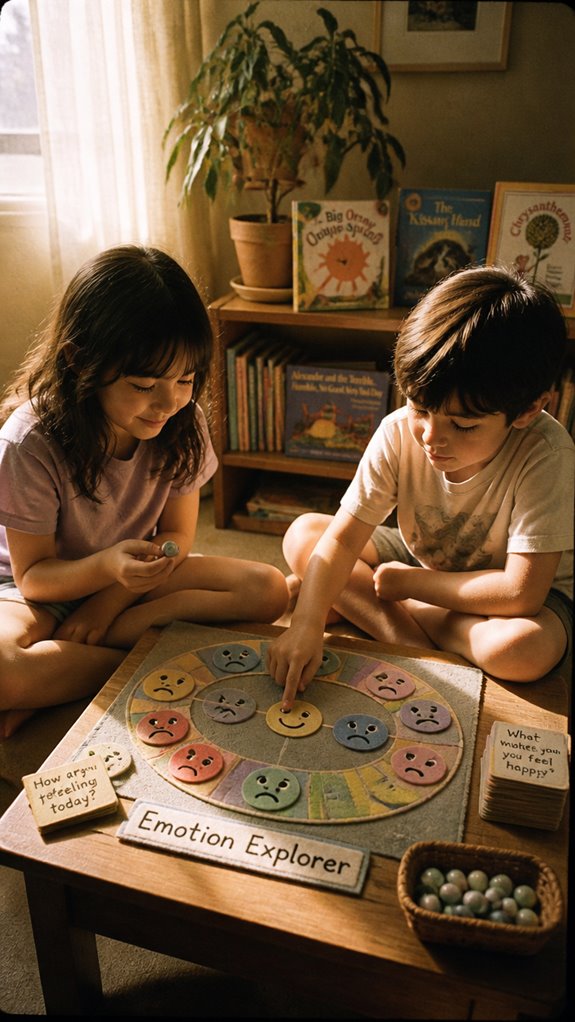
| Emotion cards | Sort by intensity, discuss why each feeling matters |
| Journaling prompts | Write about a day’s connection, note any discomfort |
| Guided meditation | Center on breath, notice emotional shifts, share realizations |
Relationship Skills Program for Kids
Build a relationship‑skills program that feels like a daily habit, not a one‑off lesson. You’ll guide kids to practice emotional literacy each morning, naming feelings and sharing them in a journal.
Daily emotional‑literacy practice builds lasting relationship skills and confidence.
By weaving conflict resolution into play, you turn disagreements into rehearsed problem‑solving drills. Parents often fear overwhelming their child; instead, set a three‑step routine: notice, name, and negotiate.
This pattern trains the brain to stay calm under pressure, a skill that research from the Harvard Center for Youth Development links to better academic outcomes. These foundational practices also develop adaptability skills that help children navigate changing social dynamics with greater flexibility.
Over time the habit compounds, giving the child a reliable system for orchestrating social change. You’re not teaching a quick fix—you’re building a lifelong framework that supports confidence and adaptability.
Digital Collaboration Tools

After helping kids master emotional literacy and conflict-resolution habits, the next step is to give them tools that let those skills flourish in a connected world. You can start by introducing virtual teamwork through familiar collaboration platforms like Google Workspace or Microsoft Teams.
Show them how to share documents, comment constructively, and assign tasks, turning each project into a practice ground for listening and compromise. Parents often worry about screen time or privacy; instead, set clear boundaries and model respectful digital etiquette.
Explain that these platforms mirror real-world workplaces, so mastering them now builds a habit of clear communication and shared responsibility. In an AI-driven future, strong communication skills will increasingly differentiate those who can collaborate effectively from those who cannot. Over time, the child will see digital collaboration as a natural extension of their relational toolbox, ready for any future team.
The Adaptive Atlas Future Skill Stack System
When you think about what skills will still matter as AI reshapes work, focus on abilities that no machine can replace—critical thinking, creativity, problem framing, and decision‑making.
Focus on irreplaceable skills—critical thinking, creativity, problem framing, decision‑making—to thrive amid AI‑driven change.
The Adaptive Atlas Future Skill Stack System builds those core capabilities while weaving emotional resilience and boundary setting into everyday practice.
You’ll notice parents fearing obsolescence, but the system reframes that anxiety as a roadmap: teach children to stay calm under pressure, to say “no” when needed, and to bounce back from setbacks. Building anti-fragile capabilities helps children not just survive disruption but actually benefit from unpredictable challenges.
By treating AI as a partner, not a replacement, kids develop self‑directed learning loops that continuously refresh their skill set.
This layered, long‑term approach ensures they remain adaptable, confident, and ready to create value across any future setting.
The Adaptive Atlas Framework
Five connected systems designed to help parents raise adaptable, future-ready children in a world shaped by AI, automation, and constant change.
| 🛡️ |
Anti-Fragile Child SystemBuilds resilience, adaptability, and the ability to handle uncertainty without shutting down. |
| 📚 |
Learning Stack ModelDevelops self-directed learning habits and continuous skill acquisition beyond school systems. |
| 🚀 |
Future Skill Stack SystemFocuses on high-value human skills that remain relevant in an AI-driven economy. |
| 🤖 |
AI Learning SystemTeaches children how to use AI as a thinking partner instead of becoming dependent on it. |
| 🧭 |
Child Type Navigator SystemPersonalizes learning and development based on each child’s strengths and personality. |
FAQ
How Do I Measure My Child’s Progress in Relationship Skills?
You’ll track measuring social growth by logging weekly interactions, noting conflict resolution success, and rating empathy. Assess emotional skills with brief reflections, peer feedback, and role‑play observations, adjusting goals as competence deepens.
Can AI Tools Replace Human Interaction for Developing Empathy?
You can’t let AI replace human connection; its limitations mean it can’t convey subtle emotions or spontaneous feedback. Mastery comes from guiding kids through real-world interactions, where empathy truly develops.
What Age Is It Appropriate to Start Teaching Conflict‑Resolution Techniques?
You’ll start conflict coaching around age four, offering age‑appropriate guidance that builds mastery‑level skills; the suspense of watching them navigate disputes fuels confidence and sharpens their resolution instincts.
How Can I Balance Screen Time With Offline Social Practice?
You balance screen time by scheduling daily tech detox periods, then replace screens with structured social games that demand collaboration, negotiation, and empathy, ensuring kids practice relationship skills while staying engaged offline.
What Cultural Considerations Should I Include in Relationship Training?
Like a mosaic, blend cultural sensitivity and diversity awareness by exposing kids to varied traditions, languages, and family structures, encouraging respectful curiosity, and modeling inclusive communication to master relational competence.