How Do Kids Actually Learn to Adapt in an AI-Powered World?
Here’s the truth: adaptability isn’t something kids inherit. It’s built through intentional practice with resilience, curiosity, and growth mindset. When children reframe setbacks as data points rather than failures, they unlock genuine confidence in uncertain situations.
A Moment That Changed Everything
My daughter froze during a coding challenge. Not because she couldn’t solve it, but because the AI tool she relied on gave unhelpful suggestions. Instead of frustration, she pivoted. She asked questions differently. She collaborated with classmates. That moment showed me why we built Adaptive Atlas: kids need spaces where technology supports rather than replaces their thinking.
What I Learned About Real Adaptation
Last month, I watched my son abandon his preferred method when it stopped working. He didn’t panic. He tried three different approaches, failed twice, succeeded once. That’s adaptability in action. Not comfort. Not avoidance. Just willingness to move sideways when forward stalls.
Quick Takeaways
- Foster a growth mindset by encouraging experimentation, learning from failures, and viewing setbacks as opportunities for growth.
- Cultivate emotional intelligence through reflection, stress management, and modeling resilience and honesty.
- Promote curiosity by exploring diverse cultures, viewpoints, and real-world experiences to develop flexibility.
- Develop problem-solving skills with structured learning, strategic thinking, and understanding neural plasticity.
- Create a supportive environment that ensures emotional safety, routine stability, and confidence-building activities.
Understanding Why Adaptability Skills Matter for Kids in the AI Era
Have you ever wondered why adaptability is becoming more important than ever for children growing up today? In a world moving so quickly, where generative learning and skill automation reshape jobs and routines, preparing kids for stability isn’t enough. Instead, you want them to thrive amid change.
Adaptability helps children embrace uncertainty, turn challenges into growth, and stay engaged without fear. This isn’t about predicting the future but building flexible minds. It means teaching them how to learn continuously and use AI tools as allies. Starting calm discussions about AI with your children can help ease their concerns and build confidence in navigating these changes.
Instead of worrying about obsolescence, focus on fostering resilience, curiosity, and decision-making. By doing so, you’re giving your child a long-term advantage—an ability to navigate complexity confidently and create value, no matter what the future holds.
How to Develop Resilience and Flexibility in Daily Life
Building resilience and flexibility in daily life starts with creating routines that encourage your child to face challenges gradually. This helps shift their mindset from fearing failure to viewing setbacks as growth opportunities. Reinforcing resilience involves celebrating effort, not just success, and teaching your child to recover quickly from disappointments. Consistent, supportive routines build this resilience over time. Flexibility grows when you introduce small changes, encouraging your child to adapt and find new solutions. Exposing children to diverse career paths helps them understand the evolving job landscape and recognize that adaptability is essential for their future success.
| Routine | Challenge | Celebration |
|---|---|---|
| Consistent bedtime | Trying new foods | Effort, not outcome |
| Daily reflection | Solving problems | Growth mindset shift |
This approach anchors your child’s ability to navigate change, ensuring they stay confident and adaptable in an ever-evolving world.
Fostering Curiosity and a Growth Mindset at Home
Encouraging curiosity and a growth mindset at home helps children see challenges as opportunities, not obstacles. By establishing simple parent-child routines focused on exploration, you create space for emotional reflection.
When kids ask questions or stumble, guide them to view setbacks as chances to learn, fostering resilience and confidence. Avoid fixing every problem immediately; instead, listen and validate their feelings, helping them develop emotional awareness. Research shows that AI-enhanced writing tools can complement this learning approach by providing real-time feedback that encourages children to reflect on their own work and iterate on their ideas.
This approach shifts focus from avoiding failure to embracing it as part of growth. Over time, children begin to see themselves as capable and adaptable.
Keep in mind, you’re shaping their mindset for a future where their ability to learn, reflect, and stay curious will be invaluable, even in a world dominated by AI and rapid change.
Engaging Kids in Creative, Iterative Problem-Solving Projects
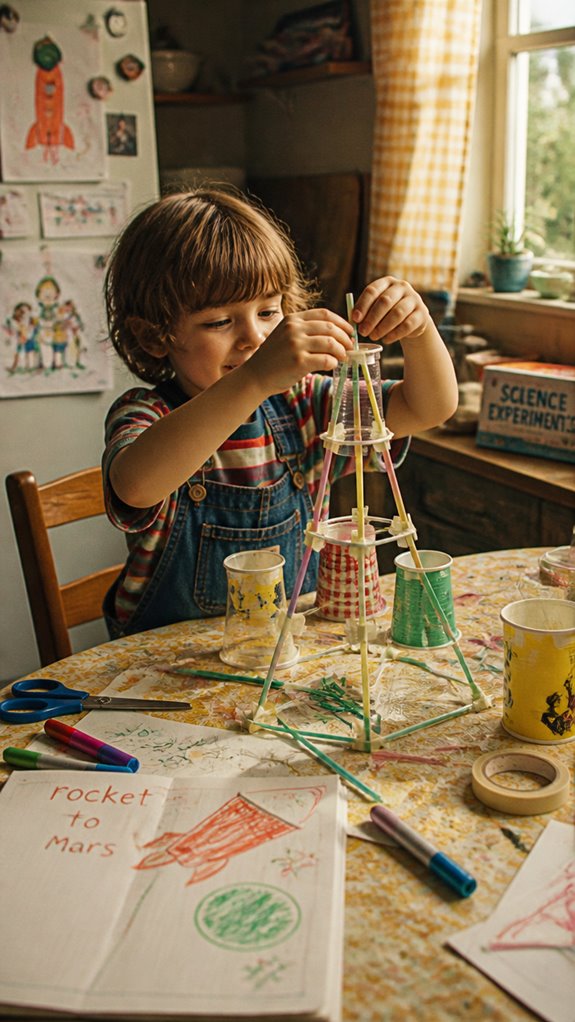
Many parents worry that fostering creativity and problem-solving can feel overwhelming or too complex at home. The good news is, you don’t need to create elaborate setups—simple, engaging projects work best.
Use gamified challenges to turn problem-solving into play, making it fun and rewarding. For example, turn a household task into a game with clear goals and feedback.
Incorporate storytelling techniques to help kids see their work as a story of trial, error, and growth, fostering resilience and curiosity. This approach encourages iterative thinking—learning through repeated attempts—so kids develop a mindset that values persistence and refinement.
Supporting unconventional career choices requires parents to model adaptability themselves, demonstrating how flexibility and creative problem-solving lead to success in non-traditional paths.
Over time, these systems help children see challenges as opportunities, preparing them to adapt and thrive in a rapidly changing future.
Creating a Supportive Environment for Emotional Safety and Growth
Creating a supportive environment for emotional safety and growth starts with understanding that children thrive when they feel secure and accepted. When kids experience emotional regulation through consistent routines and calm responses, they learn to handle frustration and uncertainty. Parental modeling plays a vital role; by managing your emotions openly, you teach resilience and adaptability. Research shows that critical thinking development accelerates when children feel psychologically safe to explore ideas and make mistakes without fear of judgment.
| Emotional Regulation | Parental Modeling | Child’s Growth |
|---|---|---|
| Stay calm during stress | Show honesty in feelings | Develop confidence |
| Create routines for comfort | Apologize when wrong | Build trust and stability |
| Encourage expression | Practice patience | Foster independence |
| Validate feelings | Model problem-solving | Nurture emotional intelligence |
| Celebrate effort | Demonstrate self-care | Cultivate adaptability |
This environment helps kids see challenges as opportunities, empowering them to navigate a changing world confidently.
Building Human Skills: Creativity, Empathy, and Critical Thinking
As children face a world of rapid change, cultivating human skills like creativity, empathy, and critical thinking becomes more important than ever. These skills—rooted in emotional intelligence and social agility—prepare your child to navigate uncertainty confidently.
Instead of fearing what AI might replace, see these abilities as their unique advantage, helping them build relationships and think deeply. Encourage chances for your child to solve problems creatively, listen actively, and consider different viewpoints. Understanding how others feel strengthens their ability to connect meaningfully with peers and respond with compassion in any situation.
See human skills as your child’s advantage—fostering deep thinking, relationship-building, and problem-solving amidst AI’s rise.
These skills don’t just foster resilience—they form the foundation for long-term adaptability. Keep in mind, nurturing creativity, empathy, and critical thinking is a systematic process. It’s about creating consistent opportunities for growth, modeling emotional understanding, and supporting your child’s natural curiosity.
This approach ensures they’re ready for a future where human skills remain essential.
Adaptability Skills Training for Kids

What does it really mean to teach adaptability skills to kids in today’s world? It’s about preparing them for constant change, not fixed paths. You focus on building resilience, cultural diversity awareness, and technological literacy. These skills help children navigate an uncertain future confidently. Understanding stress management is equally important, as it equips children with coping mechanisms to handle the pressures that accompany rapid technological and social change.
| Embrace Curiosity | Foster Flexibility |
|---|---|
| Encourage exploring different cultures and viewpoints. | Teach kids to adapt quickly to new tools and situations. |
| Use real-world stories and systemic thinking. | Focus on long-term growth, not just short-term success. |
| Teach them how to work with, not against, AI tools. | Help children see change as an opportunity. |
| Build confidence in their ability to learn and develop. | Support experimentation and exploration without fear. |
Neuroscience Insights Into Adaptability
Understanding plasticity mitigation helps you see that late progress isn’t impossible, it just requires different approaches. For analytical kids in particular, structured learning approaches can unlock their natural problem-solving strengths while building flexibility. Kids can strengthen their adaptive capacity over time, with carefully timed experiences. This knowledge encourages a calm, strategic *view* — nurturing their long-term ability to navigate uncertainty confidently and proactively.
Navigating Emotional Resilience Challenges
Have you noticed how kids can sometimes seem overwhelmed by setbacks or strong emotions? That’s natural, but it’s also an opportunity. Teaching emotional agility helps children manage their feelings without getting stuck or shutting down.
Resilience training isn’t about avoiding difficulty; it’s about building the capacity to stay steady amid challenge. Encourage your child to recognize emotions as they come and respond thoughtfully instead of reactively.
This creates a stable foundation for the future, where adapting to constant change is key. Cultivating emotional resilience helps them think clearly when disruptions occur, rather than panic or shut down.
Over time, they learn that facing feelings head-on makes them stronger and more capable of maneuvering uncertainty with confidence. Just as children can learn to fix digital mistakes in their online presence, they can also repair emotional setbacks by addressing them directly rather than letting them compound. This emotional agility becomes a crucial skill in the AI-driven world.
The Adaptive Atlas Anti-Fragile Child System
Building an anti-fragile child starts with understanding that resilience isn’t just about bouncing back from setbacks — it’s about growing stronger because of them.
You can nurture this by fostering honest parent-child communication, creating routines that support sleep hygiene, and encouraging reflection on challenges. The anti-fragile mindset develops when children experience manageable stressors that build their capacity to handle future difficulties.
Visualize your child as:
- A sturdy tree that bends but doesn’t break in storms, growing deeper roots with each storm.
- A curious explorer, learning to navigate uncertainty with confidence.
- Someone who sees setbacks as opportunities for skill-building rather than failures.
The Full Adaptive Atlas Framework
The full Adaptive Atlas Framework brings together all the parts needed to prepare your child for a future defined by constant change. It recognizes that cultural influences and technological impacts shape how they see the world and develop skills. Instead of fearing uncertainty, you can see this as an opportunity.
This system helps your child build resilience, learn to adapt, and thrive even as norms shift. It’s based on the idea that long-term capability matters more than short-term success. By focusing on core skills like critical thinking and creativity, and teaching them to work with AI, you give your child a sense of control and confidence.
This framework turns complexity into practical, manageable steps, helping your child navigate a future that’s unpredictable but full of opportunity.
The Adaptive Atlas Framework
Five connected systems designed to help parents raise adaptable, future-ready children in a world shaped by AI, automation, and constant change.
| 🛡️ |
Anti-Fragile Child SystemBuilds resilience, adaptability, and the ability to handle uncertainty without shutting down. |
| 📚 |
Learning Stack ModelDevelops self-directed learning habits and continuous skill acquisition beyond school systems. |
| 🚀 |
Future Skill Stack SystemFocuses on high-value human skills that remain relevant in an AI-driven economy. |
| 🤖 |
AI Learning SystemTeaches children how to use AI as a thinking partner instead of becoming dependent on it. |
| 🧭 |
Child Type Navigator SystemPersonalizes learning and development based on each child’s strengths and personality. |
FAQ
How Can Parents Effectively Model Adaptability in Their Own Behavior?
You demonstrate resilience like a steady oak bending in storms; through flexible behavior modeling and embracing change, you inspire your kids to navigate shifts confidently, fostering their adaptability and setting them free to grow amid life’s inevitable uncertainties.
What Are Practical Ways to Assess a Child’s Innate Resilience and Flexibility?
To assess your child’s emotional resilience and flexibility, observe how they handle setbacks, adapt to change, and bounce back from challenges. Pay attention to their problem-solving, openness to new ideas, and capacity for self-regulation.
How Do Cultural Differences Influence Teaching Adaptability to Children?
Cultural norms shape adaptability stereotypes, influencing how you teach kids resilience and flexibility. Challenging these norms liberates children, empowering them to embrace diverse skills and viewpoints, ultimately fostering genuine adaptability regardless of cultural expectations.
What Role Does Technology Play in Reinforcing or Hindering Adaptability Skills?
Technology shapes adaptability skills through digital literacy and fostering tech resilience. Embrace tools to empower your child’s independence, encouraging exploration and problem-solving, while remaining vigilant to avoid dependency that could hinder their ability to adapt and innovate.
How Can Schools Support the Development of Adaptability Beyond the Home Environment?
Envision a school garden, thriving through community involvement, where kids nurture emotional intelligence alongside adaptability. By fostering collaboration and resilience, schools liberate children to embrace change, develop core skills, and confidently grow amidst evolving challenges.
References
- https://racheldines.substack.com/p/10-critical-skills-kids-need-in-the
- https://cefa.ca/preparing-children-with-essential-skills-for-a-future-dominated-by-ai-and-machine-learning/
- https://sproutinmotion.com/what-skills-will-your-child-need-in-the-age-of-ai/
- https://oxfordlearning.com/future-ready-study-skills-how-to-prepare-your-child-for-the-ai-age/
- https://www.k12dive.com/spons/building-future-ready-students-embracing-ai-adaptability-and-innovation-i/757443/
- https://lpadesignstudios.com/research/advancing-adaptive-k-12-learning-ecosystems-in-the-ai-era
- https://www.nea.org/resource-library/artificial-intelligence-education/iv-teaching-and-learning-age-artificial-intelligence
- https://neurosciencenews.com/childhood-adversity-brain-development-25455/
- https://pmc.ncbi.nlm.nih.gov/articles/PMC10524449/
- https://pmc.ncbi.nlm.nih.gov/articles/PMC12987549/