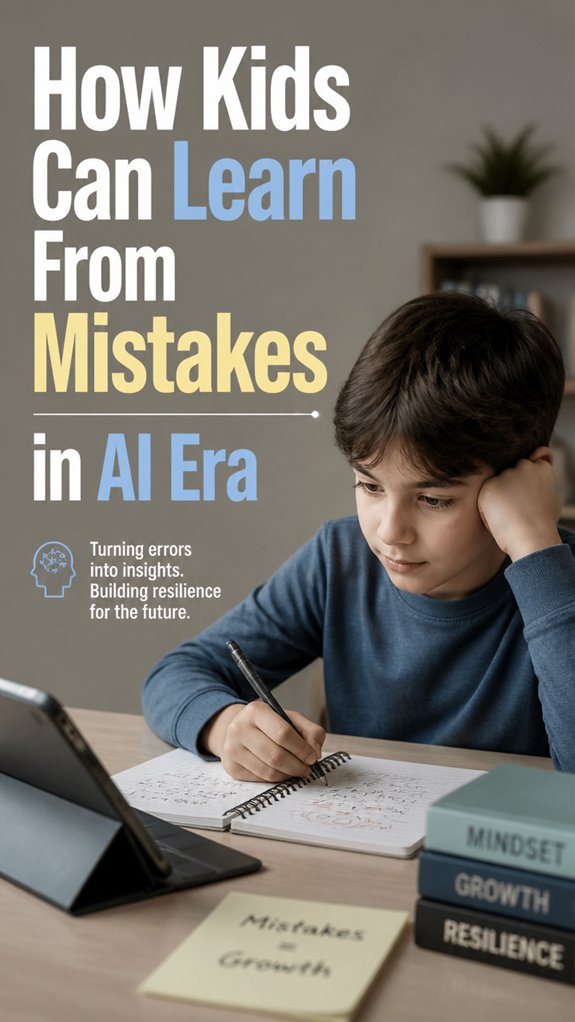
How can parents guide children to view AI mistakes as growth opportunities rather than failures?
In our AI-saturated world, mistakes aren’t roadblocks. They’re blueprints for building resilience, critical thinking, and ethical judgment. When kids learn to question AI outputs and verify information, they develop independence that algorithms can’t replicate.
Learning Through Real-World Setbacks
My daughter once trusted an AI tool to summarize her research. The output was polished but incomplete. Instead of frustration, we dug deeper together, comparing sources, identifying gaps. That moment shifted something. She realized machines process patterns, not wisdom. This is exactly why we created Adaptive Atlas. We wanted parents equipped to turn these teachable instances into confidence-building conversations. Not lectures. Real dialogue about how setbacks shape judgment.
A Moment That Changed Everything
Last month, my son submitted homework revised by an AI writing tool. His teacher flagged it. Rather than shame, we explored what happened. He learned verification matters. That single correction taught him more about intellectual honesty than any lecture could. He now questions every shortcut.
Quick Takeaways
- Teach children to analyze AI errors critically, viewing them as opportunities for learning rather than failures.
- Encourage independent verification of AI outputs to develop critical thinking and self-learning skills.
- Foster resilience by framing mistakes as essential for growth and building emotional awareness and moral development.
- Promote experimentation and reflection to turn setbacks into opportunities for adaptation and personal progress.
- Prepare kids for an AI-driven future by cultivating flexible problem-solving, ethical awareness, and lifelong learning skills.
Why Teaching Kids to Spot AI Errors Builds Critical Thinking
Because AI is becoming a common part of our daily lives, it’s important to teach kids how to spot errors in the information it produces. This skill supports their understanding of AI ethics and develops error detection, making them more aware of AI’s strengths and limits.
When children learn to question AI outputs, they build critical thinking—an essential ability for the future. This doesn’t mean expecting perfect AI, but rather recognizing patterns of mistakes and understanding why they happen. By developing self-learning skills, children become more independent in evaluating information and verifying AI-generated content rather than accepting it at face value.
How to Use AI Mistakes to Teach Decision-Making in Children
Handling AI mistakes isn’t just about spotting errors; it’s a chance to teach your child how to make better decisions. Embracing algorithmic humility helps children see that mistakes are part of learning, not failure. Use error-driven pedagogy to turn setbacks into revelations.
When AI provides an incorrect answer, calmly explore why it happened—was it outdated data or a biased model? This teaches kids to understand that errors aren’t the end, but opportunities to analyze and decide how to proceed. Instead of fearing mistakes, view them as tools for developing decision-making skills. By linking effort to reward, children learn to recognize that persistent problem-solving leads to better outcomes than giving up.
These moments build resilience, critical thinking, and confidence—all essential for a future where adaptability and system thinking matter most. With practice, your child learns to navigate ambiguity wisely, shaping their path forward.
Practical Strategies to Encourage Risk-Taking and Reflection
Encouraging risk-taking and reflection in children is essential for preparing them for a future marked by rapid change. Many parents fear failure, but viewing mistakes as opportunities fosters resilience.
Fostering risk-taking and reflection builds resilience, preparing children for a rapidly changing, uncertain future.
Encourage children to take creative risks—experimenting with new ideas without fear of failure.
Support their emotional regulation by helping them recognize and manage feelings that arise during setbacks. If a child feels frustrated or anxious, guide them to understand these emotions rather than suppress them.
Reflective practices—like discussing what they learned—help children see mistakes as part of growth. This builds confidence and adaptability, key skills for steering through an uncertain, AI-driven world. Establishing healthy daily routines provides the foundation for children to process their experiences and maintain the energy needed for continuous learning and growth.
Overcoming Challenges When Teaching Kids From AI Errors
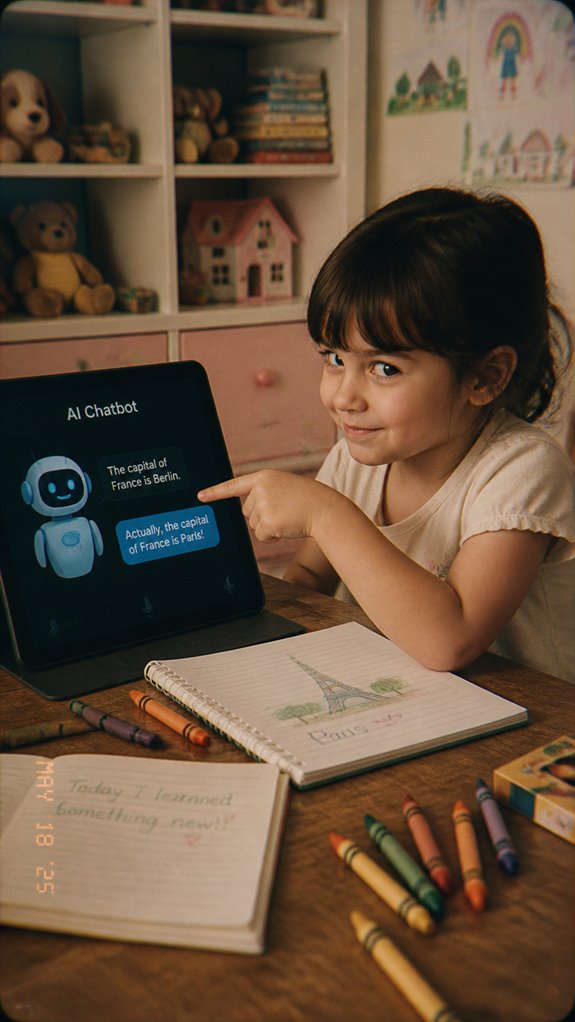
AI errors can be alarming, especially when you’re trying to guide your child’s learning process. Concerns about AI bias and error propagation are common, but they don’t need to be fears that control your approach.
Instead, see these errors as opportunities to teach resilience and critical thinking. When an AI gives wrong information, it’s a moment to discuss how technology can be imperfect and how humans can question and verify. Understanding how AI enhances writing skills can help you frame these conversations constructively with your child.
This helps your child understand that mistakes in AI aren’t personal failures but part of a systems pattern. Your role is to build a calm, confident environment where errors are part of learning.
Over time, your child learns to navigate these challenges, using them to develop adaptable skills essential for an uncertain future.
Mistake Learning System for Kids
Many parents worry that kids might see mistakes as failures, but in a world of rapid change, mistakes are powerful learning tools. A mistake learning system for kids helps them develop emotional awareness and moral development by understanding their feelings and the impact of their actions. By using a growth mindset approach, children learn to view errors as opportunities for improvement rather than reflections of their abilities.
Mistakes are essential learning tools, fostering emotional awareness and moral growth in children.
Envision your child:
- Recognizing frustration and learning to calm themselves
- Reflecting on a wrong choice and building honesty
- Developing resilience as they recover and grow from setbacks
This system encourages a mindset where mistakes become stepping stones, fostering independence and moral strength. It’s about guiding your child to see errors not as dead ends, but as essential parts of long-term growth.
With patience and intention, you can help your child turn mistakes into valuable tools for their future.
Growth Mindset Research Basis
Research shows that a growth mindset—the belief that abilities and intelligence can be developed through effort—is a powerful foundation for children’s success now and in the future. When your child sees mistakes not as failures but as learning opportunities, they build emotional intelligence and moral reasoning. Based on the belief that individuals can adapt and grow through effort, this mindset helps them persist through challenges, understand the importance of effort, and develop resilience. It also encourages empathy, as they recognize everyone is capable of growth. Parents should consider how traditional education paths may or may not support this growth-oriented approach depending on the learning environment and teaching philosophy. Many parents worry about a future dominated by AI, but fostering a growth mindset shifts focus from fixed intelligence to ongoing development. It gives your child the tools to adapt, collaborate, and leverage skills, ensuring they’re prepared for a rapidly changing world. Ultimately, it’s about building long-term, adaptable capabilities that nurture confidence and moral strength.
Addressing Resilience Setbacks Effectively
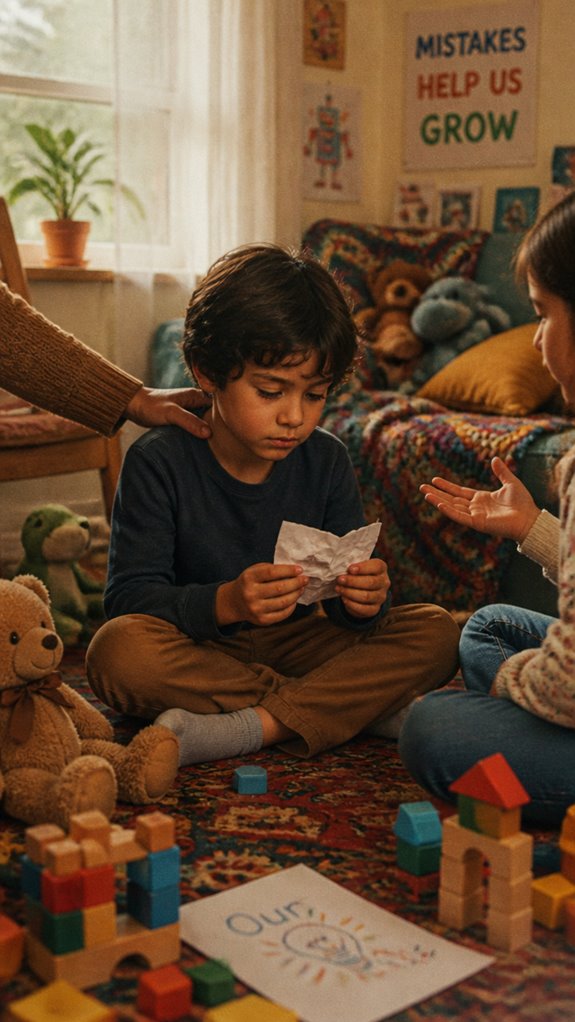
Children will face setbacks and frustrations as they learn and grow, especially in a world that’s constantly changing. Instead of avoiding difficulty, encourage them to develop emotional awareness—recognizing their feelings and understanding why they feel that way. Research shows that parental support and validation significantly strengthens a child’s ability to bounce back from disappointment.
Peer collaboration becomes essential, helping kids see setbacks as shared challenges. Picture your child:
- Sharing struggles and solutions with friends
- Gaining confidence from mutual support
- Learning to stay calm and see failure as a step forward
When setbacks happen, guide your child to pause, breathe, and reflect instead of shutting down. Remind them that resilience isn’t about never falling but about growing stronger afterward.
Building emotional awareness and fostering peer collaboration turn setbacks into opportunities, empowering your child to face future challenges with calm confidence and adaptable resilience.
The Adaptive Atlas Anti-Fragile Child System
Building an anti-fragile child system means preparing your child to thrive amid uncertainty and change. In today’s world, artificial intelligence and rapid shifts can feel overwhelming, but this system offers calm, grounded pathways.
It focuses on cultivating emotional resilience so children can handle setbacks without losing confidence. Instead of fearing mistakes, your child learns to see them as part of growth—essential for long-term adaptability.
This approach shifts away from rigid expectations, encouraging kids to develop flexible mindsets and problem-solving skills. The anti-fragile child system strengthens children not just by helping them survive challenges, but by enabling them to gain from disorder and stress.
By nurturing resilience and comfort with uncertainty, you help your child build strength for the future.
It’s not about avoiding mistakes but learning to recover and grow stronger with each challenge, creating a foundation that supports lifelong learning and confidence.
The Full Adaptive Atlas Framework
The Full Adaptive Atlas Framework unites five interconnected systems that equip your child to navigate an AI-driven world with steady capability.
You fear AI will erase jobs—it’s true some will shift, but this framework reframes that into freedom: your child thrives by adapting, not chasing fixed paths.
- Picture your kid bouncing back from failure like antifragile steel, stronger in uncertainty.
- Envision them mastering self-directed learning loops, fueled by AI tools like ChatGPT as amplifiers.
- See them charting unique paths via personalized profiles, creating value ethically across futures.
You define parental roles: guide with intention, weave in ethical considerations like AI bias checks.
Build this system now—your child’s long-term leverage compounds, liberating them from obsolescence.
The Adaptive Atlas Framework
Five connected systems designed to help parents raise adaptable, future-ready children in a world shaped by AI, automation, and constant change.
| 🛡️ |
Anti-Fragile Child SystemBuilds resilience, adaptability, and the ability to handle uncertainty without shutting down. |
| 📚 |
Learning Stack ModelDevelops self-directed learning habits and continuous skill acquisition beyond school systems. |
| 🚀 |
Future Skill Stack SystemFocuses on high-value human skills that remain relevant in an AI-driven economy. |
| 🤖 |
AI Learning SystemTeaches children how to use AI as a thinking partner instead of becoming dependent on it. |
| 🧭 |
Child Type Navigator SystemPersonalizes learning and development based on each child’s strengths and personality. |
FAQ
How Can Parents Effectively Model Critical Evaluation of AI Errors?
Envision you’re a hacker, constantly testing AI’s limits. You model critical evaluation by discussing ethical considerations openly, encouraging emotional resilience, and demonstrating transparency when errors occur, empowering your kids to think independently and navigate AI’s complexities freely.
What Age Is Appropriate for Children to Start Analyzing AI Mistakes?
You can start exploring AI mistakes when your child reaches developmental readiness around age 10, as their cognitive capacity becomes sufficient for critical thinking and analysis. This empowers them to freely evaluate AI errors confidently and independently.
How Do Cultural Differences Influence Approaches to Learning From AI Errors?
Cultural outlooks deeply shape how you approach learning from AI errors, embracing diversity in thought and method. You’re liberated to challenge norms, fostering a learning environment that celebrates unique viewpoints and adapts to varied cultural values.
What Tools or Platforms Best Support Teaching Kids to Spot AI Inaccuracies?
You should explore platforms that offer interactive feedback and gamified learning, like Code.org or BrainPOP, to empower kids in spotting AI inaccuracies. These tools foster critical thinking while making learning engaging, liberating curiosity and independence.
How Can Educators Integrate AI Error Analysis Into Existing Curricula?
You can integrate AI error analysis into your curriculum through interactive simulations that encourage exploration and ethical reflections, empowering students to question AI outputs critically, fostering liberation from passive learning, and cultivating independent, adaptable thinkers in a complex AI-driven world.
References
- https://www.facultyfocus.com/articles/teaching-with-technology-articles/when-ai-gets-it-wrong-a-pedagogical-approach/
- https://www.learningrx.com/irvine/how-is-ai-changing-learning-and-what-skills-do-kids-need-most-23/
- https://www.kidsaitools.com/en/articles/what-happens-ai-gets-wrong-teaching-kids
- https://www.gse.harvard.edu/ideas/edcast/24/10/impact-ai-childrens-development
- https://oxfordlearning.com/future-ready-study-skills-how-to-prepare-your-child-for-the-ai-age/
- https://www.tandfonline.com/doi/full/10.1080/1360080X.2024.2384003
- https://studentexperiencenetwork.org/wp-content/uploads/2015/09/What-We-Know-About-Growth-Mindset.pdf
- https://news.med.virginia.edu/research/the-growth-mindset-trend-experts-caution-of-valuing-effort-over-success/
- https://www.beautifulminds-newsletter.com/p/growth-mindset-theory-whats-the-actual
- https://thedecisionlab.com/reference-guide/neuroscience/growth-mindset