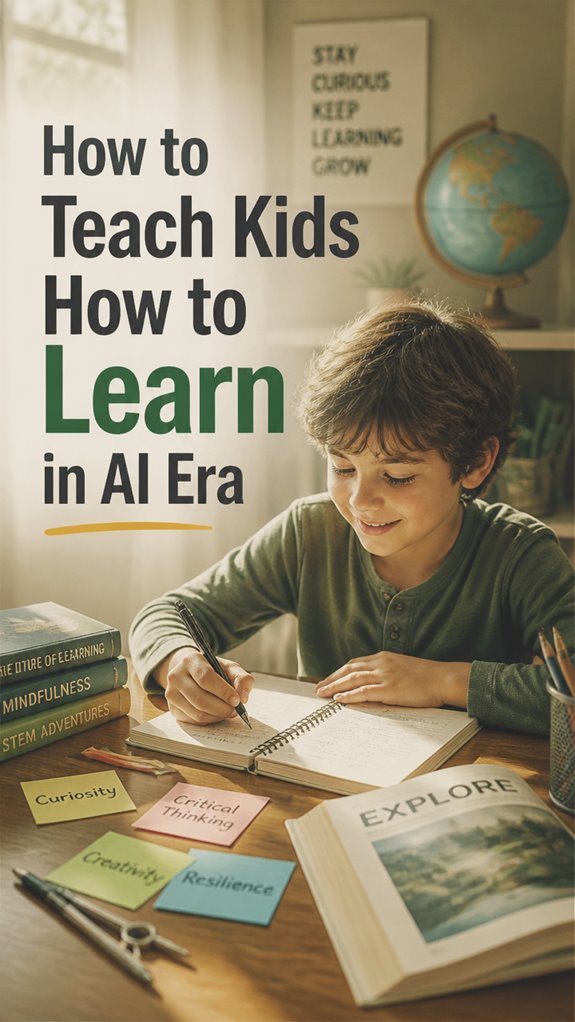
How do you prepare your child for a world where Google knows everything? You shift focus from memorization to building adaptive thinking skills. Your child needs practice identifying problems, hunting resources independently, and refining their approach when things don’t work.
Why We Built Adaptive Atlas
My daughter came home frustrated after memorizing fifty state capitals, only to ask: “But why does this matter?” That question haunted me. I watched her struggle not with facts, but with knowing *how* to learn when faced with real challenges. That’s when we created Adaptive Atlas. We built it because kids need learning systems that breathe and bend with their growth, not rigid curriculums that treat brains like filing cabinets. AI becomes a thinking partner here, not a shortcut machine. She hypothesizes first. Then she questions what AI suggests. That’s where real learning lives.
The Self-Directed Learning Loop That Changed Everything
Last month, my son tackled a coding problem without asking for answers. He found three resources, tested approaches, failed twice, adjusted his strategy, and solved it himself. Watching him build that resilience loop was everything. He wasn’t memorizing syntax. He was learning how to learn.
Quick Takeaways
- Prioritize meta-learning and self-directed feedback loops over passive information absorption to build adaptive, independent thinking capabilities.
- Teach children to use AI as a thinking partner by hypothesizing first, critiquing responses, and challenging convenient answers.
- Build distraction-free focus through daily 20-minute concentrated sessions on real projects aligned with each child’s strengths.
- Develop transfer skills through repeated retrieval practice, emotional regulation, and metacognitive monitoring to strengthen neural pathways durably.
- Create supportive learning environments that encourage questions, mistakes, and autonomous pacing while fostering emotional resilience and internal feedback systems.
Start With Systems, Not Lesson Plans: Why Self-Directed Learning Loops Matter
While most parents still think of learning as something that happens inside a classroom or comes from a curriculum, the real work of preparing your child for the AI era happens in the spaces between formal instruction—in how they learn when no one’s teaching them. Kids also need to develop digital cleanup skills early, learning how to manage and correct their online presence as part of responsible self-directed exploration.
Self-directed learning loops are where this happens. Your child encounters a problem, seeks resources, tests solutions, and adjusts based on results. This cycle builds independent thinking that classroom integration alone can’t develop.
When children encounter problems, seek resources, and adjust based on results, they build independent thinking no classroom alone can develop.
The motivational incentives matter too. When your child owns the learning process—choosing what to explore, how to approach it—engagement shifts from external compliance to intrinsic drive. They’re not waiting for permission to think.
You’re not replacing formal education. You’re building the system beneath it. This is where adaptability compounds.
Understanding optimal timing for specialization helps parents recognize when to nurture broad exploration versus guided focus, ensuring self-directed systems prepare children for eventual mastery without premature narrowing.
Make AI a Thinking Partner, Not an Answer Machine: Building Independence and Judgment
Once your child’s self-directed learning loop is active, they’ll inevitably reach for AI to help solve problems—and that’s exactly when the real work begins. The risk isn’t that AI will think for them. It’s that they’ll outsource their thinking entirely.
Your role is teaching them to use AI as a cognitive partner, not an oracle. Have them start with their own hypothesis before asking. Ask them to critique the AI’s response. Push back on answers that feel too convenient.
This builds emotional resilience—they learn that struggle sharpens judgment. Cultural adaptability matters too. Different situations require different AI approaches. When family conversations about technology become routine, children develop the vocabulary and comfort to navigate uncertainties with confidence.
A child who experiments thoughtfully with tools develops the independence and discernment that separate capable adults from those left behind.
For creative kids career path guidance, parents can draw from specialized resources that help channel this developing judgment toward meaningful future opportunities.
Invest in Skills That Compound Over Decades (Not Ones AI Will Handle Tomorrow)
The temptation is real: invest in whatever skill seems marketable right now, then watch as AI handles it within a few years. Parent-driven biases and cultural expectations often push you toward whatever appears prestigious or immediately employable. That’s backwards.
Instead, focus on capabilities that compound—critical thinking, creative problem-framing, complex decision-making, and adaptive learning itself. These aren’t replaced by tools; they’re amplified by them.
Researcher Daniel Kahneman’s work on judgment and decision-making shows that independent thinking remains irreplaceable. Skills that deepen over decades create exponential advantage. Future-ready skills require deliberate cultivation rather than passive exposure to whatever technology dominates today.
Your child mastering spreadsheets today becomes obsolete fast. Your child learning to ask better questions, challenge assumptions, and synthesize information across domains? That compounds forever.
This shift moves you from chasing trends toward building genuine leverage.
Project-based learning offers children hands-on experiences that naturally develop these compounding capabilities through exploration and creation.
Neuroscience of Metacognition Development
Building on the foundation that compounding skills matter far more than trendy ones, you need to understand how your child’s brain actually develops the capacity to learn those skills—and that’s where metacognition comes in.
Metacognition is thinking about thinking. It’s your child’s ability to monitor their own learning, catch mistakes, and adjust their approach mid-stream. Active engagement with challenging problems—rather than passive consumption of AI-generated answers—strengthens these metacognitive muscles.
Metacognition is thinking about thinking—your child’s ability to monitor learning, catch mistakes, and adjust mid-stream.
Neuroscience shows us that neural plasticity—your brain’s capacity to rewire itself—peaks during childhood but remains active throughout life. This means you’re not locked into fixed intelligence; you’re building adaptive learning machinery.
Metacognitive scaffolding works by teaching your child to ask themselves: What strategy isn’t working? What do I need to learn next?
This internal feedback loop is what separates people who compound capability from those who plateau. You’re fundamentally building the operating system that lets them learn anything relevant, whenever it matters.
For families exploring non traditional schooling, this metacognitive foundation becomes especially critical, as self-directed learning environments demand strong awareness of one’s own learning process.
Self-Directed Learning Brain Development

How does your child move from following instructions to setting their own learning agenda? This shift happens in the brain through neural plasticity—the brain’s capacity to rewire itself based on experience.
When you create space for your child to ask questions, make mistakes, and course-correct independently, you’re literally building new neural pathways.
Self-directed learning requires three key components:
- Emotional resilience to sit with confusion without shutting down
- Internal feedback loops where the child evaluates their own progress
- Autonomy in pacing so learning feels like discovery, not compliance
Your role isn’t to provide all answers. It’s to design environments where your child practices making learning decisions.
This builds the executive function needed to navigate constant change. Children who develop this capability don’t just adapt to the future—they shape it. As AI becomes more prevalent in their lives, parents should proactively discuss AI fears with kids to help them build confidence in their own critical thinking abilities.
Attention Fragmentation in Digital Environments
Parents fear this fragments their child’s future edge, but you can reclaim control with simple systems.
Challenge the outdated belief that more screen time builds skills; it trains shallow skimming, not deep mastery. Reframe: Build attention muscle through timed, distraction-free zones daily. Start with 20 minutes of single-task focus on real projects, like building or reading. For social children, matching focused activities to their natural interpersonal strengths can make deep work feel engaging rather than isolating.
This patterns long-term power—kids who master focus navigate AI’s chaos, turning tools into amplifiers. You’ll raise adaptable thinkers who compound capabilities, not chase fleeting dopamine.
Stay calm; you’ve got the system.
Just as clear speaking exercises help children articulate thoughts with confidence, deliberate attention training builds the cognitive clarity needed for meaningful learning in noisy digital spaces.
Learning Mastery System for Kids
Once your child can sustain focus, the real work begins—turning that attention into retained, actionable knowledge. This is where most learning systems fail. You’re not building a data storage unit; you’re building a thinking partner who can retrieve, apply, and build on what they know. The meta learning techniques you instill now become their permanent advantage for any subject they encounter.
Learning mastery requires three core shifts:
- Memory capacity expands through retrieval practice—not cramming. Your child retrieves information repeatedly across time, which strengthens neural pathways and makes knowledge durable.
- Emotional regulation stabilizes the learning environment—stress blocks memory consolidation. When your child feels safe during challenge, they retain more and connect ideas faster.
- Transfer training bridges gaps—your child applies knowledge across different situations, not just the original lesson.
This system compounds. Each cycle strengthens both capability and confidence for what comes next. A Learning Data Interpretation Toolkit helps you understand results about how to interpret kids learning progress data, ensuring you can track which techniques are actually working.
The Adaptive Atlas Learning Stack Model
Learning mastery builds the foundation, but it doesn’t automatically translate into the kind of self-directed capability your child will need when information changes faster than any curriculum can update. The future of learning depends on systems that evolve alongside knowledge itself. The Adaptive Atlas Learning Stack Model replaces passive absorption with active loops.
You’re building cognitive scaffolding that lets your child acquire skills independently, not dependence on external instruction.
This framework operates in three layers: first, your child identifies what they need to learn. Second, they develop internal feedback systems to track progress. Third, they refine their approach based on results.
Learning frameworks become personalized systems rather than one-size-fits-all structures.
This shift matters because it transforms learning from a phase into a continuous process. Your child doesn’t wait for answers—they learn how to find them. That’s where real leverage lives.
Adaptive learning reshapes education by responding to each learner’s needs in real-time, making this stack model particularly powerful for the AI era.
The Adaptive Atlas Framework
Five connected systems designed to help parents raise adaptable, future-ready children in a world shaped by AI, automation, and constant change.
| 🛡️ |
Anti-Fragile Child SystemBuilds resilience, adaptability, and the ability to handle uncertainty without shutting down. |
| 📚 |
Learning Stack ModelDevelops self-directed learning habits and continuous skill acquisition beyond school systems. |
| 🚀 |
Future Skill Stack SystemFocuses on high-value human skills that remain relevant in an AI-driven economy. |
| 🤖 |
AI Learning SystemTeaches children how to use AI as a thinking partner instead of becoming dependent on it. |
| 🧭 |
Child Type Navigator SystemPersonalizes learning and development based on each child’s strengths and personality. |
FAQ
How Do I Know if My Child Is Actually Learning or Just Going Through the Motions?
You’ll spot real learning through motivation assessment and engagement indicators. Watch whether your child asks questions unprompted, pursues problems when frustrated, or explains concepts to others.
True learning shows curiosity driving action, not compliance. If she’s merely completing tasks without thinking, you’re seeing performance theater.
The difference? Independent learners own their struggle. They experiment, fail, and iterate.
That’s the antifragility that matters long-term in an AI-driven world.
What Specific Age Should I Start Teaching AI Literacy and Tool Use?
Start around age seven or eight when critical thinking capabilities crystallize. You’re not teaching complex coding—you’re cultivating curiosity about how tools think. Early exposure builds comfort, not dependence.
Let them experiment with ChatGPT for creative projects. The real power emerges when they grasp that AI amplifies thinking rather than replaces it. This foundation compounds through their teens, positioning them as capable collaborators, not passive consumers.
How Do I Balance Screen Time With AI Tool Exploration Without Causing Harm?
You’re not managing screen time versus AI exploration—you’re building digital boundaries that serve learning. Set structured tool time where your child explores AI with intention, not passively.
Pair this with offline activities that develop emotional regulation: physical challenge, creative work, conversation. This rhythm prevents dependency while building the metacognitive awareness they’ll need to leverage technology without being controlled by it.
Quality interaction matters more than duration.
What Happens if My Child’s Interests Don’t Align With Future-Proof Skills?
Your child’s interests aren’t obstacles—they’re the foundation. Think of skill alignment like planting seeds in soil you’ve already prepared.
Passion creates the engine; future-proof capabilities become the fuel.
You’re not forcing your child into predetermined roles. Instead, you’re building critical thinking, problem-framing, and AI collaboration skills *within* what already captivates them.
This approach compounds over time. Relevance follows engagement, not the reverse.
How Do I Measure Progress When Traditional Grades No Longer Apply?
You’re measuring what actually matters: capability growth and learning velocity.
Track motivation metrics—does your child initiate projects, ask better questions, recover from setbacks?
Assessment innovation means observing skill application across environments, not test scores. You’ll see progress when they independently solve problems, collaborate effectively, and adapt their approach.
That’s the real signal of future readiness.