Why Do Creative Projects Matter for Your Child’s Tomorrow?
Creative, hands-on projects build problem-solving, resilience, and adaptability. STEM challenges, outdoor exploration, arts, and storytelling spark curiosity while fostering a growth mindset. These skills prepare kids for real-world change and uncertainty ahead.
A Lesson From the Classroom Floor
My daughter sat frustrated, her cardboard bridge collapsing for the third time. Instead of fixing it, I asked: “What did you learn?” Her eyes lit up. That moment shaped why we created Adaptive Atlas. We noticed kids needed more than activities; they needed permission to fail forward. Our platform weaves project-based learning with reflection tools, helping parents guide growth through real challenges, not just Pinterest-perfect crafts.
When Experimentation Became Everything
Last month, my son spent two hours building a water filtration system from household items. No screen time. No complaints. He didn’t need perfection; he needed purpose. Watching him troubleshoot taught me that engagement happens when kids own their learning journey, not when adults script every outcome.
Quick Takeaways
- Incorporate STEM-based design challenges and prototypes to foster critical thinking, problem-solving, and hands-on skills relevant to future careers.
- Use outdoor exploration combined with arts activities to spark creativity, observational skills, and real-world connections.
- Implement project-based learning at home with open-ended questions and diverse materials to build resilience and independent thinking.
- Focus on developing future-ready skills like adaptability, creativity, and AI fluency through experiential, real-world projects.
- Maintain reflective journals and creative libraries to encourage self-awareness, emotional intelligence, and continuous growth.
Creative STEM and Hands-On Projects to Build Critical Skills
While it’s easy to worry about how rapidly technology is changing, focusing on creative STEM and hands-on projects gives your child practical skills that last. Interdisciplinary approaches blend science, technology, engineering, and math, helping your child see real-world connections and develop problem-solving techniques.
These projects foster critical thinking and resilience, essential for a future marked by constant change. By encouraging your child to explore design challenges or build prototypes, you help them learn how to analyze problems and craft effective solutions.
This isn’t about memorization but about building adaptable skills that shift with transforming technology. Understanding job disruption trends helps parents recognize why these foundational competencies matter more than ever for their children’s future readiness. As renowned educators like Seymour Papert emphasized, engaging children in active, meaningful projects prepares them to navigate uncertainty confidently—creating a foundation for long-term success and innovation.
Arts and Outdoor Activities That Spark Kids’ Creativity
- Use outdoor exploration to cultivate curiosity about nature, building observational skills that translate to problem-solving.
- Incorporate arts like painting or crafts, encouraging your child to express their unique viewpoint and develop critical thinking.
- Promote storytelling—whether around a campfire or through creative writing—to strengthen imagination and communication.
- Combine these activities with AI creative tools to create rich, dynamic experiences that prepare your child to navigate ambiguity confidently.
These practices lay a foundation for future resilience, making adaptability a natural part of their growth.
How Parents Can Support Project-Based Learning at Home
Supporting project-based learning at home isn’t about perfect execution or having all the answers; it’s about creating an environment where your child can explore, experiment, and build skills over time. You do this through meaningful parent-child dialogue and curiosity triggers that stimulate thinking rather than just giving solutions.
| Action | Focus | Outcome |
|---|---|---|
| Ask open-ended questions | Curiosity triggers | Sparks independent thinking |
| Celebrate effort, not just success | Growth mindset | Builds resilience |
| Provide diverse materials | Exploration | Expands creative capacity |
| Join your child’s interests | Relational connection | Fosters confidence |
| Reflect on processes | Learning awareness | Reinforces systems thinking |
Future Skill Development Strategies
Focusing on future skill development means shifting your attention from simply teaching your child specific subjects to nurturing capabilities that will stay relevant regardless of how technology evolves. By emphasizing future adaptability and cognitive flexibility, you prepare your child for constant change.
Consider these strategies:
- Cultivate resilience—teach them to thrive through setbacks and uncertainty.
- Foster self-directed learning—encourage curiosity to keep learning agile.
- Promote problem framing—help them analyze situations from different angles.
- Integrate AI fluency—show how to collaborate with intelligent tools, not compete with them.
These steps build confidence and empower your child to navigate a rapidly shifting world. Understanding their strengths and weaknesses through structured self-discovery enables them to leverage their natural capabilities while addressing growth areas. Instead of fearing obsolescence, focus on developing core skills that expand their capacity to adapt and lead.
Hands-On Environmental Experiments
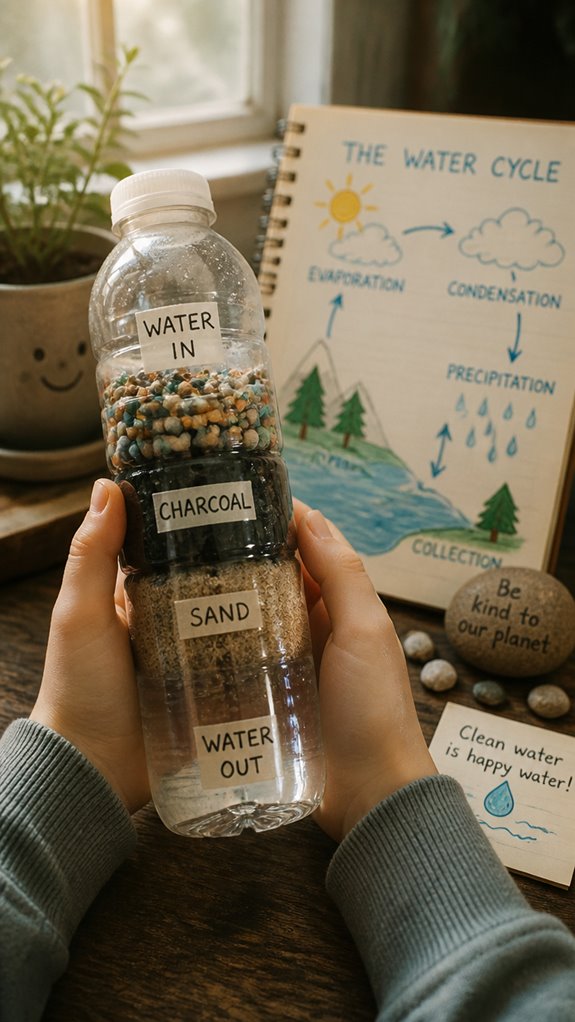
Hands-on environmental experiments provide a practical way to teach children about the natural world and its challenges, fostering curiosity and problem-solving skills that will serve them well in an uncertain future. Through eco-friendly crafts like water cycle bags or simple water filtration bottles, kids see how nature works and how they can help protect it. Nature journaling encourages reflection and helps children develop a personal connection to the environment, turning observation into understanding. These activities build resilience, creativity, and critical thinking—capabilities that are essential in a changing world. Instead of fearing the future, you empower your child by giving them tools to observe, adapt, and make a difference. These experiments instill long-term habits that will benefit both their growth and the planet’s health. Growing a Bean in a Cup reinforces botany lessons by demonstrating plant parts and the plant’s life cycle, helping children grasp the fundamentals of plant biology.
Tracking Progress With Reflective Journals
Reflective journaling is a practical way to help children understand themselves better and develop essential future skills like self-awareness and resilience. Using reflection techniques and goal setting, you can guide your child to track their growth and face uncertainty confidently. Consider these key points:
- Encourage regular journaling to build habits that foster mindfulness and emotional intelligence. Journaling promotes emotional awareness by allowing children to process their feelings and reactions over time.
- Use structured prompts like the 1-3-5 method to help children identify gratitude, excitement, and daily goals.
- Focus on cyclical reflection, where children record experiences, analyze them, and monitor progress toward goals. This approach helps develop critical thinking skills necessary for navigating complex challenges in their futures.
- Model journaling yourself to demonstrate its value, helping your child see reflection as a powerful tool for shaping their future.
This process shifts the focus from controlling outcomes to cultivating adaptable, resilient minds ready for the world ahead.
Creative Project Library for Kids
A well-organized Creative Project Library offers children a diverse range of ideas to explore, build skills, and develop confidence in their abilities. You can guide them to engage in creative collaboration, working together to solve problems or invent new ideas.
Brainstorming techniques, like mind-mapping or free-movement drawing, help children generate fresh viewpoints and think flexibly. When children see a variety of projects, they learn that failure is part of growth, not a setback.
The goal isn’t to have them produce perfect outcomes but to foster resilience and curiosity. Research shows that modern learning strategies significantly enhance children’s ability to retain information and apply knowledge across different contexts. As a parent or teacher, your role is to provide a calm, structured environment and empower children to take ownership of their learning journey.
This encourages long-term adaptability, preparing them for a future where creativity and collaboration are essential.
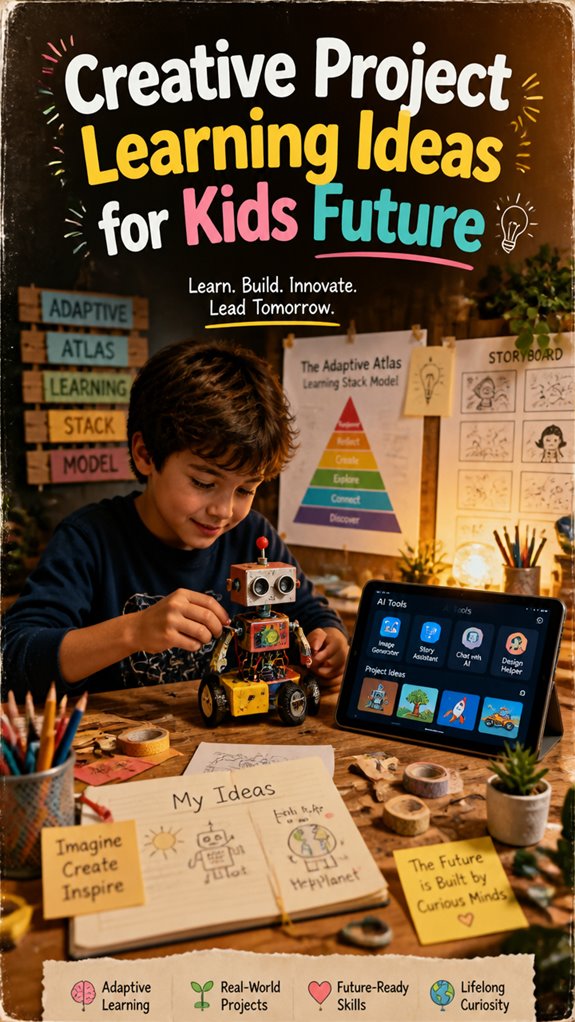
The Adaptive Atlas Learning Stack Model
The Adaptive Atlas Learning Stack Model offers a clear framework for understanding how children can thrive in a world of constant change. It emphasizes mindset shifting and skill integration, empowering your child to adapt proactively.
Here’s what it focuses on:
- Building an anti-fragile mindset that handles uncertainty without breaking.
- Developing self-directed learning habits to keep growth continuous.
- Cultivating future-proof skills like creativity, critical thinking, and decision-making.
- Teaching children to leverage AI as a tool for amplifying their capabilities without dependence.
This model helps you see that success isn’t about predicting the future but preparing your child to navigate it confidently. By implementing project-based learning at home, you create the real-world context where children apply these frameworks and develop the adaptive capabilities they need.
The Adaptive Atlas Framework
Five connected systems designed to help parents raise adaptable, future-ready children in a world shaped by AI, automation, and constant change.
| 🛡️ |
Anti-Fragile Child SystemBuilds resilience, adaptability, and the ability to handle uncertainty without shutting down. |
| 📚 |
Learning Stack ModelDevelops self-directed learning habits and continuous skill acquisition beyond school systems. |
| 🚀 |
Future Skill Stack SystemFocuses on high-value human skills that remain relevant in an AI-driven economy. |
| 🤖 |
AI Learning SystemTeaches children how to use AI as a thinking partner instead of becoming dependent on it. |
| 🧭 |
Child Type Navigator SystemPersonalizes learning and development based on each child’s strengths and personality. |
FAQ
How Can Projects Evolve as My Child’s Interests Change?
You can evolve projects by encouraging interest exploration; for instance, when your child shifts from painting to robotics, adapt the project to develop new skills. This approach boosts skill development and keeps them engaged in lifelong learning.
What Are Effective Ways to Encourage Risk-Taking in Creative Projects?
You can foster risk-taking by modeling confident experimentation, emphasizing learning over perfection, and framing mistakes as growth opportunities. This builds creative confidence and teaches your child effective risk management, empowering them to push boundaries boldly.
How Do I Balance Structured Projects With Free Exploration?
Research shows children thrive when balancing structure with freedom, boosting independence fostering. You can set creative boundaries that guide exploration, empowering kids to innovate confidently while knowing their limits, helping them master autonomy and strategic thinking simultaneously.
What Role Does Play Have in Developing Future-Ready Skills?
Play benefits skill development by fostering creativity, resilience, and problem-solving—key future-ready skills. You empower your child through play, transforming simple activities into powerful opportunities for adaptive growth and independent thinking in an uncertain world.
How Can Project Learning Adapt to Different Learning Paces?
You can harness adaptive strategies and personalized approaches to match each child’s unique learning pace. By customizing projects, you empower them to thrive, stay engaged, and develop essential skills, ensuring they remain resilient and capable amid rapid, ongoing change.
References
- https://www.imthecheftoo.com/blogs/stem-for-kids/50-fun-and-simple-projects-for-kids-to-spark-creativity
- https://myplinkit.com/2020/06/project-based-learning-ideas/
- https://www.weareteachers.com/project-based-learning-ideas/
- https://www.edutopia.org/blog/20-ideas-for-engaging-projects-suzie-boss
- https://commonsensepress.com/creative-art-projects-for-kids/
- https://kubrio.com/blog/project-ideas-for-kids
- https://www.bloomearlylearning.org/crafts-projects-to-boost-a-childs-creativity-and-imagination/
- https://coleykuyperart.com/blogs/blog/3-easy-projects-to-do-with-your-kids-to-spark-creativity-creative-living
- https://www.edutopia.org/article/7-nature-experiments-to-spark-student-curiosity/
- https://www.imthecheftoo.com/blogs/stem-for-kids/eco-explorers-engaging-environmental-science-experiments-for-kids