How Can Children Master Goal Adjustment When AI Changes Everything?
Kids thrive when taught that flexibility beats rigidity. Teaching them to see setbacks as upgrades, not failures, builds the resilience needed for an unpredictable future.
A Real Moment That Changed How I Parent
My daughter Sarah froze when her coding project failed. Instead of fixing it, she wanted to quit. I watched her spiral, then asked one question: “What did the error teach you?” That shift transformed everything. She rebuilt it differently. That’s when I realized we needed Adaptive Atlas, a platform helping families navigate change through storytelling and reflection, not lectures.
When Flexibility Becomes Your Superpower
Last month, my son abandoned his original career plan after discovering machine learning. My first instinct? Panic. Then I remembered Sarah’s error moment. I asked questions instead of offering solutions. He’s now exploring something genuine. Adaptation isn’t weakness. It’s intelligence responding to new information.
Quick Takeaways
- Foster a growth mindset that views change and setbacks as opportunities for learning and goal re-calibration.
- Teach children to develop adaptable skills like critical thinking, creativity, and problem-solving for future readiness.
- Encourage reflection and self-awareness to help kids navigate emotional challenges and stay open to new pathways.
- Promote media literacy and data validation to empower kids to make informed decisions amid evolving information landscapes.
- Integrate systems that support resilience and personalized learning, enabling children to collaborate with AI and build confidence.
How AI Shapes Kids’ Future Goals
AI is changing how we think about kids’ future goals, but it’s important to see this shift as an opportunity rather than a threat.
With AI integration, children are no longer bound by fixed careers or rigid plans. Instead, goal flexibility becomes essential. They learn to adapt their ambitions as technology evolves, focusing on skills like critical thinking, creativity, and problem-solving that are future-proof. Research shows that future-ready skills development requires intentional guidance to help children stay competitive in evolving job markets.
You can guide your child to see change as an advantage—not something to fear—by encouraging a mindset of continuous learning and adaptability.
This way, they develop the confidence to explore different paths, knowing that skills can be refined and realigned over time.
The goal isn’t to predict what’s next but to equip your child to navigate constant change with resilience and purpose.
Building Creative and Critical Skills for Lasting Success
Building creative and critical skills is essential for preparing children to succeed in a world of rapid change. You don’t need to fear constant disruption—instead, focus on nurturing adaptability. Use parent technology as a tool, not a crutch, to support your child’s growth.
Incorporate play collaboration: encouraging kids to explore ideas together builds both creativity and teamwork. These shared experiences teach children to think outside the box and develop problem-solving skills that last. When children encounter setbacks during collaborative projects, responding effectively to failure helps them build resilience and learn from their mistakes.
Keep in mind, the goal is to foster confidence, resilience, and independence—traits that enable kids to navigate ambiguity and learn continuously.
How to Help Kids Validate Information and Make Smarter Choices
Parents often worry that kids will be overwhelmed by the flood of information they encounter daily. But instead of fear, focus on building their data literacy and bias detection skills. These are essential for smarter choices in the AI era. An Information Evaluation Toolkit can provide structured frameworks to help children systematically assess online sources and content.
Focus on enhancing kids’ data literacy and bias detection for smarter decision-making in the AI age.
Here’s how to help:
- Teach critical reading — Encourage kids to ask, “Who’s behind this info?” and “What’s their goal?”
- Model questioning — Show how to spot bias and check sources for reliability.
- Use real-world examples — Discuss news or social media, breaking down messages together.
- Promote reflection — Ask, “Is this helpful? What other viewpoints exist?”
This approach empowers your child to confidently navigate information, make independent judgments, and stay adaptable—key skills for the future.
Fostering Emotional and Independent Thinking for Goal Flexibility

Fostering emotional resilience and independent thinking helps children stay adaptable as they pursue their goals. In today’s fast-changing world, it’s natural to worry about how they’ll handle setbacks or uncertainty.
But building emotional resilience means teaching your child to stay grounded during challenges, recover quickly, and view difficulties as growth opportunities. Self-awareness is key — when children understand how they feel and react, they can make mindful choices rather than react impulsively.
This inner clarity creates a sense of control and confidence. Keep in mind, goal flexibility isn’t about avoiding failure, but about staying open to new paths. Understanding hybrid career structures can help children recognize that multiple career pathways exist, allowing them to adjust their goals with greater awareness of emerging opportunities.
Your role is to support their inner strength, helping them develop the emotional skills that enable long-term adaptability and empower them to navigate the future with calm assurance.
Flexible Goal Adjustment System for Kids
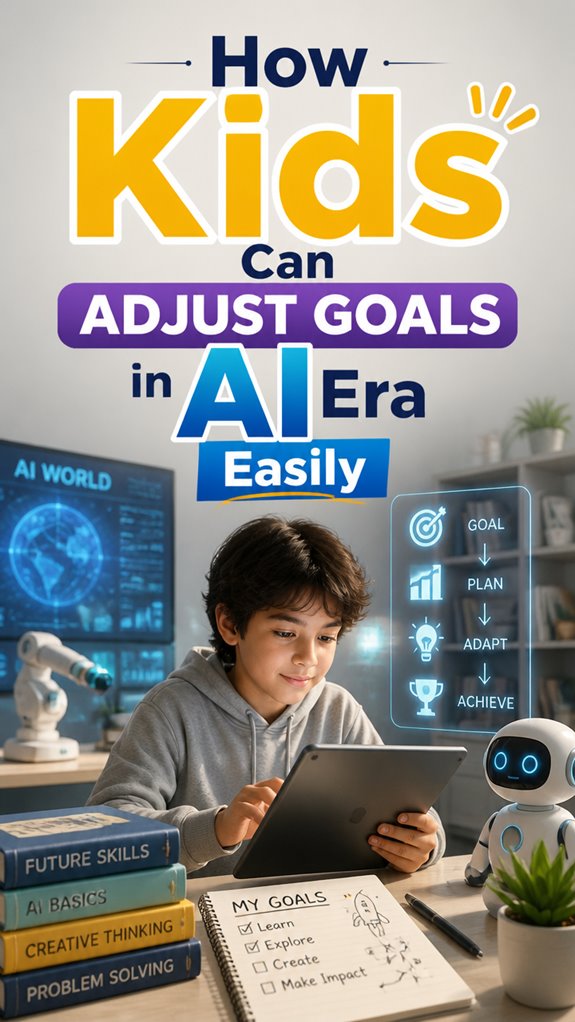
Have you ever worried that your child might struggle to adapt when goals shift or unexpected changes occur? That’s natural, but it’s also an opportunity. A flexible goal adjustment system supports goal recalibration and encourages mindset shifts. Here’s what to focus on:
- Teach children to view change as part of growth, not failure.
- Help them learn to set new small goals after unexpected setbacks.
- Encourage reflection on past adjustments to build confidence.
- Reinforce that adaptability shapes future success, not rigid plans.
- Support them in developing goal recalibration skills that help them reassess priorities when circumstances shift unexpectedly.
Child Resilience Studies Basis
Understanding resilience means recognizing a child’s capacity to bounce back and adapt during difficult times. It involves both their thoughts and actions, shaped by parental resilience and childhood adversity. When harsh experiences like neglect or loss occur, resilient children develop inner strength through traits like self-control, optimism, and social skills. These qualities are supported by protective factors that help them overcome challenges long-term.
| Resilience Components | Key Factors | Focus Areas |
|---|---|---|
| Emotional strength | Self-regulation, self-efficacy | Building confidence and coping skills |
| Social support | Relationships, social skills | Fostering connections and trust |
| Personal traits | Optimism, problem-solving | Promoting positive outlooks and adaptive thinking |
With a steady system of support, parents can help children grow resilience, enabling them to navigate an ever-changing future confidently.
Identifying Adaptive Growth Barriers

As the world accelerates and changes faster than ever, it’s natural to worry that barriers to growth might hold your child back.
Yet, these barriers are often surfaces for deeper issues like limited cognitive flexibility or rigid goal settings.
To help your child thrive, focus on identifying these hurdles early:
- Fixed mindsets that block adaptation, making change seem threatening.
- Inflexible goals that don’t evolve with new skills or perspectives.
- Emotional reactions to setbacks, preventing goal realignment.
- Lack of self-awareness about strengths and challenges.
Teaching your child to conduct a digital cleanup of past mistakes can build awareness of how their digital presence evolves with growth.
The Adaptive Atlas Anti-Fragile Child System
Building resilience in children is more important than ever, especially as the world becomes increasingly unpredictable. The Adaptive Atlas Anti-Fragile Child System helps kids develop this strength through childhood exploration and technological fluency.
Fostering resilience through exploration and tech fluency prepares children to thrive in an unpredictable world.
It encourages children to view challenges as opportunities and helps them grow through difficulty, rather than avoid it. This approach builds confidence, flexibility, and a sense of control over their learning and future. Through antifragility principles, children learn that stressors and setbacks can actually strengthen their ability to handle future obstacles.
Instead of fearing rapid change, you can focus on nurturing their ability to adapt and stay engaged under pressure. By supporting resilience and curiosity, you empower your child to navigate uncertainty with a calm mind.
This long-term outlook ensures they’re prepared not just for what’s coming, but to thrive within it.
The Full Adaptive Atlas Framework
The Full Adaptive Atlas Framework connects the Anti-Fragile Child System you just explored with four more layers that work together as one operating system for your child’s future. You fear AI will erase paths, but this builds resilience, freeing your child to thrive amid change.
- Learning Stack Model: You teach self-directed loops, so your child masters *developing* knowledge independently.
- Future Skill Stack: You prioritize critical thinking and digital literacy, skills AI amplifies, not replaces—like Elon Musk’s focus on human leverage.
- AI Learning System: You guide AI as a partner, boosting exploration without dependency.
- Child Type Navigator: You tailor it all, blending social emotional growth to fit your child’s unique strengths.
This system reclaims control, ensuring long-term capability over outdated linear goals.
The Adaptive Atlas Framework
Five connected systems designed to help parents raise adaptable, future-ready children in a world shaped by AI, automation, and constant change.
| 🛡️ |
Anti-Fragile Child SystemBuilds resilience, adaptability, and the ability to handle uncertainty without shutting down. |
| 📚 |
Learning Stack ModelDevelops self-directed learning habits and continuous skill acquisition beyond school systems. |
| 🚀 |
Future Skill Stack SystemFocuses on high-value human skills that remain relevant in an AI-driven economy. |
| 🤖 |
AI Learning SystemTeaches children how to use AI as a thinking partner instead of becoming dependent on it. |
| 🧭 |
Child Type Navigator SystemPersonalizes learning and development based on each child’s strengths and personality. |
FAQ
How Can Parents Encourage Flexible Thinking in Rapidly Changing Contexts?
You can encourage creative flexibility and cognitive adaptability by modeling open-mindedness, embracing change, and empowering your child to experiment without fear. Foster exploration, support resilience, and celebrate growth as they navigate a world of constant change.
What Role Do Emotional Skills Play in Adapting Long-Term Goals?
Did you know 70% of resilient individuals report strong emotional skills? You, as a parent, boost your child’s emotional resilience to foster goal agility, empowering them to navigate ambiguity, setbacks, and shifts with confidence and liberation.
How Do Individual Differences Affect Goal Adjustment Strategies?
Your motivation fluctuations and personality traits shape how you adapt goals; embracing your unique strengths allows you to navigate change freely, fostering confidence, resilience, and continuous growth. This personalized approach liberates you from one-size-fits-all strategies, empowering authentic development.
Can AI Tools Replace Human Mentorship in Goal Development?
AI influence can’t fully replace human mentorship because it’s like a lighthouse guiding ships—you need the human touch for genuine connection and subtle understanding, empowering your child’s growth beyond merely automating mentorship.
How Do Children Learn to Balance Exploration and Focus?
You cultivate creative curiosity and adaptive strategies, encouraging your child to explore freely while maintaining focus through intentional routines and reflection. This balance liberates them to innovate boldly while staying grounded in their progressing goals.
References
- https://www.voicesforinnovation.org/preparing-our-kids-for-the-ai-era/
- https://oxfordlearning.com/future-ready-study-skills-how-to-prepare-your-child-for-the-ai-age/
- https://www.gse.harvard.edu/ideas/edcast/24/10/impact-ai-childrens-development
- https://discourse.biologos.org/t/raising-our-children-in-the-age-of-artificial-intelligence/56646
- https://developingchild.harvard.edu/resource-guides/guide-resilience/
- https://www.frontiersin.org/journals/psychology/articles/10.3389/fpsyg.2021.754115/full
- https://pmc.ncbi.nlm.nih.gov/articles/PMC6069421/
- https://www.camh.ca/en/health-info/guides-and-publications/growing-up-resilient
- https://pmc.ncbi.nlm.nih.gov/articles/PMC12432124/
- https://www.brownhealth.org/be-well/seven-cs-resilience-and-how-parents-can-build-resilient-children