
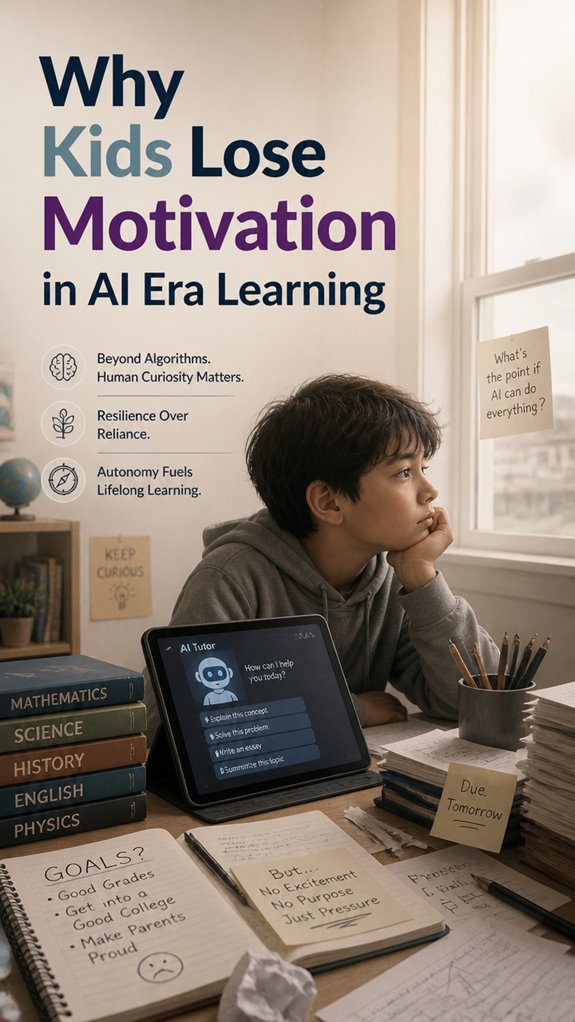
Why Your Child’s Motivation Crashes in AI Learning Environments
Does your kid seem less curious about learning lately? Digital tools often create motivation collapse because instant rewards hijack the brain’s reward system, preventing deep neural development.
I watched my daughter transform from eager explorer to passive consumer within weeks of heavy app use. She’d tap for answers instead of wrestling with problems. That’s when I realized we needed something different. Adaptive Atlas exists because kids deserve learning that challenges without crushing them. We built it to restore genuine struggle, the kind that actually grows brains and builds confidence.
Real Experience That Changed Everything
Last month, I sat with my son as he tackled a math problem without his tablet. His frustration mounted. Then something shifted. Instead of reaching for the app, he tried again. That persistence sparked something I hadn’t seen in months. His face lit up when he solved it himself. That moment proved resilience isn’t lost, just buried under shortcuts.
Quick Takeaways
- Overreliance on AI reduces confidence and emotional resilience by providing quick answers, diminishing problem-solving motivation.
- Digital overexposure leads to frustration, impatience, and decreased engagement due to disrupted dopamine regulation.
- AI’s personalization can create predictable routines, discouraging curiosity and discouraging bold questioning.
- Excessive use of AI weakens social skills and collaborative motivation essential for holistic learning.
- Quick digital rewards diminish anticipation for meaningful challenges, reducing intrinsic motivation to learn.
How AI Tools Undermine Motivation and Engagement
AI tools often seem like a quick fix for learning and problem-solving, but they can also unintentionally undermine motivation if you’re not careful. When children rely too heavily on AI, they might lose confidence in their own thinking and emotional resilience.
This can lead to frustration and disconnection from their learning process. Plus, overuse of AI can weaken social connectivity, making it harder for kids to collaborate, share ideas, and build relationships—key skills for the future. By fostering curiosity in children, parents can help counteract these effects and keep their kids engaged with genuine learning.
As parents, your goal is to create a balanced environment where children use AI as a tool, not a crutch. Reinforce their ability to face challenges and develop independence.
This approach helps children stay engaged, confident, and adaptable—essential qualities in a constantly developing world.
The Impact of AI on Brain Development and Neural Pathways
Children’s brains are constantly wiring and rewiring through experiences, and recent research shows that engaging with digital tools like AI can influence those neural pathways. This process affects neural plasticity, the brain’s ability to adapt and change, and impacts cognitive flexibility—your child’s capacity to shift thoughts and strategies. Identifying and nurturing your child’s unique strengths through personalized learning approaches can help counteract motivational challenges in AI-driven environments.
While some worry about negative effects, understand that this is part of building resilience, not damage. Instead of fearing change, see it as an opportunity to nurture long-term adaptability.
As a parent, you can guide this development by encouraging diverse, meaningful experiences that strengthen neural pathways. By intentionally designing learning environments, you help your child develop a flexible mind that’s ready for future challenges, rather than being constrained by outdated ideas of fixed intelligence.
Why Background Knowledge Boosts Learning and Curiosity
A strong foundation of background knowledge makes learning both faster and more meaningful. When your child understands the framework around new ideas, they can connect new information to what they already know.
This knowledge reinforcement helps them see patterns and see the bigger picture, making learning less overwhelming and more engaging.
Many parents worry that focusing on background facts might limit curiosity, but true mastery comes from understanding how concepts fit together, not just memorizing.
Focusing on understanding connections fosters mastery and curiosity, beyond just memorizing facts.
By nurturing background framework, you empower your child to explore deeper questions instead of skimming surface details.
Artificial intelligence tools can further support this process by providing personalized feedback that helps reinforce connections between existing knowledge and new concepts.
This approach builds confidence, sparks genuine curiosity, and creates a stable base for adapting to rapid change.
Ultimately, it’s about giving your child tools to learn, question, and thrive in an uncertain future.
How AI Homogenizes Thinking and Reduces Creativity in Kids

As AI tools become more common, there’s a growing concern that they might lead kids to think in similar, predictable ways. This homogenized thinking can reduce creativity because kids get used to following the same patterns AI suggests.
When children rely too much on these tools, they may stop asking bold questions or exploring outside the box. Instead, they become comfortable with routine solutions that fit the AI’s mold.
But keep in mind, it’s not about fear—it’s about being intentional. You can guide your child toward using AI as an amplifier of their unique ideas, not a crutch.
The Risks of Skipping Developmental Steps in Children’s Thinking Skills
Skipping developmental steps in thinking skills may seem like a quick fix, but it risks creating gaps in your child’s cognitive infrastructure. Developmental milestones are carefully designed to build essential skills gradually, shaping how children connect ideas, solve problems, and adapt.
When you rush past these steps, your child might struggle to handle complex challenges later or feel overwhelmed by ambiguity. It’s common to want quick results, but true growth depends on a solid foundation.
By respecting each stage, you ensure they develop resilience, critical thinking, and independence—key capabilities for the unpredictable future. Focus on supporting them through these steps. Research shows that future-ready skills are best developed when children progress through each cognitive stage at their own pace, allowing their brains to integrate new learning with existing knowledge.
This approach creates a long-term, adaptable mind that can navigate change confidently, rather than leaving them vulnerable when real challenges arise.
How to Foster Resilience and Motivation Amid AI Challenges
Adapting to the rapid changes brought by AI can feel overwhelming, but building resilience and motivation in your child creates a steady foundation for maneuvering uncertainty. Emotional resilience helps children handle setbacks and frustration without losing confidence, while fostering intrinsic motivation encourages them to learn for their own growth, not just external rewards. Antifragility—the capacity to gain strength from stress and disorder—goes beyond resilience by enabling children to thrive when faced with disruption and unpredictability.
To support this:
- Cultivate a growth mindset, emphasizing effort over innate ability
- Encourage self-reflection to build awareness of strengths and challenges
- Create safe spaces for failure, showing it as part of learning
- Celebrate progress, no matter how small, to inspire ongoing effort
- Model resilience and curiosity yourself, reinforcing that learning is a lifelong journey
These approaches help your child develop independence, adaptability, and a sense of control—vital for their future in a world of constant change.
Motivation Recovery Toolkit for Kids

Have you ever noticed how your child’s motivation can dip suddenly, especially during challenging tasks or after setbacks? This is normal, but it can also shake their confidence in learning.
To help, focus on rebuilding intrinsic motivation through curiosity cultivation. When you encourage children to explore ideas they find meaningful, they develop a love of discovery, not just the task itself. Research shows that positive learning attitudes are foundational to sustaining motivation even when tasks become difficult.
Instead of relying on external rewards, create environments where curiosity thrives. Ask open-ended questions that spark their wonder and give them space to experiment.
This approach strengthens their long-term capability, making learning more engaging and resilient. Keep in mind, your goal isn’t perfect performance but fostering a mindset where curiosity fuels ongoing growth and a sense of control over their future.
Dopamine Dysregulation Impacts Motivation
Many parents notice how their child’s motivation can suddenly drop, especially after screens or quick rewards. This happens because constant stimulation disrupts dopamine regulation, leading to motivation decline. When kids get instant gratification from digital content, their brains start expecting quick hits of pleasure. This makes it harder to focus on slow, effortful tasks that build long-term skills. Overstimulating screens create mood swings and impulsivity. Instant rewards condition the brain for quick dopamine bursts. Rapid dopamine reuptake causes quick motivation drops. Reduced anticipation of future rewards weakens drive. Lower distress tolerance makes challenges harder to face. The overstimulation also hinders the development of self-control and patience, which are essential for sustained motivation and resilience in learning.
Engaging Children With Real-World Challenges
Engaging children with real-world challenges helps them develop the resilience and adaptability they need for the future. When kids face complex, authentic problems, they learn to navigate ethical dilemmas and manage social-emotional dynamics. This builds their confidence to handle uncertainty, rather than avoiding it. Problem solving skills are essential for children to thrive in an increasingly complex world where they must think critically and adapt to new situations.
Many parents worry about exposing children to difficult situations, but instead of shielding, focus on guiding them through these experiences with understanding. It’s not about forced solutions, but giving children safe spaces to think critically, reflect, and adapt.
The Adaptive Atlas Anti-Fragile Child System
Building an anti-fragile child means helping your child develop resilience to handle uncertainty, setbacks, and challenges without shutting down. This system nurtures intrinsic motivation by fostering curiosity and a sense of autonomy support, so children feel in control of their learning journey. Anti-fragility goes beyond mere resilience by enabling children to actually improve and grow stronger when exposed to stressors and adaptive challenges.
Helping children build resilience and curiosity empowers them to embrace challenges and learn from setbacks autonomously.
- Encourage exploration without immediate judgment
- Celebrate effort and growth over pure achievement
- Support flexible thinking and adaptability
- Create safe spaces for failure and recovery
- Connect challenges to meaningful goals
The Full Adaptive Atlas Framework
The Full Adaptive Atlas Framework shows how all parts of supporting your child’s future work together as a cohesive system. It emphasizes fostering intrinsic motivation and encouraging autonomous learning, so children stay engaged and motivated over time.
Instead of relying on external rewards, they develop a love for exploration and problem-solving that fuels their curiosity. This system acknowledges fears about rapid change but offers reassurance through long-term commitment to adaptable skills.
By building resilience, independence, and confidence, you help your child see learning as a journey they control.
The framework doesn’t aim to predict every change but provides a clear structure for managing uncertainty. It empowers you to create a nurturing environment where your child learns not just facts but how to thrive in a constantly adapting world.
The Adaptive Atlas Framework
Five connected systems designed to help parents raise adaptable, future-ready children in a world shaped by AI, automation, and constant change.
| 🛡️ |
Anti-Fragile Child SystemBuilds resilience, adaptability, and the ability to handle uncertainty without shutting down. |
| 📚 |
Learning Stack ModelDevelops self-directed learning habits and continuous skill acquisition beyond school systems. |
| 🚀 |
Future Skill Stack SystemFocuses on high-value human skills that remain relevant in an AI-driven economy. |
| 🤖 |
AI Learning SystemTeaches children how to use AI as a thinking partner instead of becoming dependent on it. |
| 🧭 |
Child Type Navigator SystemPersonalizes learning and development based on each child’s strengths and personality. |
FAQ
How Can Parents Ensure Children Develop Critical Thinking Alongside AI Tools?
You can promote critical thinking by encouraging your children to question AI dependency, explore independent ideas, and use AI tools for creativity enhancement. Fostering curiosity and reflection helps them stay empowered and adaptable in a dynamic world.
What Signs Indicate a Child’s Motivation Is Declining Due to AI Reliance?
Like a flashlight dimming in darkness, signs of motivation decline show when AI dependency replaces curiosity, creativity, and effort. If your child relies solely on AI, losing the spark of independent thinking, their motivation is quietly slipping away.
How Does AI Impact Long-Term Curiosity and Intrinsic Motivation in Kids?
AI can dampen intrinsic curiosity and cause motivation decline by making answers too easy, reducing your child’s desire to explore, question, and learn independently. To liberate their curiosity, foster challenges that inspire genuine discovery and personal growth.
What Educational Practices Best Counteract Ai-Induced Homogenization of Thought?
You foster creative confidence and embrace diverse outlooks by encouraging open-ended exploration, critical thinking, and collaborative problem-solving. This liberates children from AI’s homogenization, inspiring original ideas and empowering them to challenge conformity with confidence and resilience.
How Can We Measure Genuine Understanding Versus Superficial Completion With AI?
Like peeling an onion, authentic comprehension reveals depth beyond superficial tasks. You measure true understanding by testing reasoning, application, and transfer, ensuring responses go beyond rote completion, opening genuine mastery instead of surface-level engagement.
References
- https://pmc.ncbi.nlm.nih.gov/articles/PMC12333830/
- https://www.psychologytoday.com/us/blog/the-algorithmic-mind/202603/adults-lose-skills-to-ai-children-never-build-them
- https://fordhaminstitute.org/national/commentary/does-ai-only-help-motivated-students
- https://ai.stanford.edu/blog/teaching/
- https://www.youtube.com/watch?v=qC_lXX0LoCg
- https://thejacobsladdergroup.org/2025/04/the-dopamine-cycle-impacts-of-excessive-screen-time/
- https://www.youtube.com/watch?v=s_P6sNFjLzI
- https://pmc.ncbi.nlm.nih.gov/articles/PMC3341492/
- https://pmc.ncbi.nlm.nih.gov/articles/PMC2815132/
- https://www.teachingtimes.com/regulating-the-rollercoaster-understanding-dysregulation-and-dopamine-in-adhd/