Teaching Growth Mindset: Why Does It Matter?
Want your child to bounce back from failure instead of shutting down? Growth mindset is the antidote. It rewires how kids respond to struggle, transforming setbacks into fuel for improvement rather than proof of inadequacy.
A Lesson from the Classroom
Last year, I watched Maya freeze during a math competition. Her shoulders hunched. Her pencil hovered. She whispered, “I’m just not a math person.” That moment crystallized why we created Adaptive Atlas. We wanted a platform that teaches kids effort compounds. That intelligence isn’t fixed. That struggle signals growth, not weakness. We document these real stories because they prove mindset shifts work.
When Effort Became Everything
My nephew spent weeks bombing his violin auditions. Then something clicked. He stopped measuring himself against “natural talent” and started tracking progress weekly. His teachers noticed immediately. The difference? He celebrated small wins. Reframed mistakes as data, not defeats. That’s adaptive resilience in action.
Quick Takeaways
- Use positive language that emphasizes effort, strategy, and persistence over innate talent to promote a growth mindset.
- Normalize mistakes and challenges as essential learning opportunities for resilience and neural development.
- Encourage self-awareness and emotional regulation to help children manage setbacks constructively.
- Reinforce progress and effort with specific praise, avoiding fixed mindset phrases like “You’re so smart.”
- Create a safe, supportive environment that fosters curiosity, adaptability, and viewing failures as growth opportunities.
Why Failure Builds Resilience and Growth in Kids
When children experience failure, it often feels uncomfortable. But it’s actually an essential part of their growth.
Taking risks is how they learn to manage emotions like frustration or disappointment, building emotional regulation over time. Failure isn’t a signal to give up; it’s a chance to develop resilience — the ability to bounce back stronger.
When you support children through setbacks, you encourage them to see mistakes as opportunities to grow, not signs of incapability. This mindset helps them become adaptable in a changing world.
Instead of fearing failure, focus on creating safe spaces for risk-taking and emphasizing learning from setbacks. Over time, children gain confidence, knowing they can handle uncertainty and keep moving forward—skills crucial for their future success.
Proven Strategies to Help Children Embrace Challenges
Helping children see challenges as opportunities rather than threats begins with your approach. Mindset shifting involves guiding them to view difficulty as a chance to grow, not as a setback.
Helping children see challenges as growth opportunities starts with your supportive approach and positive mindset.
Challenge acceptance becomes a skill they develop through your calm reassurance and consistent support. Instead of avoiding tough tasks, encourage children to take them on, reminding them that every challenge builds resilience and capability.
It’s normal to fear failure, but reframing it as part of learning restores their sense of control. Focus on creating a routine where effort and persistence are valued over instant success.
This helps kids see that ongoing effort, even in uncertainty, is a reliable path to their growth. Tracking their progress with a skill progress tracker helps visualize how their consistent effort translates into measurable improvement over time. Over time, challenge acceptance becomes a natural and empowering part of their mindset.
How to Use Words and Praise to Foster a Growth Mindset
The words you choose and how you praise your child play a pivotal role in shaping their mindset. Verbal affirmations and praise patterns influence how kids view challenges and effort. Instead of focusing on innate ability, highlight their persistence, strategy, and progress. Use praise that reinforces growth, like “You worked hard on that,” or “You’re improving because you keep trying.” Avoid fixed mindset phrases such as “You’re so smart,” which can limit their belief in effort. In doing so, you help your child see that skills develop through effort and learning. Understanding emotions of others also supports growth mindset development, as children who recognize and empathize with different emotional responses become more resilient in their own learning journeys. This mindset creates resilience and encourages independence, empowering them to face the future confidently, knowing their ability to adapt and grow is within their control.
| Fixed Praise Pattern | Growth-Focused Pattern |
|---|---|
| “You’re so smart.” | “You showed great effort.” |
| “You’re born talented.” | “You’ve improved a lot.” |
| “That was easy for you.” | “It took practice to get there.” |
| “You’re naturally talented.” | “You’re developing your skills.” |
Tips for Creating a Supporting Environment for Persistence

Creating a supportive environment for persistence starts with understanding that children need safety and encouragement to face challenges without fear of failure. Parent-teacher collaboration plays a crucial role in building this stability. When you and teachers share consistent messages and strategies, children see acceptance of effort as a valued part of growth.
Cultural affirmation is equally important—celebrating diverse backgrounds helps children feel valued and understood, fostering resilience in their unique journeys. Recognize that setbacks are natural; reframing these as opportunities empowers children to persevere. Strong problem solving skills enable children to approach obstacles strategically rather than becoming discouraged by them.
Focus on long-term patterns rather than quick fixes, establishing routines that promote steady effort. Keep in mind, your calm guidance and consistent support help children develop confidence, enabling them to navigate uncertainty and future challenges with resilience and independence.
Growth Mindset Training for Kids
Many parents worry that teaching kids about growth mindset is just about encouraging them to try harder, but it’s really about shaping how they see challenges and setbacks. Growth mindset training helps children develop cognitive flexibility, so they can adapt their thinking when faced with new or difficult situations.
It also boosts emotional intelligence, allowing them to recognize and manage their feelings around failure without shutting down. This approach reassures you that success isn’t about fixed traits but ongoing development.
Instead of forcing effort, you focus on building habits of resilience, curiosity, and self-awareness. When children learn to embrace challenges, they transform obstacles into valuable learning experiences that strengthen their abilities. Over time, this creates a foundation for your child to see setbacks as opportunities to learn, shaping a confident, adaptable mindset that’s essential for thriving in a changing world.
Neuroscience of Resilience Development
Understanding how resilience forms in the brain can help you guide your child through setbacks with confidence. Neuroplasticity development shows us that the brain can rewiring itself, creating stronger pathways that foster brain resilience. This means children aren’t fixed; their ability to bounce back improves with experience and support.
Resilience in children grows through experience and supportive relationships, harnessing the brain’s ability to rewire itself.
Consider these points:
- Stronger connections between the prefrontal cortex and amygdala help kids regulate emotions, making resilience easier.
- Encouraging activities like mindfulness and exercise promote neuroplasticity, which rewires the brain for adaptive responses.
- Supportive relationships transmit resilience traits through epigenetic changes, strengthening their future capacity to face challenges.
Fears about fixed traits and helplessness fade once you see resilience as a skill that grows. By implementing adaptive learning strategies at home, you can personalize the challenges your child faces to match their current skill level, ensuring they experience manageable difficulties that build confidence. You can guide your child to develop this essential capacity through everyday actions.
Overcoming Fixed Mindset Tendencies

Fixed mindset tendencies—when children believe their abilities are just innate traits—can hold them back from reaching their full potential.
They risk falling into perfectionism traps, where mistakes feel like failures rather than learning opportunities. Fixed labels, like “not good at math,” limit growth and create a false sense of static ability.
As a parent, your goal is to shift these patterns. Reframe setbacks as part of the learning process. Research shows that mistakes drive children’s growth by building neural pathways and resilience. Emphasize effort and progress over innate talent.
Help your child see abilities as developable skills, not fixed traits. This approach creates space for resilience and long-term growth.
The Adaptive Atlas Anti-Fragile Child System
Building resilience in children isn’t about shielding them from every difficulty—it’s about helping them grow stronger through challenges. This process depends on developing self-awareness and emotional regulation, key skills for steering change confidently.
The Adaptive Atlas Anti-Fragile Child System emphasizes these areas by encouraging children to recognize their feelings, understand their reactions, and recover quickly from setbacks. Anti-fragile systems actually improve and gain strength from stress and adversity rather than merely bouncing back to their original state.
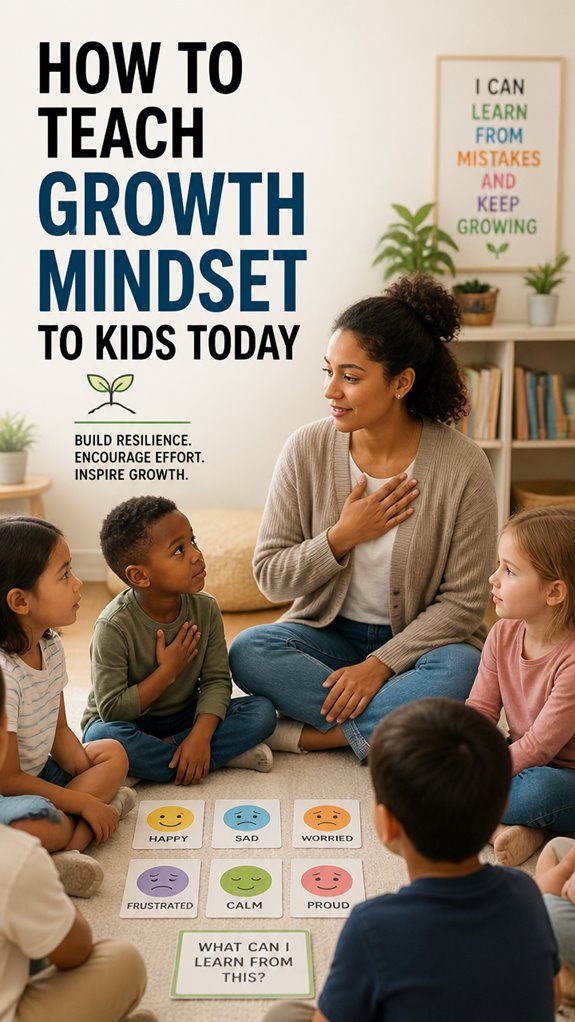
You can foster this by teaching children to pause, reflect, and label their emotions. Support their ability to adapt by modeling calm, focused responses.
Recall, the goal isn’t perfection but progress. Focus on:
- Building awareness of emotional states.
- Strengthening self-regulation strategies.
- Encouraging reflection after challenges.
Through this, you prepare them for a future where resilience and adaptability are their greatest strengths.
The Full Adaptive Atlas Framework
How does Adaptive Atlas turn uncertainty into a child’s greatest advantage? You break free from cultural norms that demand fixed paths, building a system where your child thrives amid change. Don’t fear AI reshaping jobs—reframe it: you equip them with emotional intelligence to navigate ambiguity, turning volatility into leverage.
Adaptive Atlas integrates five layers: Anti-Fragile foundation, self-directed Learning Stack, Future Skill outputs, AI as partner, and personalized Child Type navigation. This flow compounds capabilities for their future freedom.
| Layer | Old Fear | New Liberation |
|---|---|---|
| Anti-Fragile | Failure crushes | Builds resilience |
| Learning Stack | Rigid schools | Self-directed growth |
| Future Skills | Job loss | Emotional intelligence edge |
You gain control, raising adaptable creators, not conformists.
The Adaptive Atlas Framework
Five connected systems designed to help parents raise adaptable, future-ready children in a world shaped by AI, automation, and constant change.
| 🛡️ |
Anti-Fragile Child SystemBuilds resilience, adaptability, and the ability to handle uncertainty without shutting down. |
| 📚 |
Learning Stack ModelDevelops self-directed learning habits and continuous skill acquisition beyond school systems. |
| 🚀 |
Future Skill Stack SystemFocuses on high-value human skills that remain relevant in an AI-driven economy. |
| 🤖 |
AI Learning SystemTeaches children how to use AI as a thinking partner instead of becoming dependent on it. |
| 🧭 |
Child Type Navigator SystemPersonalizes learning and development based on each child’s strengths and personality. |
FAQ
How Early Can I Start Teaching Growth Mindset to Children?
Think of planting resilience seeds early; you can start during developmental stages, even in infancy. Early intervention weeds out fear, nurturing a growth mindset as children grow, revealing their potential to adapt, learn, and thrive beyond limits.
What Are Common Signs a Child Has a Fixed Mindset?
You’ll notice belief barriers like avoiding challenges or giving up easily; these mindsets manifest as resistance to effort or fear of failure. Recognizing these signs helps you liberate your child by addressing fixed mindset beliefs early.
How Do I Handle Persistent Failure Without Discouraging My Child?
You handle persistent failure by engaging in resilience training and sharing motivational storytelling that emphasizes growth from setbacks. This approach empowers your child, fosters inner strength, and highlights progress, liberating them from discouragement and building unstoppable confidence.
Can Praising Effort Sometimes Backfire or Be Misunderstood?
Praising effort can sometimes backfire if it’s misunderstood praise, making kids believe only specific actions matter instead of fostering genuine resilience and curiosity. Focus on authentic feedback to liberate their confidence and intrinsic motivation for growth.
How Do Cultural Differences Impact Growth Mindset Development?
Cultural influence shapes mindset diversity, coloring beliefs about failure and success. You liberate growth potential by understanding these differences, embracing varied viewpoints, and fostering environments where all cultural narratives can inspire resilient, adaptable mindsets in children.
References
- https://biglifejournal.com/blogs/blog/teach-growth-mindset-kids-activities
- https://www.youtube.com/watch?v=w6LLxTcVN9k
- https://positivepsychology.com/growth-mindset-for-kids/
- https://www.childdevelopmentclinic.com.au/growth-mindset.html
- https://bchp.childrenshospital.org/news/7-steps-nurturing-growth-mindset
- https://amshq.org/blog/child-psychology/2023-08-16-8-the-power-of-yet-helping-children-develop-a-growth-mindset/
- https://thecalmishteacher.com/teaching-growth-mindset/
- https://www.edutopia.org/article/growth-mindset-resources/
- https://www.journals.uchicago.edu/doi/full/10.1086/697956
- https://pmc.ncbi.nlm.nih.gov/articles/PMC6717018/