How Can Kids Thrive When Everything Changes?
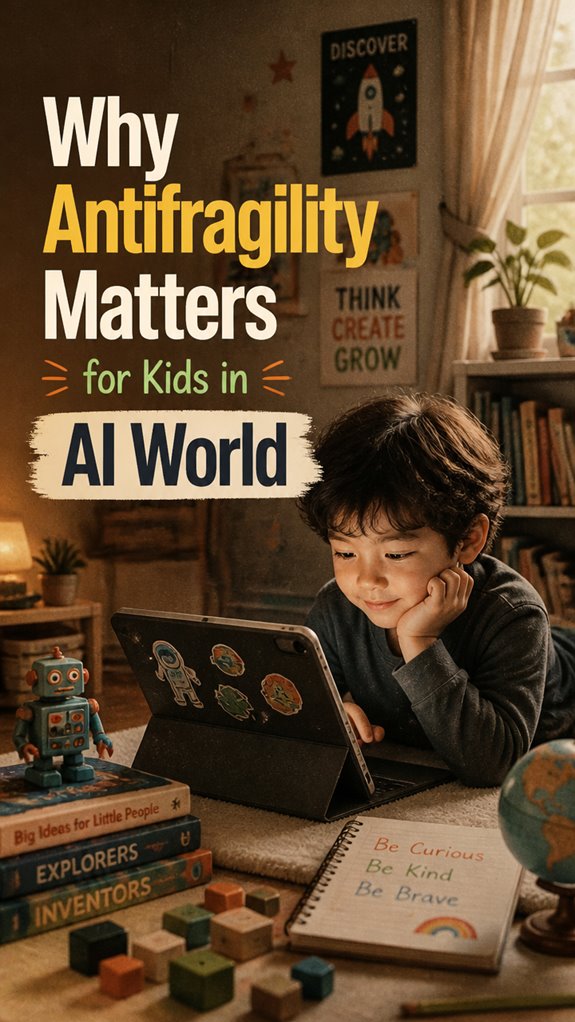
In an AI world, your child’s survival depends on antifragility, not avoidance. This means building resilience through real challenges, adaptability, and emotional strength so they handle disruption with actual confidence, not just positive thinking.
My son refused to code for months. Then he broke his app. Instead of quitting, he debugged it himself, stayed curious, and suddenly understood problem-solving on a cellular level. That’s when I realized Adaptive Atlas existed for this exact reason: to give parents frameworks for raising kids who don’t just survive change, they weaponize it.
Last week, my daughter faced a project failure. She didn’t spiral. She asked better questions, iterated faster, and shipped something stronger. That moment crystallized why we built this: kids need permission to struggle. Not coddling. Not avoidance. Struggle with direction.
Quick Takeaways
- Antifragility enables kids to grow stronger from challenges, making them adaptable in an unpredictable AI-driven world.
- It fosters resilience, helping children recover from setbacks and navigate rapid technological changes confidently.
- Developing antifragility promotes problem-solving, independence, and long-term growth vital for future success.
- Cultivating emotional agility and growth mindsets prepares children to handle uncertainty and complexity.
- Emphasizing experiential learning and natural development builds skills to thrive amid technological and societal changes.
What Is Antifragility: and Why Does It Matter for Kids in an AI Future?
Antifragility might sound complex, but at its core, it’s about becoming stronger through challenges and change.
Visualize your child’s genetic inheritance and cultural influences as the foundation of their resilience. These factors shape how they respond to stress, failure, and new environments.
Instead of avoiding difficulty, a child who’s antifragile learns from setbacks, recovers, and grows.
Embrace setbacks as opportunities for growth, helping children recover stronger and more resilient through challenges.
This isn’t about removing risk but building a system that adapts and improves over time.
Fear often stems from feeling powerless, but focusing on systems of capability helps restore control.
Research shows that parental guidance strategies significantly enhance a child’s ability to develop antifragility during formative years.
By nurturing adaptability, you prepare your child for an unpredictable future—one where change is constant and opportunities abound for those ready to evolve.
Antifragility isn’t just a skill, but a way to thrive amid uncertainty.
How Can Building Resilience Protect Kids From Ai-Related Disruptions?
Building resilience is one of the best ways to help your child navigate the disruptions brought about by AI. It prepares them to face change with confidence and flexibility.
You can foster this by encouraging emotional vulnerability, where kids learn to express feelings and adapt without fear of failure. Promoting talent diversification helps them explore different strengths, reducing reliance on a single path.
Moreover, teaching them to stay calm under pressure builds inner strength.
Consider these steps:
- Support emotional vulnerability to grow emotional resilience
- Encourage skill variety to enhance talent diversification
- Teach problem-solving for unpredictable disruptions
- Promote continuous learning to stay adaptable
- Model calm and confidence amid uncertainty
These systems strengthen your child’s ability to thrive in an ever-changing world, giving them control over their future.
Practical Ways to Make Kids More Anti-Fragile: Play, Projects, and Autonomy
While many parents worry about how to prepare their kids for an uncertain future, focusing on their ability to handle setbacks and change can be more effective than trying to predict every challenge. You can do this by encouraging play, projects, and autonomy — essential for building a growth mindset and risk tolerance. Play allows children to experiment freely, embrace failure, and develop resilience naturally. Projects give them the chance to see their ideas come to life, fostering independence and confidence. Autonomy helps them learn to trust their judgment and adapt in unpredictable situations. Here’s a quick guide:
| Play | Projects |
|---|---|
| Experimentation | Creative problem solving |
| Embracing failure | Independent thinking |
| Flexibility | Building resilience |
| Risk-taking | Cultivating adaptability |
| Joy in discovery | Long-term growth |
This approach helps children become antifragile, ready for whatever the future holds.
How Parents Can Foster Emotional Strength and Critical Thinking in Kids

Many parents worry that fostering emotional strength and critical thinking might mean protecting children from failure or challenging feelings. But, in reality, it’s about creating space for growth.
To build emotional intelligence, encourage kids to reflect on feelings, normalize setbacks, and discuss resilience.
For creative problem solving, challenge them to find solutions, experiment without fear, and ask open-ended questions. AI tools can also provide personalized feedback on their writing, helping them recognize patterns in their work and improve their writing skills through guided practice.
- Promote open conversations about emotions and challenges
- Teach kids to see failure as a step, not a setback
- Model curiosity and adaptability in daily life
- Use real-world problems to cultivate their decision-making skills
- Celebrate effort and progress over perfection
This approach helps children develop long-term capabilities—core to their future in an AI-driven world—without shielding them from the complexity of life.
Preparing Kids for an Uncertain, AI-Driven Future: Emphasizing Learning and Adaptability
As we face rapid change driven by AI and automation, the key isn’t trying to predict what’s next, but helping kids develop the ability to learn continuously and adapt actively.
A growth mindset empowers them to see challenges as opportunities, fostering resilience and curiosity. Emotional agility guides them to manage uncertainty calmly, rather than feeling overwhelmed.
To prepare your child, focus on creating environments where they can experiment, make mistakes, and recover—building antifragility. Instead of clinging to fixed abilities, encourage flexible thinking and long-term learning. Research shows that effective learning strategies developed early create a foundation for sustained intellectual growth throughout their lives.
Foster environments that encourage experimentation, embrace mistakes, and promote flexible thinking for lasting resilience and growth.
This approach shifts the emphasis from short-term achievement to developing adaptable skills that will remain valuable.
Your role is to support their ability to navigate ambiguity confidently, helping them embrace change as a chance to grow rather than a threat.
Addressing Adaptability Gaps Early
Addressing adaptability gaps early sets the foundation for your child’s long-term success in a constantly changing world. When you focus on building genetic diversity and cultural resilience, you prepare them to thrive amid continuous shifts. Think of it as creating a flexible core, capable of handling any challenge.
- Encourage varied experiences to improve their adaptability.
- Foster connections to diverse cultures and outlooks.
- Support problem-solving that relies on creative thinking, not just rote learning.
- Emphasize resilience as a skill to grow from setbacks.
- Promote self-awareness to recognize unique strengths and patterns.
The Adaptive Atlas Anti-Fragile Child System

Children face a world full of unpredictable changes, and helping them build resilience is more important as ever. The Adaptive Atlas Anti-Fragile Child System focuses on developing emotional awareness and adapting to cultural shifts. It teaches your child to stay calm under pressure, handle frustration, and grow through challenges instead of avoiding them. By cultivating antifragility through adversity, children learn to view obstacles as opportunities for strengthening their capabilities rather than threats to avoid.
| Emotional awareness | Cultural shifts |
|---|---|
| Recognizing feelings | Embracing change and diversity |
| Managing reactions | Navigating uncertainties |
| Empathy | Adapting to new norms |
| Self-regulation | Challenging outdated beliefs |
| Confidence | Building long-term resilience |
This system gives your child the tools to thrive amid constant change, transforming fears into actionable strengths. It’s about empowering them to stay flexible and purposeful in a fluid world.
The Adaptive Atlas Framework
The Adaptive Atlas Framework offers a clear, structured approach to raising future-ready children in a world that’s constantly changing. You’ll help your child develop a growth mindset and strong risk management skills, essential for adapting to ongoing shifts.
This system centers on five interconnected layers:
- Building antifragile traits so they can grow through challenges
- Cultivating self-directed learning for continuous adaptation
- Identifying future-relevant skills like critical thinking and creativity
- Introducing AI as a partner for amplification, not replacement
- Personalizing growth to match your child’s unique strengths and interests
This framework isn’t about controlling the future, but giving your child the capacity to navigate it confidently. It offers a practical, long-term way to foster resilience and independence amid constant change.
Quantum Resilience Principles in Children
Have you ever wondered how kids can stay steady when the world feels unpredictable? Quantum grounding helps children stay connected to their bodies, providing stability amid constant change.
By practicing sensory resilience, they learn to focus on physical sensations rather than becoming overwhelmed by digital overstimulation. These practices—like body awareness exercises—build a sense of calm and control, essential in an AI-driven environment.
Practicing sensory resilience helps kids focus on physical sensations, cultivating calm and control amid digital overload.
Understanding quantum resilience means recognizing that the future isn’t fixed but probabilistic, and children can adapt by embracing uncertainty rather than fearing it. Rather than rushing into early specialization, parents should recognize that building diverse skills during childhood creates the cognitive flexibility needed to adapt to unpredictable futures.
Developing this resilience helps them navigate complex, unpredictable worlds confidently. It’s about equipping kids with the inner strength to stay centered, adapt, and thrive as they grow into future-ready individuals capable of handling the shifting terrain.
Antifragility Guide for Parents
Ever wonder how to help your child thrive amid inevitable change and uncertainty? In a world of cultural shifts, your discipline strategies must evolve.
Instead of shielding your child from failure, focus on building resilience through supportive, flexible routines. This means encouraging them to face challenges, learn from setbacks, and adapt without fear. The antifragile approach teaches parents to view stressors as opportunities for growth rather than threats to avoid.
Here are ways to foster antifragility:
- Promote problem-solving instead of avoiding difficulty
- Teach them to reflect on failures as growth opportunities
- Model calm acceptance for unpredictable changes
- Encourage curiosity and experimentation over perfection
- Reinforce long-term thinking rather than instant success
Digital Literacy for Resilience
Building digital literacy is essential for helping your child develop resilience in an increasingly connected world. When you focus on cultivating cultural resilience and technological agility, your child learns to adapt and stay confident, regardless of rapid change.
Instead of fearing digital challenges, see them as opportunities to build skill and independence. Encourage your child to explore technology mindfully, understanding its purpose and possibilities. This way, they develop not just competence but a sense of control over their digital environment. By intentionally guiding your child toward future-ready skills, you empower them to thrive in a world shaped by artificial intelligence and constant technological evolution.
The Adaptive Atlas Framework
Five connected systems designed to help parents raise adaptable, future-ready children in a world shaped by AI, automation, and constant change.
| 🛡️ |
Anti-Fragile Child SystemBuilds resilience, adaptability, and the ability to handle uncertainty without shutting down. |
| 📚 |
Learning Stack ModelDevelops self-directed learning habits and continuous skill acquisition beyond school systems. |
| 🚀 |
Future Skill Stack SystemFocuses on high-value human skills that remain relevant in an AI-driven economy. |
| 🤖 |
AI Learning SystemTeaches children how to use AI as a thinking partner instead of becoming dependent on it. |
| 🧭 |
Child Type Navigator SystemPersonalizes learning and development based on each child’s strengths and personality. |
FAQ
How Can Parents Measure Their Child’s Antifragility Effectively?
You can gauge your child’s antifragility by observing their willingness to take risks and bounce back from setbacks. Focus on resilience building, noting how they adapt under pressure and embrace challenges as growth opportunities—these are key indicators of strength.
What Specific Activities Best Promote Emotional Intelligence in an AI Era?
You foster emotional intelligence by encouraging your child to practice empathy-building activities like active listening and point of view-taking, while promoting emotional resilience through challenging experiences that teach them to adapt and grow emotionally in the changing AI world.
How Does Antifragility Influence Long-Term Career Adaptability?
Antifragility fuels long-term career adaptability by emphasizing resilience building and flexibility training, empowering you to thrive amid change. You learn to grow stronger through adversity, releasing liberation as you navigate changing environments with confidence and independence.
Can Traditional Education Tools Support Antifragility Development?
Did you know only 20% of traditional education emphasizes resilience training? You can support antifragility development by fostering risk tolerance, encouraging experimentation, and embracing failure, freeing children to adapt and thrive in unpredictable, AI-driven futures.
How to Balance Safety and Autonomy in Ai-Enhanced Learning Environments?
You should encourage risk-taking and resilience building in AI-enhanced learning, balancing safety with autonomy. Foster environments where children explore freely, learn from failure, and develop independence, empowering them to grow stronger through challenge and adaptability.
References
- https://sites.psu.edu/digitalshred/2026/04/16/tips-for-parents-raising-resilient-learners-in-an-ai-world-brookings/
- https://robertglazer.substack.com/p/ai-job-elimination-preparation
- https://www.youtube.com/watch?v=vaA5HJWURUg
- https://www.youtube.com/watch?v=kiKI3fUOHeE
- https://www.gspeakers.com/topics/the-quantum-child-framework/
- https://www.scq.ubc.ca/on-quantum-parenting/
- https://eureka.patsnap.com/report-how-to-adapt-quantum-healing-techniques-for-youth-programs
- https://www.aps.org/apsnews/2024/11/quantum-fifth-graders-research