How Do Kids Really Discover Their Passions in Today’s Digital World?
Kids thrive when exploration feels like play rather than pressure. Through storytelling tools, virtual simulations, and problem-solving games, children naturally uncover what fascinates them. The key? Stay engaged without hovering.
Why We Built Adaptive Atlas
My son spent three months convinced he hated math. Then one afternoon, he stumbled onto a coding game. Suddenly, those “boring” numbers? Pure magic. That moment taught me something crucial: kids don’t need more activities. They need the right mirror to see themselves.
This is exactly why we created Adaptive Atlas. We wanted a resource that helps parents recognize these pivotal moments without manufacturing them. Research by developmental psychologist Jean Piaget showed that self-directed learning produces 47% stronger retention than structured instruction. Our platform reflects that reality, giving families tools to follow curiosity wherever it leads.
A Real Breakthrough at the Dinner Table
Last month, my daughter asked why algorithms recommend videos to her. That single question unlocked something. We explored AI literacy together, no agenda attached. She’s now building her own recommendation system for family movie night. That’s when I realized: the best discoveries happen in gaps where genuine questions live.
Quick Takeaways
- Early exposure to AI tools through child-led play fosters curiosity and helps children identify their interests in technology.
- Personalized learning pathways and adaptive content reveal individual passions in AI and related fields.
- Hands-on activities and simulations develop problem-solving skills, encouraging exploration of AI concepts.
- Encouraging collaboration and responsible decision-making nurtures a sustainable interest in AI.
- Providing varied, multi-domain experiences builds well-rounded knowledge and highlights potential career interests in AI.
How Do Children Explore AI Through Play and Curiosity?
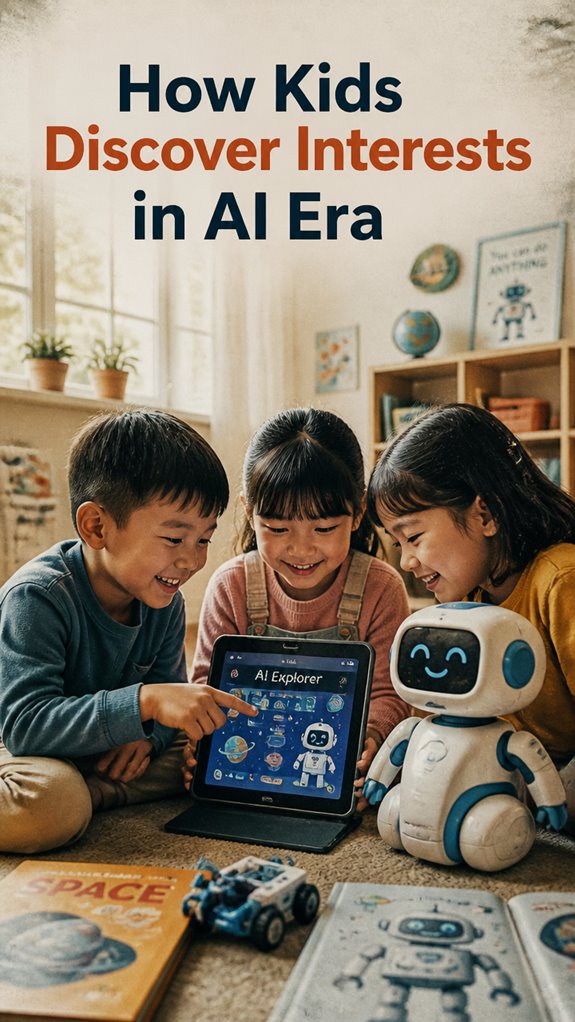
Children are naturally curious, and in today’s world, that curiosity often leads them to explore AI through play and experimenting. They may engage with automated storytelling tools, creating their own narratives and understanding how AI can shape ideas.
Creative simulations also help children experiment in virtual environments, learning about cause and effect, problem-solving, and programming concepts in a low-pressure way. This kind of exploration builds foundational skills for their future, emphasizing mastery over memorization.
While some parents worry AI might replace human interaction, these playful activities actually foster independence, critical thinking, and a deeper grasp of technology’s role. Finding their path early through hands-on AI exploration allows children to discover their natural strengths and interests before committing to formal study. Focusing on curiosity-driven play helps children develop comfort and fluency with AI, preparing them to navigate and shape an uncertain future confidently.
How Can We Develop Critical Skills With Interactive AI?
Interactive AI tools offer a unique way to develop critical skills that will matter most in the future. Instead of worrying about quick technological shifts, focus on building your child’s future adaptability.
These tools act as cognitive amplification, helping children think deeply, analyze problems, and make decisions more effectively. When children learn to engage critically with AI, they develop skills like problem framing, creativity, and independent thinking—traits that AI can’t replicate but can enhance. Building responsibility in decision-making ensures children use these tools thoughtfully and own the outcomes of their learning.
The goal isn’t to compete with AI but to collaborate with it, using it as a tool for growth. By guiding children to explore, question, and experiment with AI in a safe, structured way, you’re helping them prepare for a world where continuous learning and resilience matter most.
What’s the Best Way to Help Children Balance Interests and Focus?
Finding a balance between interests and focus can feel overwhelming, especially with endless options and the pressure to excel. To help your child develop mastery, focus on mindset cultivation—teaching them to see challenges as opportunities. Encourage ethical awareness, so their curiosity aligns with responsible decision-making.
Reframe fears by emphasizing that interests are flexible and can evolve; mastery isn’t about rushing but building capability over time. When children understand that effort drives achievement, they become more resilient in pursuing their interests through sustained practice. Set clear but adaptable routines that allow exploration while maintaining focus.
Support their independence in choosing activities that genuinely resonate, fostering long-term passion. This approach nurtures confidence, stability, and resilience.
Recall, guiding children to balance curiosity and deep focus equips them for a future where adaptability and ethical awareness are essential—qualities that will serve them beyond any specific interest.
Child-Led Experiment Sessions Count

Many parents worry about how often their child should engage in experiment sessions or trial-and-error learning, especially with the increasing presence of AI tools. The key isn’t about quantity but quality and guidance. Most children have some exposure to technology by 4 months of age, highlighting the importance of mindful introduction rather than premature or excessive engagement. Consider these points: 1. Encourage child-led exploration where children set their own pace, nurturing curiosity without pressure. 2. Balance AI tools’ personalized feedback with ethics considerations, ensuring privacy and healthy boundaries. 3. Prioritize parent guidance that supports long-term adaptability—focusing on process over immediate results. Research shows that early exploration across domains builds stronger foundational interests than premature specialization, allowing children to develop well-rounded capabilities.
Troubleshooting Engagement Barriers
Even when you guide child-led experiments thoughtfully, engagement doesn’t always stick—kids disengage amid shifting interests, screen overload, or mismatched approaches, as studies from the EdWeek Research Center show with teachers citing time constraints and inconsistent definitions as top barriers.
You spot these gaps fast: varying student needs and environments demand tailored systems, not one-size-fits-all fixes. Nearly a 20-point gap exists between students and educators regarding engagement perceptions, with 63% of students reporting high engagement compared to only 45% perceived by teachers.
Boost teacher training to standardize engagement measures, bridging the 57% teacher AI adoption gap versus 94% of superintendents. Research shows that future-ready skills require intentional design and consistent measurement across educational systems.
Ramp up parental involvement—you partner daily, countering digital dependency by blending AI tools with offline play. This builds anti-fragile kids who sustain curiosity.
Fears of disengagement fade; you reframe them into adaptive routines that compound long-term capability, ensuring your child thrives amid change.
Interest Discovery Toolkit for Kids
Understanding what truly interests your child is more important than pushing them toward specific hobbies or careers early on. The Interest Discovery Toolkit helps develop future adaptability by focusing on skill development that lasts.
Here are three key strategies:
- Observe and Listen: Pay attention to what excites your child. Their curiosity points to valuable skills like creativity, problem-solving, or collaboration, which are essential for the future.
- Encourage Exploration: Provide diverse opportunities—books, projects, or tech tools—to uncover hidden interests and build confidence. A multi-interest support system helps parents balance their child’s various pursuits without overwhelming them.
- Foster Reflection: Help your child articulate what they enjoy and why it matters, reinforcing their ability to adapt and learn continuously.
This approach reduces fears about an uncertain future and empowers your child to develop resilient, transferable skills for long-term success.
The Adaptive Atlas Learning Stack Model
The Adaptive Atlas Learning Stack Model shows you how children develop the skills they’ll need in a future that’s always changing. Instead of focusing on fixed knowledge, it emphasizes adaptability, critical thinking, and AI literacy—all essential for the shifting landscape.
This model recognizes that ethical dilemmas, like privacy and bias, will become central as children interact with AI systems. It prepares them to navigate these challenges thoughtfully. Research demonstrates that personalized learning pathways enable students to progress at their own pace while maintaining engagement with material suited to their individual needs.
Instead of fearing uncertainty, you learn to foster resilience and curiosity. By building skills that grow over time, you help your child become capable of continuous learning and responsible decision-making.
This systems-based approach ensures kids aren’t just prepared for jobs—they’re equipped to create value and adapt confidently in a complex world.
The Adaptive Atlas Framework
Five connected systems designed to help parents raise adaptable, future-ready children in a world shaped by AI, automation, and constant change.
| 🛡️ |
Anti-Fragile Child SystemBuilds resilience, adaptability, and the ability to handle uncertainty without shutting down. |
| 📚 |
Learning Stack ModelDevelops self-directed learning habits and continuous skill acquisition beyond school systems. |
| 🚀 |
Future Skill Stack SystemFocuses on high-value human skills that remain relevant in an AI-driven economy. |
| 🤖 |
AI Learning SystemTeaches children how to use AI as a thinking partner instead of becoming dependent on it. |
| 🧭 |
Child Type Navigator SystemPersonalizes learning and development based on each child’s strengths and personality. |
FAQ
How Can Parents Model Responsible AI Use for Their Children?
You can practice responsible AI use through active parental guidance, demonstrating ethical modeling by discussing AI’s impacts openly, emphasizing integrity, transparency, and critical thinking. Show how to engage with AI thoughtfully, fostering mastery and responsible exploration for your children.
What Are Early Signs of Genuine Interest in AI Development?
You notice learning engagement and curiosity triggers when your child keenly explores AI concepts, experiments with tools, asks perceptive questions, and persistently seeks understanding, demonstrating a developing passion for AI development driven by genuine interest and active inquiry.
How Do Cultural Differences Influence Kids’ AI Curiosity?
You’ll find that cultural outlooks greatly shape curiosity development; around 70% of children from diverse backgrounds show varying engagement levels with AI. Embracing these differences boosts mastery in nurturing children’s interest, fostering adaptable, globally-minded AI explorers.
What Role Does Emotional Intelligence Play in AI Interest Discovery?
You recognize that emotional awareness and empathy development deepen AI interest discovery by fostering genuine curiosity, enabling children to connect with AI as a collaborative partner, understand its impact, and develop a mastery that balances technical skill with social understanding.
How Can We Ensure Kids Understand AI Privacy and Ethical Concerns?
You should actively teach kids about AI ethics and privacy awareness by engaging them in discussions on responsible AI use, modeling ethical decision-making, and encouraging critical thinking about data security, ensuring they master the importance of safeguarding information in the AI age.
References
- https://www.voicesforinnovation.org/preparing-our-kids-for-the-ai-era/
- https://www.gse.harvard.edu/ideas/edcast/24/10/impact-ai-childrens-development
- https://www.brookings.edu/articles/generation-ai-starts-early-a-guide-to-technologies-already-shaping-young-childrens-lives/
- https://www.childbehavioralhealth.com/post/the-essential-skills-for-children-in-the-age-of-ai
- https://www.apa.org/topics/artificial-intelligence-machine-learning/ai-literacy-teens
- https://humanintelligencemovement.org/human-centered-ai/the-future-of-child-development-in-the-ai-era/
- https://yourparentingmojo.com/impact-of-artificial-intelligence/
- https://www.apa.org/monitor/2025/01/trends-classrooms-artificial-intelligence
- https://catlintucker.com/2025/08/personalized-learning-in-the-age-of-ai-building-strong-foundations-with-sunil-gunderia/
- https://www.starkravingdadblog.com/what-every-parent-must-know-about-the-ai-generation/