Can AI Replace What Your Child Learns in School?
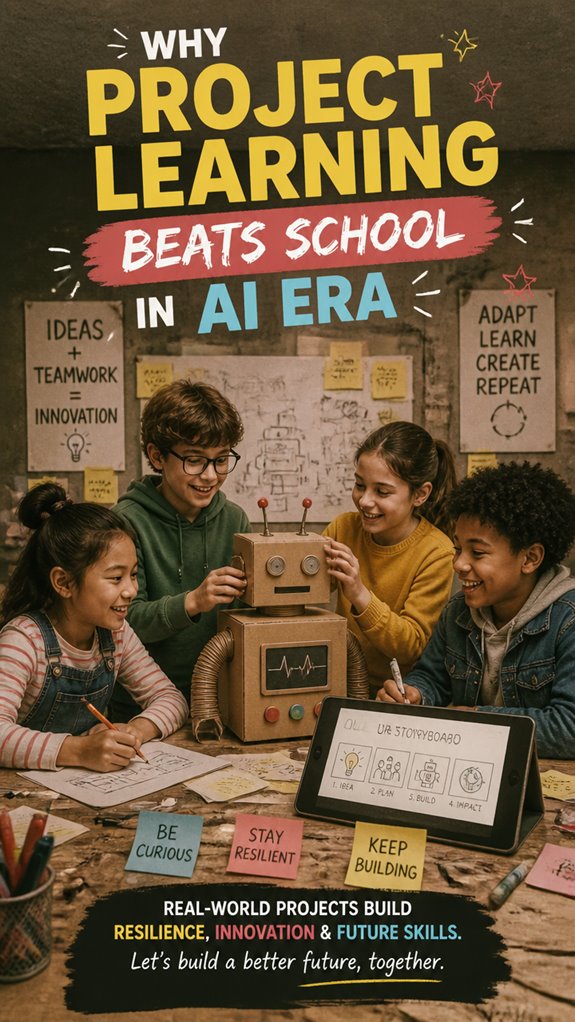
Not quite. Project-based learning develops creativity, emotional intelligence, and complex problem-solving that AI struggles to replicate. Traditional schools lean on memorization while PBL builds hands-on mastery, collaboration, and adaptability for an unpredictable future.
I watched my daughter freeze during a group project. She knew the content cold but couldn’t communicate her ideas to teammates. That moment shifted everything. We started designing learning experiences through Adaptive Atlas, our platform, because we realized schools were teaching answers, not resilience. We wanted kids to feel the productive struggle of real problems. Watching her return to that same project weeks later, leading confidently, proved something: systems thinking and emotional agility beat perfect test scores every single time.
Last month, I sat with a teenager debugging her coding project at 10 PM. Not because she had to. Because she wanted to solve it. She’d failed three times. Her persistence didn’t come from grades or teacher pressure. It came from owning the problem. That’s the gap project learning fills that traditional education misses entirely.
Quick Takeaways
- Project-based learning fosters critical thinking, creativity, and real-world problem-solving skills that AI alone cannot replicate.
- It emphasizes deep mastery and flexibility, preparing students for unpredictable future challenges better than traditional schooling.
- PBL encourages collaboration, emotional intelligence, and technological fluency essential for future success in an AI-driven world.
- Active, hands-on experiences increase engagement and resilience, promoting lifelong learning and adaptability over passive memorization.
- The focus on systems thinking and innovation equips learners to create value and thrive amid technological and societal changes.
How Does Project-Based Learning Develop Skills AI Cannot Replicate?
Project-based learning helps children develop skills that AI can’t easily replicate, and it does so by focusing on real-world problems, collaboration, and creative thinking. When kids work on meaningful projects, they develop skill depth, mastering complex concepts beyond surface-level understanding.
Project-based learning fosters deep skills through real-world problems, collaboration, and creative thinking.
This approach cultivates creativity, encouraging children to find original solutions and think flexibly. Unlike traditional schooling, which often emphasizes rote memorization, PBL nurtures the ability to adapt and innovate—key qualities for the future.
Research from organizations like the Edutopia Institute shows that children engaged in project work build stronger problem-solving habits and resilience.
To maximize the benefits of project-based learning, it’s important to minimize screen distractions so children can fully concentrate on collaborative work and deep thinking. As parents, understanding that these deep skills create a lasting foundation shifts your focus from short-term achievement to fostering long-term capability—an essential advantage in a world shaped by rapid change and AI.
Why Is PBL the Best Prep for Success in an AI-Driven Future?
| Cultural Outlooks | Evaluation Difficulties |
|---|---|
| In an age where AI can generate and analyze information, there’s concern that traditional skills may fade. But project-based learning (PBL) prepares children for this shift. PBL emphasizes collaboration, critical thinking, and cultural agility—skills that adapt across diverse environments. These qualities are essential when cultural outlooks shape global cooperation and innovation. | Standard assessments often struggle to measure these deep skills, making it hard to gauge true readiness. PBL offers practical understanding into how kids approach real-world challenges, giving parents confidence. It highlights the importance of systems thinking and adaptability, rather than rote memorization. This aligns with the future’s demands, fostering children’s ability to thrive amid ongoing change, and giving them a strategic advantage in an unpredictable world. |
The hidden skills that schools traditionally overlook—such as emotional intelligence, complex problem-solving, and technological fluency—become increasingly valuable when students engage in project-based learning environments that mirror real-world AI applications.
How Can Parents Support and Enhance Project-Based Learning at Home?
Supporting your child’s project-based learning at home might seem overwhelming at first, especially with so many resources and opinions out there. But your role is essential. Parent collaboration creates a strong foundation for creative environments where children can experiment, fail, and grow.
Your support at home builds confidence and fosters a creative space for your child’s growth and experimentation.
Instead of giving directives, ask open-ended questions to stimulate their thinking. Provide tools like simple materials or digital platforms that encourage exploration. Keep in mind, children thrive when they feel supported and empowered to take ownership of their projects.
Your confidence fosters resilience and independence. Focus on creating a space where curiosity is celebrated. When you support long-term skills like problem-solving and adaptability, you help prepare your child for a future shaped by continuous change.
Your involvement makes a lasting difference.
Neuroscience Insights on Adaptability
Understanding how children’s brains develop resilience and flexibility can help you support their ability to adapt over time. Neural plasticity, the brain’s capacity to reorganize itself, is key to this process. It enables children to learn from experience, recover from setbacks, and build emotional resilience.
When you encourage environments that challenge children without overwhelming them, you strengthen these adaptive skills. Fear of their inability to keep up is natural, but recall, resilience isn’t about avoiding failure—it’s about learning to bounce back stronger. Creative project-based learning fosters both technical competency and creative problem-solving abilities that enhance children’s capacity to navigate an increasingly complex technological landscape.
Learning by Doing

When children learn by doing, they develop practical skills crucial for thriving in a rapidly changing world. Active engagement fosters experimental collaboration, where children work together, test ideas, and refine their understanding through hands-on creativity. AI’s role in digital learning can tailor these experiences further by adapting activities to each child’s unique needs, making learning more effective and personalized. Research shows that active learning halves failure rates and boosts participation—up to 13 times more than passive methods. AI enhances this process by providing simulations, interactive feedback, and real-time problem-solving. This approach encourages children to take risks, learn from mistakes, and build confidence. Many parents worry about keeping pace with AI, but learning by doing shifts focus from memorization to adaptable skills like critical thinking and creativity. It’s about building systems that sustain long-term capability, empowering your child to navigate uncertainty with resilience and autonomy.
Addressing Learner Disengagement Strategies
Addressing learner disengagement is essential for helping children stay connected to their education and develop skills for the future. A mindset shift is needed—moving from fear of change to confidence in adaptable strategies.
The classroom environment should foster ownership, relevance, and relational connections. When children see themselves reflected in the curriculum and get to make choices, they become more motivated and engaged. Developing systems thinking skills enables students to understand complex problems and see how different elements of their learning interconnect.
Only 13% of students report being fully engaged in school, highlighting the urgent need for changes in educational practices.
Regular feedback and personalized interventions prevent disengagement before it takes root. As research from organizations like the Learning Policy Institute shows, an environment focused on mastery rather than grades boosts motivation.
Modern Learning Upgrade Guide
In today’s rapidly changing world, the way you support your child’s learning must evolve if they’re to thrive long-term. Instead of focusing solely on memorization, a Modern Learning Upgrade emphasizes developing cognitive flexibility and emotional resilience—keys to adapting in uncertainty. By implementing daily learning routines, you can create structured yet flexible study schedules that allow your child to balance exploration with intentional skill-building. Here’s a simple framework to guide you:
| Focus Area | Action | Benefit |
|---|---|---|
| Self-directed learning | Encourage curiosity and exploration | Builds confidence and independence |
| Resilience training | Support for bouncing back from setbacks | Fosters emotional strength |
| Adaptive mindset | Reinforce adaptability as strength | Prepares for constant change |
| Leveraging AI | Teach use of AI as a thinking partner | Enhances problem-solving skills |
This approach shifts control back to you, empowering your child for a future of continuous growth.
The Adaptive Atlas Learning Stack Model
The Adaptive Atlas Learning Stack Model offers a clear way to understand how children can thrive amid constant change. It emphasizes creative autonomy and collaborative innovation, essential skills for the future.
Instead of fears about automation replacing jobs, it shows how kids can build long-term capabilities that adapt to shifting sceneries.
Focusing on future resilience, children develop adaptable skills to thrive amid constant change.
This model offers parents practical direction: nurture resilience, encourage independence, and foster a mindset of continuous learning.
By focusing on expanding children’s creative autonomy, you empower them to create value in unpredictable environments.
Collaborative innovation becomes a core theme—teaching kids to work with AI thoughtfully rather than compete against it.
Research demonstrates that adaptive learning tools help children develop the flexibility needed to succeed in rapidly evolving environments.
This approach shifts the focus from fixing a fixed future to building adaptable, confident individuals who are prepared to lead and innovate over time.
The Adaptive Atlas Framework
Five connected systems designed to help parents raise adaptable, future-ready children in a world shaped by AI, automation, and constant change.
| 🛡️ |
Anti-Fragile Child SystemBuilds resilience, adaptability, and the ability to handle uncertainty without shutting down. |
| 📚 |
Learning Stack ModelDevelops self-directed learning habits and continuous skill acquisition beyond school systems. |
| 🚀 |
Future Skill Stack SystemFocuses on high-value human skills that remain relevant in an AI-driven economy. |
| 🤖 |
AI Learning SystemTeaches children how to use AI as a thinking partner instead of becoming dependent on it. |
| 🧭 |
Child Type Navigator SystemPersonalizes learning and development based on each child’s strengths and personality. |
FAQ
How Does PBL Foster Long-Term Adaptability Beyond Specific Skills?
You see, PBL fosters long-term adaptability by emphasizing curriculum flexibility and real-world relevance, empowering you to develop critical thinking and problem-solving skills that transfer across multiple situations, ensuring you’re prepared for continuous change and changing opportunities.
What Role Does Intrinsic Motivation Play in Successful PBL Experiences?
You realize intrinsic motivation ignites learner engagement, empowering students to take ownership of their projects, persist through challenges, and cultivate a deep passion for learning—fueling success and resilience in tomorrow’s unpredictable world through purpose-driven action.
How Can Teachers Effectively Implement AI Tools Within PBL Frameworks?
You can effectively implement AI tools in PBL by leveraging personalized assessments and collaborative platforms, empowering students to tailor their learning paths and work together seamlessly, ultimately fostering independence, innovation, and mastery in an AI-driven world.
What Are the Challenges in Transitioning From Traditional to PBL Models?
You may find that curriculum rigidity and assessment challenges hinder your shift to PBL models, but by embracing flexibility and redefining success criteria, you empower yourself to open authentic learning and foster future-ready student capabilities effectively.
How Does PBL Support Diverse Learner Profiles in an Ai-Centric World?
You empower diverse learners through project-based learning by creating personalized pathways, integrating cultural relevance, and fostering critical thinking. This approach guarantees each student’s unique strengths thrive, preparing them to excel and adapt confidently in an AI-driven world.
References
- https://spencereducation.com/pblandai/
- https://edu-ai.org/the-unfolding-vision-of-ai-and-project-based-learning/
- https://matthewwemyss.wordpress.com/2023/08/07/the-power-of-project-based-learning-in-the-ai-era/
- https://today.usc.edu/ai-is-changing-how-students-learn-or-avoid-learning/
- https://pmc.ncbi.nlm.nih.gov/articles/PMC12333830/
- https://learningpolicyinstitute.org/blog/educating-ai-era-urgent-need-redesign-schools
- https://www.edtechdigest.com/2026/05/06/rewriting-the-classroom-for-the-ai-era/
- https://www.digitallearninginstitute.com/blog/ai-in-digital-learning-benefits-applications-and-challenges
- https://www.webanywhere.com/2024/01/ai-learning-development/
- https://www.discoveryeducation.com/blog/educational-leadership/ai-in-education/