How Can Families Navigate AI Together Without Panic?
Families thrive when they prioritize digital ethics and critical thinking over fear. Open conversations about data privacy and online safety build genuine trust between generations.
Last summer, my daughter asked why her tablet knew she liked dinosaurs. That simple question launched us into weekly “tech detective” sessions, examining how algorithms work. We created Adaptive Atlas specifically for moments like these, recognizing that parents needed scaffolded frameworks rather than intimidating tech jargon. Research from MIT’s Sherry Turkle shows families who discuss technology actively report 40% higher digital literacy than those avoiding the topic entirely.
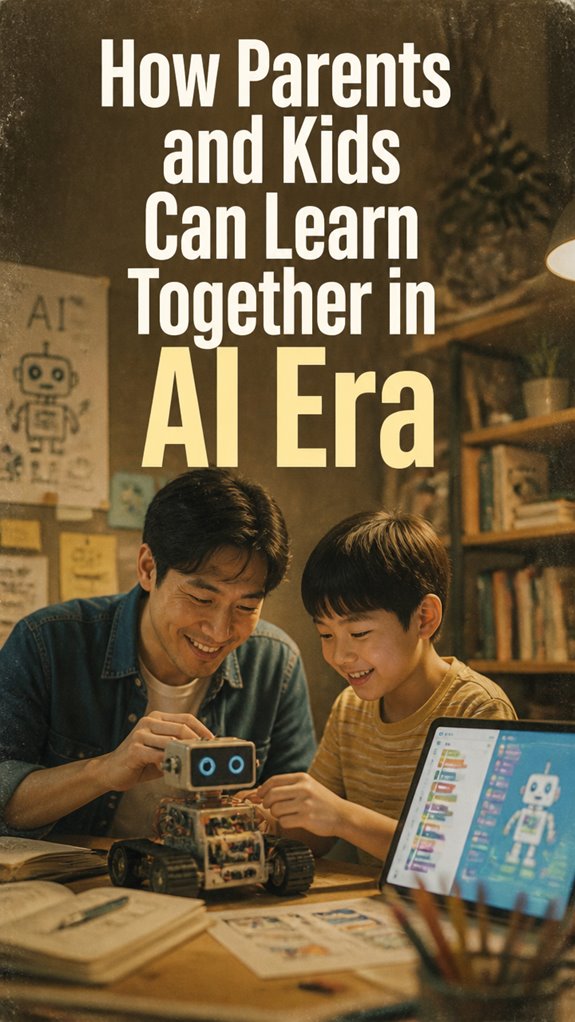
I’ll never forget when my ten-year-old explained cookies to her grandmother using only household items. That’s when I realized learning happens through play, not lectures. We built a mock social media platform from cardboard, making visible what usually stays invisible behind screens.
Building Routines That Stick
Establish weekly maker sessions where family members prototype solutions together. This transforms passive screen consumption into active problem-solving. Simple activities like creating digital journals or coding simple games develop skills gradually while maintaining genuine connection and shared discovery.
Quick Takeaways
- Engage in joint AI projects, games, and experiments to foster hands-on learning and mutual curiosity.
- Establish open dialogue about digital ethics, privacy, and AI technology to build understanding and trust.
- Incorporate age-appropriate discussions and activities that develop critical thinking and media literacy skills.
- Create a family learning routine that emphasizes continuous growth, adaptability, and shared exploration of new AI tools.
- Support and motivate each other’s interests and challenges to build resilience and a collaborative learning environment.
How Can Families Use AI Safely and Effectively?
Many parents worry about how to keep their children safe in a world increasingly shaped by AI, and that’s a natural concern. To use AI safely and effectively, focus on data privacy and ethical considerations.
Parents’ main concern: keeping children safe as AI shapes our future through privacy and ethics.
Teach your children to be cautious about sharing personal information online, emphasizing the importance of privacy. Explain that responsible AI use means understanding how data is collected and used, helping them develop a sense of digital responsibility. Having calm discussions about AI fears can help address anxieties and build confidence in navigating this landscape together.
Instead of fearing AI, see it as a tool for growth—an amplifier for their skills. Build routines around respectful, ethical AI interactions, guiding them toward critical thinking and integrity.
This approach not only protects their future but also fosters long-term mastery of AI as a positive, responsible partner in learning.
Setting Up Practical AI Rules for Your Family
Creating practical AI rules for your family helps build a foundation of trust and responsible use, which is essential for your child’s future. Establish clear guidelines around AI ethics and privacy boundaries to foster safe exploration.
These rules help children understand the importance of respecting others’ data and the risks of oversharing online. Focus on teaching your kids that AI is a tool for enhancement, not a substitute for judgment or empathy.
Set boundaries that limit screen time while encouraging intentional use of AI for learning and creativity. Regularly review and update these rules to match your child’s growth and the shifting technological environment. Understanding digital safety fundamentals ensures your family stays protected as AI technology continues to evolve.
In doing so, you empower your child to navigate AI thoughtfully and confidently, shaping their future with awareness and responsibility.
Age-Appropriate Strategies for Parent-Child AI Learning
As children grow, their understanding of AI should evolve alongside their developing minds, grounding them in skills that match their age and curiosity. Generational collaboration becomes essential, allowing you to learn together and shape ethical considerations from the start.
Instead of shielding children from technology, focus on age-appropriate exposure that builds confidence and responsibility. For younger kids, introduce simple concepts like responsible data use or fairness in algorithms through games and storytelling.
For older children, engage in discussions about AI’s societal impacts, emphasizing ethical decision-making. This approach helps children view AI as a tool for positive change, while you stay connected and informed. Building future-ready skills ensures children develop the capabilities they’ll need to thrive in an increasingly AI-driven world.
Building Critical Thinking and Fact-Checking Skills With AI

Building critical thinking and fact-checking skills with AI might seem intimidating at first, especially when faced with the vast tide of information online. But it’s about building media literacy and cognitive resilience. Understanding how others interpret information can also help children recognize different perspectives and emotional responses to content they encounter.
You can guide your child to question sources, assess credibility, and recognize bias in digital content.
- Encourage them to cross-check facts using multiple reputable sources.
- Teach them to identify signs of unreliable information, like sensational headlines or lack of citations.
- Use AI tools together to analyze data and differentiate fact from opinion.
- Foster discussions that challenge assumptions, helping your child develop independent judgment.
Cultivating Curiosity and a Growth Mindset Together
Have you ever wondered how to nurture your child’s natural curiosity while also helping them develop resilience in facing challenges? Parent empowerment comes from engaging in shared exploration—learning side by side creates a safe space for curiosity to flourish.
Instead of offering quick answers, ask questions that prompt your child to think deeply and explore possibilities. Emphasize a growth mindset by praising effort and persistence, framing setbacks as opportunities to learn.
This approach helps children see challenges as normal parts of growth, fostering resilience. Keep in mind, your role isn’t to control the learning process but to guide, encouraging ongoing discovery. By developing these skills together, you’re preparing your child to thrive in roles that require human-centered abilities like critical thinking and adaptability—qualities that contribute to jobs resilient to AI disruption.
Over time, this shared exploration cultivates curiosity, builds confidence, and aligns with their long-term ability to adapt and thrive in a changing world.
Percentage of Joint Learning Activities
Understanding how often parents and children engage in joint learning activities can provide valuable insight into their development and future readiness. It’s not about perfection but about creating consistent opportunities for collaborative projects and joint problem solving.
Regular joint learning activities strengthen development and prepare children for future challenges.
Regular engagement, like attending school events or participating in extracurricular activities, fosters essential skills for the AI era—adaptability, critical thinking, and resilience. When parents and children work together on creative projects, they shift from passive consumption to active maker mindset, building confidence in their ability to solve complex problems. Most parents report that children participate in activities to enrich their learning experiences beyond the classroom.
- About 83% of students have parents attending meetings, setting a foundation for shared learning.
- Roughly 36% involve children in tutoring or academic prep, emphasizing collaborative skill development.
- Over 50% of children participate in sports or arts, where joint problem solving builds teamwork.
- Family involvement in community events (up to 44%) enhances cultural awareness and social skills.
Consistent participation nurtures your child’s long-term capability, reinforcing a stable, adaptable foundation for the future.
Addressing Engagement and Motivation

When children are engaged and motivated, they’re more likely to thrive in a world that’s constantly changing. Motivation strategies like personalized content and real-world relevance make learning more meaningful.
When kids see how lessons connect to their interests—like space for space lovers—they feel more intrinsic motivation.
Engagement techniques, such as giving them autonomy over topics or pacing, foster a sense of control and persistence.
Studies from organizations like Stanford show that high-quality feedback boosts motivation and confidence, leading to better learning outcomes.
The key is to create an environment that satisfies children’s needs for relevance, autonomy, and growth. Developing critical thinking skills helps children evaluate information and make thoughtful decisions in their learning journey.
Family Learning System Toolkit
Creating a family learning system begins with building a toolkit that supports ongoing growth, rather than relying solely on fixed routines or one-size-fits-all approaches. Your toolkit should foster intergenerational conversations, helping both adults and kids share viewpoints and learn from each other.
Focus on developing emotional resilience, so your child can handle setbacks and uncertainty confidently. By embracing adaptive education paths, you allow your family to respond to each member’s evolving learning needs rather than following a predetermined curriculum.
- Curate shared learning experiences that encourage open dialogue
- Use reflective questions to strengthen resilience and understanding
- Incorporate diverse perspectives to expand thinking
- Regularly review and adapt your approach based on your child’s developing strengths and needs
This toolkit isn’t just about information; it’s about building a connected system that nurtures independence and adaptability—key skills for the future.
You’re shaping resilient, future-ready children through thoughtful, continuous engagement.
The Adaptive Atlas Learning Stack Model
Have you ever wondered how children can keep learning effectively in a world where knowledge is constantly changing? The Adaptive Atlas Learning Stack Model helps you do just that. It emphasizes personalized learning, tailoring growth to each child’s strengths, fostering cognitive resilience.
This means your child becomes adaptable, able to handle uncertainty and setbacks without losing confidence. Instead of relying solely on memorization, it encourages self-directed learning, where kids become active explorers of their knowledge. Schools often fail to teach critical AI literacy, which leaves students unprepared for understanding how artificial intelligence will shape their future careers and decision-making.
The Adaptive Atlas Framework
Five connected systems designed to help parents raise adaptable, future-ready children in a world shaped by AI, automation, and constant change.
| 🛡️ |
Anti-Fragile Child SystemBuilds resilience, adaptability, and the ability to handle uncertainty without shutting down. |
| 📚 |
Learning Stack ModelDevelops self-directed learning habits and continuous skill acquisition beyond school systems. |
| 🚀 |
Future Skill Stack SystemFocuses on high-value human skills that remain relevant in an AI-driven economy. |
| 🤖 |
AI Learning SystemTeaches children how to use AI as a thinking partner instead of becoming dependent on it. |
| 🧭 |
Child Type Navigator SystemPersonalizes learning and development based on each child’s strengths and personality. |
FAQ
How Can Parents Model Responsible AI Use for Their Children?
You model responsible AI use by demonstrating ethical usage and privacy awareness, actively discussing AI’s implications, practicing transparency, and showing how to balance innovation with moral considerations, fostering mastery in your children for steering AI responsibly.
What Are Signs of Over-Reliance on AI in Family Learning?
Like a boat drifting off course, over-reliance on AI leads to signs of dependency, such as technology fatigue and diminished critical thinking. Recognize disengagement, reduced problem-solving, and passive learning as indicators of too much AI dependence.
How Do We Adapt AI Activities for Children With Different Learning Styles?
You tailor AI activities by leveraging personalized learning to match each child’s learning style, fostering creative exploration. This approach empowers mastery, encourages diverse problem-solving methods, and cultivates confident, adaptable learners who thrive amid continuous technological evolution.
What Role Should Emotional Intelligence Play in Ai-Facilitated Learning?
Like a compass guiding ships through fog, emotional intelligence anchors AI learning journeys. You must cultivate emotional awareness and social skills, enabling mastery of interactions, fostering resilience, empathy, and authentic connections that elevate both your child’s and your own growth.
How Can Families Incorporate AI Into Daily Routines Without Feeling Overwhelmed?
You can master AI integration by establishing family routines that promote seamless AI use, fostering collaboration, setting clear boundaries, and focusing on intentional engagement to prevent overwhelm, ensuring everyone benefits from the transformative potential of AI in daily life.
References
- https://educateempowerkids.org/wp-content/uploads/2026/01/EEK-AI-Guide.pdf
- https://www.aiparenttech.com/p/what-research-tells-us-about-ai-kids-families
- https://www.youtube.com/watch?v=EKQ0le-ABLY
- https://www.youtube.com/watch?v=WgVmYiIKgN8
- https://www.starkravingdadblog.com/what-every-parent-must-know-about-the-ai-generation/
- https://nces.ed.gov/pubs2024/2024113_Summary.pdf
- https://www.pewresearch.org/social-trends/2015/12/17/5-childrens-extracurricular-activities/
- https://pmc.ncbi.nlm.nih.gov/articles/PMC7507646/
- https://www.mdrc.org/work/publications/impact-family-involvement-education-children-ages-3-8
- https://pmc.ncbi.nlm.nih.gov/articles/PMC2973328/