What if grades are actually hiding how your kid truly learns? They are. Ditching test scores as your primary metric reveals how your child processes information, their curiosity patterns, and problem-solving approach instead.
Why We Built Adaptive Atlas
My daughter bombed a math test despite understanding concepts perfectly. She froze under pressure. That moment cracked open my entire philosophy about learning. I watched her spiral from “I’m stupid” to discovering she processes information through movement and conversation, not written exams. We started experimenting with self-directed feedback loops using tools like AI to expose blind spots without creating reliance. Carol Dweck’s research confirmed what we experienced: growth emerges through reflection and peer collaboration, never from scores. That’s why we created Adaptive Atlas. We needed a system that measures *how* kids learn, not what they regurgitate. The meta-skills transfer everywhere. Across subjects. Into life.
The Moment Learning Clicked
Last week, my son designed his own feedback system using voice notes instead of worksheets. He caught his own pattern: rushing through problems before reading fully. No teacher intervention needed. Just awareness. That shift from passive grading to active metacognition rewired everything.
Quick Takeaways
- Diagnose each child’s learning patterns and processing style to tailor support and leverage individual strengths effectively.
- Design environments where learners direct their own discovery, using mistakes as valuable feedback for growth and independence.
- Build self-assessment skills so children evaluate progress internally rather than relying on external grades and validation.
- Connect learning across subjects through reflection and collaboration to strengthen neural pathways and deepen understanding.
- Foster curiosity-driven exploration supported by parents to boost intrinsic motivation and create self-sustaining learners.
Diagnose Your Child’s Learning Pattern to Design the Right System
Before you can build a learning system that actually works, you need to understand how your child thinks—not what they know, but how they process information, respond to challenge, and naturally gravitate toward problems.
Understanding how your child thinks—their processing style, challenge response, and problem-solving approach—is your foundation for effective learning systems.
This diagnostic step is your foundation for effective parenting strategies that stick.
Some kids learn by doing. Others need to understand the why first. Some thrive under pressure; others freeze. These aren’t personality quirks—they’re learning patterns that determine which motivation techniques will actually land. Modern learning strategies recognize that understanding these individual patterns is the key to unlocking better academic results.
Start observing without judgment. Watch how your child tackles something unfamiliar. Do they rush in or hesitate? Do they ask questions or experiment? Do they give up quickly or push through frustration?
This pattern is gold. It tells you how to structure challenges, calibrate support, and design systems that amplify their natural strengths rather than fighting them.
Just as you’d help a child clean up their digital footprint to remove past mistakes and present their best self online, this diagnostic process helps you clear away assumptions and build on what’s actually true about your child.
Build Self-Directed Feedback Loops That Make External Grades Irrelevant
The moment your child stops asking “Did I get it right?” and starts asking “How do I know if this is working?” they’ve crossed a threshold most education systems never reach.
External grades create a dangerous feedback loop. They outsource your child’s judgment to someone else, triggering motivation psychology that rewards compliance over competence. Your child becomes dependent on external validation and vulnerable to cognitive biases like learned helplessness when feedback feels arbitrary.
Self-directed feedback loops flip this. Your child learns to measure progress against their own standards: Can they explain it? Can they apply it? Can they spot their own mistakes?
This isn’t about removing accountability. It’s about building internal calibration. When your child owns their feedback system, grades become irrelevant because they already know what they’ve mastered.
That’s the foundation of lifelong learning and genuine confidence in an unpredictable future.
Integrate AI as a Feedback Tool Within Your Learning System
Feedback mastery means using AI to reveal blind spots, not replace judgment. When your child submits work to an AI tool and receives detailed critique, they’re outsourcing analysis while retaining decision-making power.
This builds confidence because they’re directing the tool, not depending on it.
The practical shift: AI becomes their external feedback loop when internal systems need calibration. They stay in control. They learn faster. They compound capability without surrendering independence.
Neuroscience of Skill Transfer
When your child learns to code, then applies that logical thinking to writing an essay, their brain isn’t starting from scratch—it’s recognizing patterns and reusing neural pathways. This is neural plasticity in action—your child’s brain physically reorganizes itself as skills build and connect.
Researchers like neuroscientist James Zull have shown that skills transfer most effectively when you build cognitive scaffolding: deliberate structures that help one capability strengthen another. Productive failure plays a crucial role in this process—when children make mistakes and work through them, their brains strengthen the very pathways that enable flexible skill application.
Your role isn’t to teach isolated subjects. Instead, you’re connecting domains so your child sees logic in programming, writing, and problem-solving as the same underlying ability. This compounds over time.
When skills interlock, learning accelerates and becomes more resilient. Your child doesn’t just gain knowledge—they build an adaptable foundation that transfers across circumstances.
In an era where AI-driven distractions threaten to make children more sedentary, active learning systems that require physical and mental engagement become even more crucial for developing transferable skills.
Metacognition and Adaptive Learning

Meta awareness means your child can observe their own thinking patterns. They notice what strategies work, what doesn’t, and why.
Cognitive reflection—stepping back to examine their process—builds the self-correction muscle that transforms struggle into growth.
This matters because AI and automation will eliminate static knowledge, but they can’t eliminate thinking about thinking.
Children who regularly ask themselves “What worked here? Why did I fail? What would I do differently?” stay adaptable.
You’re not building perfect learners. You’re building learners who get better at learning itself.
That compounds over a lifetime.
When kids eventually share their insights or creative work online, teaching them safe online publishing practices from the start protects both their ideas and their wellbeing.
Siloed Knowledge Blocking Transfer
Siloed knowledge traps kids in isolated facts that don’t connect, blocking their ability to apply what they’ve learned across real problems. You see knowledge silos everywhere in traditional schooling—math drills that never touch real-world finance, history dates detached from decision-making. These create transfer barriers, where kids can’t wield what they know in new situations.
Parents fear this leaves children powerless in a changing world. Reframe it: you control this by building connected systems now. Researchers like E.D. Hirsch show true power comes from linking ideas into networks, not rote lists. To guide kids toward future-ready capabilities, parents must prioritize skills that flex across domains rather than narrow specializations.
Design your child’s learning as an integrated web—blend subjects through projects that demand cross-application. This equips them to adapt skills fluidly, turning knowledge into lifelong leverage. You’ll raise thinkers who dominate ambiguity, not memorize trivia.
Learning System Builder Toolkit
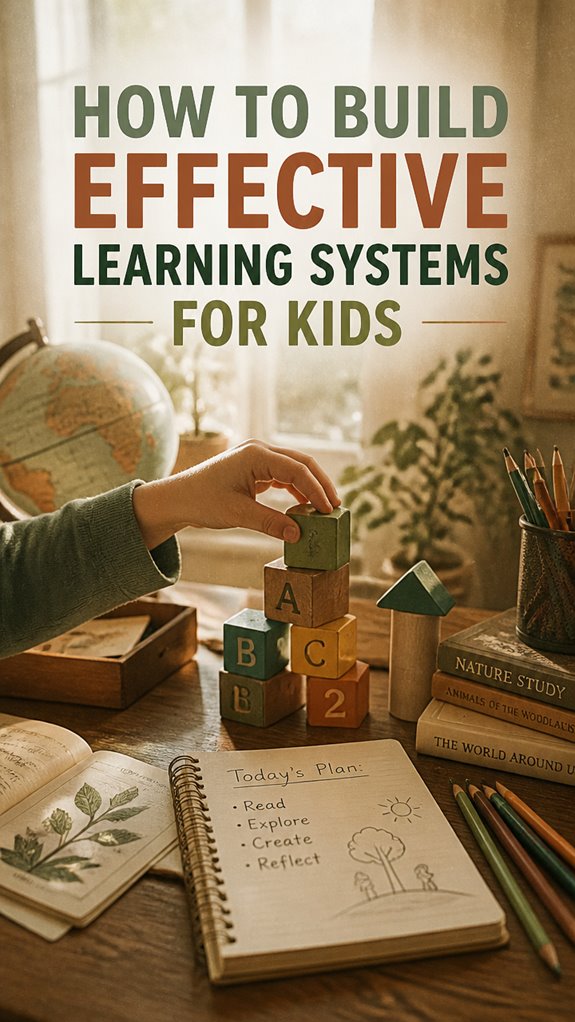
You’ve broken the silos—now you need the architecture to hold them together. Think of your toolkit as three connected pieces: a learning journal where your child documents what they’ve learned and how it connects across subjects, a weekly reflection practice that builds emotional resilience by normalizing setbacks as data, and collaborative learning partnerships where your child teaches others what they’ve mastered.
This isn’t complicated.
Your child writes down one idea from math, one from history, one from their project—then finds the pattern linking them.
A Family Learning System creates the structure for parents and kids to learn together effectively, transforming individual activities into shared discovery.
They review what frustrated them and what they learned from it.
They explain their thinking to a peer.
Researcher Carol Dweck’s work on growth mindset confirms this: systems that connect learning to reflection and collaboration compound faster than isolated instruction ever will.
You’re not adding complexity. You’re building the connective tissue that makes everything stick.
Just as creative thinking thrives when parents provide encouragement and support throughout the process, your child’s learning system grows stronger when you nurture their curiosity rather than simply direct it.
The Adaptive Atlas Learning Stack Model
Learning doesn’t happen in isolation—it happens when your child develops a system that lets them acquire, integrate, and apply knowledge across different domains. The Learning Stack Model builds intrinsic motivation by letting kids direct their own exploration rather than passively receiving information. This framework represents layered cognitive development, where each level of understanding supports and strengthens the next.
Learning thrives when children direct their own exploration across domains, building intrinsic motivation and independent thinking.
Your role shifts from instructor to architect: you design environments where collaborative learning happens naturally, where mistakes become feedback loops, and where curiosity drives progress.
This isn’t about covering more content. It’s about building the meta-skill of learning itself—the ability to identify gaps, find resources, and synthesize understanding independently.
When your child owns this process, they stop depending on grades or external validation. They become self-sustaining learners capable of acquiring any skill the future demands.
Breaking lessons into structured micro learning sessions at home helps children absorb complex concepts without overwhelming their attention spans.
The Adaptive Atlas Framework
Five connected systems designed to help parents raise adaptable, future-ready children in a world shaped by AI, automation, and constant change.
| 🛡️ |
Anti-Fragile Child SystemBuilds resilience, adaptability, and the ability to handle uncertainty without shutting down. |
| 📚 |
Learning Stack ModelDevelops self-directed learning habits and continuous skill acquisition beyond school systems. |
| 🚀 |
Future Skill Stack SystemFocuses on high-value human skills that remain relevant in an AI-driven economy. |
| 🤖 |
AI Learning SystemTeaches children how to use AI as a thinking partner instead of becoming dependent on it. |
| 🧭 |
Child Type Navigator SystemPersonalizes learning and development based on each child’s strengths and personality. |
FAQ
How Do I Know When My Child’s Learning System Needs Adjustment or Complete Redesign?
Watch for declining learning motivation and reduced parental involvement—these signal misalignment.
You’ll notice resistance to challenges, passive consumption instead of active problem-solving, or your child avoiding feedback.
Redesign when curiosity flatlines or effort becomes coercive.
The system needs adjustment if your child can’t transfer skills across environments or relies entirely on external instruction.
Trust these signals. They reveal whether your framework builds capability or merely manages compliance.
What’s the Difference Between Learning Fast and Learning in a Way That Actually Compounds?
Learning fast means you’re consuming information; learning that compounds means you’re building capability.
Research shows 70% of what people learn in isolation disappears within weeks—but skills integrated across multiple environments stick.
You’re choosing between speed vs. depth, immediate vs. long-term.
Your child’s advantage comes from connecting ideas, applying them repeatedly, and letting understanding deepen over time.
That’s what creates real leverage.
How Can I Prevent My Child From Becoming Dependent on AI as a Cognitive Crutch?
You build cognitive independence by creating friction.
Before your child uses AI, they work through the problem themselves—struggle, fail, iterate.
AI then becomes a verification tool or thinking partner, not a shortcut.
This mirrors how expert musicians practice without auto-tune first.
The dependency risk isn’t AI itself; it’s skipping struggle.
You’re not limiting tools; you’re sequencing them.
Problem-solving comes before amplification.
That’s how capability compounds.
Should I Intervene When My Child Struggles, or Let the System Teach Through Failure?
Intervene strategically, not reflexively. Your child needs emotional support during struggle—not rescue. Show her you believe she’ll solve it.
Offer motivation strategies like breaking problems into smaller steps, then step back. This builds resilience.
Research on growth mindset shows struggle activates learning. Your role isn’t preventing failure; it’s ensuring she knows failure doesn’t define her capability. That distinction shapes her entire future.
How Do I Measure Learning Progress if Traditional Grades Become Irrelevant in Our System?
You’ll track capability growth through alternative assessment: project completion, skill demonstration, problem-solving quality, and independent learning velocity. Measure holistic development across thinking, collaboration, and resilience—not test scores.
Document how your child tackles increasingly complex challenges, applies tools independently, and adapts strategy when stuck. This reveals actual future-readiness.
You’re building leverage, not compliance. That shift in measurement transforms how you parent.