How Do Kids Actually Learn Faster in an AI World?
Not by drowning in information. Kids accelerate through self-correcting feedback loops that turn struggle into skill. Grades and hand-holding? Outdated. They need spaces where curiosity sparks questions, experiments unlock patterns, and AI enhances thinking rather than doing the thinking for them.
Why We Built Adaptive Atlas
I watched my nephew spend hours memorizing facts he’d forget by next week. Then something shifted. He started solving real problems across different contexts, spacing his practice strategically, building mental models that stuck. That’s when I realized: traditional learning isn’t broken, it’s incomplete.
We created Adaptive Atlas because kids deserve learning environments that match how their brains actually work. Not faster consumption. Smarter adaptation.
A Moment That Changed Everything
Last summer, my daughter struggled with math until she started applying equations to her garden project. Real stakes. Real relevance. She connected dots traditional worksheets never showed her. That’s when adaptive thinking clicked. She wasn’t just solving problems anymore. She was thinking like a problem-solver. The difference? Everything.
Quick Takeaways
- Use AI as a cognitive partner to test ideas and explore concepts faster while maintaining critical thinking and human judgment.
- Master foundational skills early through deliberate practice and spaced repetition to build mental models for accelerated future learning.
- Develop self-directed feedback loops by reflecting on what works, enabling children to become independent evaluators and problem-solvers.
- Combine digital literacy with hands-on project-based learning across multiple contexts to strengthen skill transferability and neural pathways.
- Manage cognitive load by curating intentional information diets, focusing on depth over breadth before advancing to new topics.
What Real Learning Actually Looks Like (And Why Busy Work Isn’t It)
When you watch your child sit through hours of worksheets, multiple-choice tests, and pre-digested information, it’s natural to wonder if they’re actually learning—and that instinct is worth trusting.
True learning isn’t passive consumption. It’s active struggle with meaningful problems that require thinking, not just recall. AI-powered tutoring can help create these meaningful challenges by adapting to your child’s specific needs in real time.
Try this: ask your kid to explain how AI chatbots actually work using only words a 5-year-old would understand. The confusion, the searching for analogies, the “wait, no, let me try again”—that’s the gold.
Real learning happens when your child engages in creative exploration—trying approaches, failing, adjusting, and discovering patterns themselves. This builds emotional resilience alongside capability.
Worksheets feel productive but evaporate quickly.
The difference? One builds thinking. The other builds compliance. In an AI-driven world where information is free, your child’s advantage isn’t what they know—it’s how they think.
That shift changes everything about what learning should actually look like at home and school.
How to Build Feedback Loops That Work Without Grades
You’ve probably noticed that grades tell you almost nothing about how your child actually thinks. Real feedback loops work differently. They’re built on intrinsic motivation—what your child cares about solving—not external scores.
Grades reveal little about how children actually think. Real learning thrives on intrinsic motivation—what they genuinely care about—not external scores.
When your child creates something, ask: What worked? What didn’t? What would you do differently? This develops a growth mindset where failure becomes information, not judgment.
The best feedback is immediate and specific. If she’s coding, she sees the program crash or run. If he’s writing, he knows the argument lands or falls flat. This directness builds self-awareness faster than any report card.
Helping children develop emotional awareness strengthens their ability to recognize when they’re frustrated versus curious, letting them adjust their own learning strategies in real time.
Over time, your child internalizes the feedback loop and becomes their own evaluator. That’s when learning accelerates. They’re no longer chasing grades—they’re chasing mastery.
The Learning Stack: How Children Teach Themselves
Most parents assume their child needs a teacher to learn, but the truth is simpler and more powerful: kids who develop their own learning systems outpace those who rely on instruction alone. Independent learning at home starts with trusting that children are natural meaning-makers when given the right environment.
Child autonomy emerges when you shift from delivering answers to helping them build their own feedback loops. Your role becomes designing the conditions for curiosity cultivation—creating space where questions matter more than correct responses.
When children learn to observe patterns, test ideas, and adjust their approach based on results, they’re not just acquiring information. They’re building a self-correcting system that works whether you’re present or not.
This isn’t about leaving them alone. It’s about strategic withdrawal that builds capability.
Kids who know how to learn independently gain real advantage. They don’t freeze when facing unfamiliar challenges. They iterate, adapt, and improve.
That’s the foundation for thriving in any future.
Just as children must learn to manage their own learning systems, they should also understand the importance of managing how they appear online through practices like online reputation protection that will serve them throughout their digital lives.
Where AI Fits Into Independent Learning
Independent learning builds real capability, but it doesn’t happen in a vacuum—and it shouldn’t. AI collaboration transforms how your child explores new territory.
Rather than replacing their thinking, AI serves as a cognitive partner—a tool that surfaces information, tests ideas, and accelerates independent exploration without doing the thinking for them.
Your child asks AI questions, then questions the answers. They use it to generate options, not to outsource judgment. This distinction matters.
When your child learns to leverage AI while maintaining critical distance, they’re building something far more valuable than knowledge retrieval: they’re developing the ability to think at scale.
The future belongs to those who can partner with intelligent systems while staying in control. That’s not a risk to fear.
That’s the competitive advantage you’re building.
As children develop these AI partnership skills, parents should remain attentive to digital habit correction strategies that ensure technology serves learning rather than creating dependency. Guiding kids toward future-ready skills requires balancing technological fluency with the human judgment that AI cannot replicate.
Practice Across Different Contexts to Compound Skills
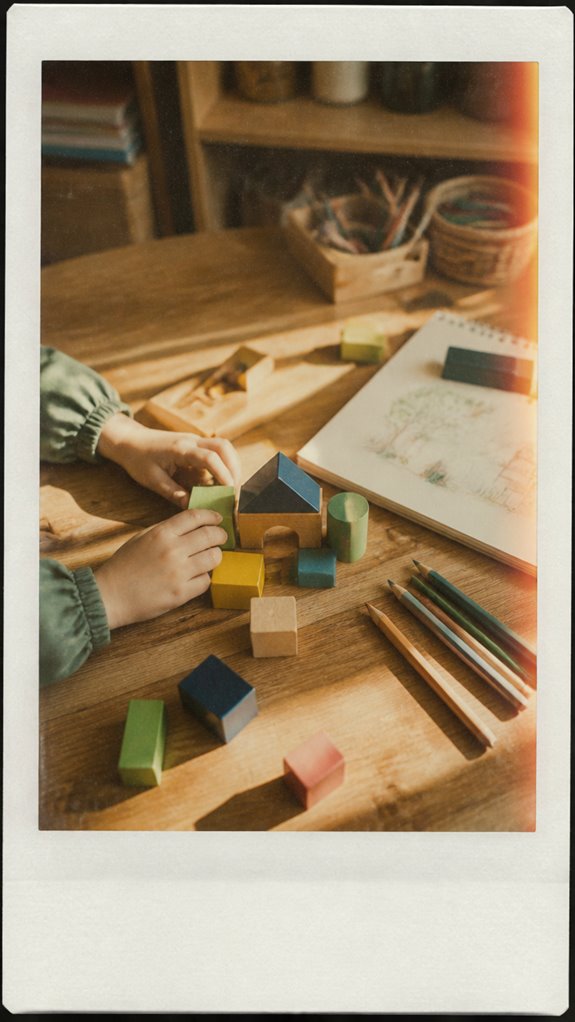
When a skill stays locked in one setting—practiced only in the classroom, or only at home—it remains fragile.
Situational transfer is where real learning happens. You’re building skill reinforcement that sticks because your child practices across multiple environments:
- Writing arguments in essays, then defending ideas in debates, then crafting social media posts.
- Math problem-solving in homework, then budgeting a project, then analyzing data with AI tools.
- Creative thinking in art class, then applying it to coding challenges, then solving real problems.
Each scenario strengthens the underlying capability differently. Your child isn’t just repeating; they’re discovering how the same skill adapts and compounds.
This is what separates fragile knowledge from durable competence. The brain locks in what transfers. When your child sees a skill work across five different scenarios, it becomes part of how they think—not just what they memorized. Unlike passive screen consumption, active cross-context practice builds neural pathways that support lasting cognitive development.
Project-based learning encourages children to explore these multiple contexts through hands-on activities that mirror real-world challenges.
Neuroscience of Cognitive Load
Your child’s brain has a finite bandwidth for processing information at any given moment—and that’s not a limitation to fear, it’s a design principle you can actually work with.
Your child’s brain has finite bandwidth—not a limitation to fear, but a design principle you can work with.
When you overload working memory, learning stalls. Researchers like John Sweller have shown that cognitive scaffolding—breaking complex tasks into manageable layers—protects neurological pathways from overload while they’re still forming.
This means your role isn’t pushing harder, but organizing smarter. Strip away distractions. Sequence skills logically. Let mastery compound gradually. Early specialization in foundational areas creates the mental models that accelerate future learning rather than forcing premature expertise.
Starting early with digital work skills equips children with the cognitive frameworks they’ll need for an AI-driven economy.
When you respect how your child’s brain actually processes information, you’re not slowing them down—you’re building stronger neural foundations for faster learning later. That’s the leverage that matters.
Spaced Repetition Enhances Retention
Forgetting isn’t a failure of your child’s brain—it’s actually how it functions, and there’s science backing a counterintuitive strategy to harness it. Psychologist Hermann Ebbinghaus discovered that spacing out review sessions dramatically improves memory reinforcement compared to cramming. Your child’s brain strengthens neural pathways when retrieval requires effort. Combining multiple competencies through diverse skills creates powerful advantages that complement memory techniques.
Here’s how spaced repetition builds knowledge retention:
- Day 1: Learn a concept with full attention
- Day 3: Review and retrieve from memory
- Week 2: Challenge recall again with slightly harder application
- Month 1: Test mastery through problem-solving
This pattern mirrors how AI systems optimize—through repeated refinement. When your child spaces practice intentionally, she’s not studying harder; she’s studying smarter.
This builds durable capability rather than temporary performance. Over time, spaced learning compounds into genuine expertise that transfers across situations, giving her real advantage in an AI-driven world. Building strong problem-solving skills equips children with adaptable capabilities that remain valuable even as technology continues to transform the workplace.
Overwhelm From Information Overload
In a world where information flows constantly—from educational platforms to social media to AI assistants—your child faces a fundamentally different challenge than previous generations: not scarcity of knowledge, but paralysis from abundance.
This isn’t failure. It’s a signal that your child needs better attention management strategies, not more discipline. The problem isn’t their capacity to learn—it’s the architecture of what they’re consuming. Practical routines help structure this architecture into manageable, intentional learning sessions rather than chaotic consumption.
Start by narrowing focus. One quality source beats ten scattered ones. Help your child build memory strategies around depth rather than breadth: mastering one concept fully before moving forward compounds far more than surface-level exposure across dozens.
Your role? Design their information diet deliberately. Filter noise early. This teaches them that learning faster means learning smarter, not consuming more. That’s leverage.
Crucially, cultivating an optimistic mindset helps children transform information overwhelm into curiosity rather than anxiety, turning the abundance from a threat into an opportunity for growth.
Fast Learning Techniques for Kids

Speed in learning isn’t about cramming more information into less time—it’s about matching how your child learns to how their brain actually retains and applies knowledge. Real fast learning combines three elements:
- Spaced repetition with application – review material at increasing intervals while using it to solve real problems
- Creativity stimulation through exploration – let your child experiment, make mistakes, and discover patterns independently
- Emotional resilience during struggle – normalize difficulty as part of learning, not a sign of failure
- Active retrieval over passive review – test recall frequently rather than rereading passively
Your child doesn’t need more content. They need deliberate practice paired with thinking. When learning feels purposeful and connected to something they care about, retention doubles.
Build these habits now, and your child compounds capability faster than peers still trapped in cramming cycles. Teaching meta learning techniques early creates a foundation where children become architects of their own education rather than passive recipients of information. Research shows that broad exploration before specializing builds stronger neural pathways and prevents premature burnout in young learners.
The Adaptive Atlas Learning Stack Model
Those habits you’ve built—spaced repetition, deliberate practice, emotional resilience—they’re the raw ingredients, but they don’t work in isolation. The Adaptive Atlas Learning Stack Model connects them into a system where your child becomes the architect of their own growth.
The raw ingredients of learning work only when connected into a system where your child becomes the architect of their own growth.
This isn’t about cramming faster. It’s about shifting learning frameworks from passive consumption to active feedback loops.
Your child learns to ask better questions, test their understanding in real time, and adjust their approach based on what’s working.
Motivation metrics matter here. When children see tangible progress and understand *why* they’re learning, effort becomes sustainable rather than forced.
They’re building self-directed learners who can acquire any skill when circumstances demand it—without needing external permission or constant instruction.
Just as children naturally absorb cultural diversity through exposure to different traditions and perspectives, neural pathways strengthen when learning environments mirror this organic discovery process.
Parents can extend this approach beyond the classroom by using adaptive learning at home to create personalized environments where children naturally practice these feedback-driven skills.
The Adaptive Atlas Framework
Five connected systems designed to help parents raise adaptable, future-ready children in a world shaped by AI, automation, and constant change.
| 🛡️ |
Anti-Fragile Child SystemBuilds resilience, adaptability, and the ability to handle uncertainty without shutting down. |
| 📚 |
Learning Stack ModelDevelops self-directed learning habits and continuous skill acquisition beyond school systems. |
| 🚀 |
Future Skill Stack SystemFocuses on high-value human skills that remain relevant in an AI-driven economy. |
| 🤖 |
AI Learning SystemTeaches children how to use AI as a thinking partner instead of becoming dependent on it. |
| 🧭 |
Child Type Navigator SystemPersonalizes learning and development based on each child’s strengths and personality. |
FAQ
How Do I Know if My Child Is Actually Learning Versus Just Appearing Busy?
You’ll know your child’s actually learning when they’re solving novel problems independently, not just completing assigned tasks.
Watch for emotional intelligence—how they handle frustration when stuck, then persist through it.
Real learning shows up as questions they generate themselves, not regurgitated answers.
They’re building leverage when they can apply what they’ve learned to unexpected situations.
Busy looks like motion; learning looks like capability that compounds.
When Should I Intervene if My Child Struggles, and When Should I Let Them Struggle?
Struggle’s the muscle-building phase—you’re watching them develop resilience, not just comfort. Intervene when they’re shutting down emotionally, not when they’re frustrated.
Balancing independence means you’re coaching the process, not solving the problem. Let them wrestle with hard things.
That’s where adaptability forms. Your job’s identifying the difference between productive struggle and learned helplessness. One compounds capability; the other erodes it.
How Does My Child’s Personality Type Affect Which Learning Methods Work Best?
Your child’s personality type directly shapes which learning methods stick. Some kids thrive with structure and clear goals; others need autonomy and exploration. Recognize whether your child’s a planner, risk-taker, collaborator, or independent thinker.
Match their natural learning preferences — not against them. This personality adaptation compounds over time, building confidence and faster skill acquisition. You’re not forcing fit; you’re amplifying what already works.
What Skills Should My Child Prioritize Learning That Won’t Become Obsolete?
Your child should prioritize critical thinking, problem framing, and creative synthesis—skills that amplify rather than compete with AI.
A teenager who can identify what question matters most gains leverage no algorithm can replicate.
Focus on AI adaptability: teaching her to collaborate with intelligent tools, evaluate their outputs, and make independent decisions.
These future proof skills compound across every domain she’ll encounter, creating options instead of dependence.
How Can I Tell if My Child Is Becoming Dependent on AI Rather Than Capable?
Watch whether your child can explain their thinking without AI. Can they break down a problem, try solutions independently, then use AI to refine? That’s capability.
If they’re stuck without it, that’s AI reliance. True independence assessment means observing if they generate ideas first, treat AI as a tool after.
You’re building someone who thinks, then amplifies — not someone searching for answers.