How Can Technology Bridge Cultural Understanding for Young Learners?
Today’s children navigate a globally connected landscape, yet many lack genuine exposure to diverse worldviews. AI-powered language apps, virtual storytelling platforms, and global exchange networks transform passive consumption into active cultural exploration, building empathy while reducing stereotypes through authentic representation.
Why Adaptive Atlas Exists (And Why It Matters)
My daughter came home confused about her classmate’s Diwali celebration. Instead of generic explanations, we launched Adaptive Atlas together. Watching her interact with real cultural narratives, guided storytelling, and peer connections revealed something crucial: kids don’t need sanitized content. They need *genuine* stories. That realization sparked our mission to create tools addressing bias concerns while honoring language diversity and lived experiences.
A Moment That Changed Everything
Last spring, my son participated in a cross-cultural pen pal exchange. Within weeks, his stereotypes about a Vietnamese family dissolved into real friendship. He suddenly cared about accurate representation, questioned media portrayals independently, and viewed difference as inherently valuable rather than foreign. That shift crystallized why intentional cultural learning tools matter.
Quick Takeaways
- Use AI-powered simulations and virtual exchanges to allow children to explore diverse cultural perspectives safely.
- Personalize cultural content like stories and music to deepen understanding and preserve heritage.
- Teach kids to recognize and question biases in AI and media for critical media literacy.
- Develop resilience and adaptability skills through reflection and exposure to diverse cultural environments.
- Incorporate mindful, evidence-based learning tools at home that foster curiosity and global awareness.
How Cultural AI Simulations Help Kids See Different Perspectives
Cultural AI simulations provide a safe and engaging way for kids to see the world from different angles. They help children recognize and challenge ethnocentric narratives that often lead to cultural stereotyping.
Many assume that understanding only one outlook is enough, but in today’s interconnected world, flexibility in thinking is critical. These simulations allow kids to explore culturally diverse stories and experiences, fostering empathy and critical thinking. Developing future-ready skills like cultural competency through AI tools prepares children for success in an increasingly globalized workforce.
Understanding multiple perspectives is essential for children to develop empathy and adapt to our interconnected world.
By engaging with varied viewpoints, children learn to question assumptions, reduce bias, and develop a more detailed understanding of global cultures. It’s a practical approach to counteract outdated stereotypes naturally and encourages long-term, adaptable thinking.
This learning builds resilience and prepares kids to navigate an increasingly complex, multicultural world confidently.
Using AI to Personalize Cultural Content and Celebrate Heritage
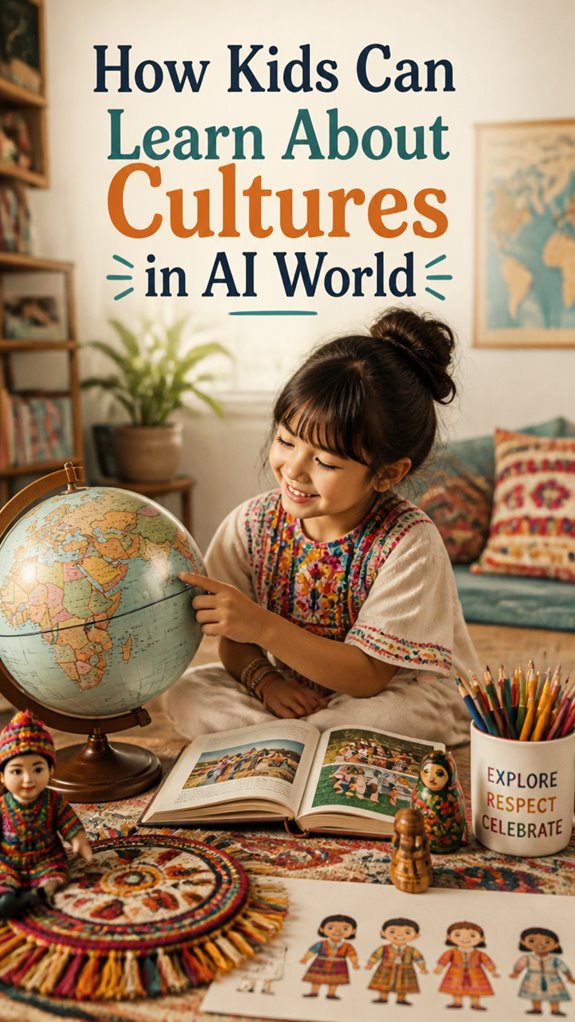
Using AI to personalize cultural content gives your child the chance to connect deeply with their heritage and explore global traditions meaningfully. It supports cultural authenticity by tailoring stories, music, and art to their background, fostering pride and identity. This approach also promotes heritage preservation by keeping traditions alive and relevant in a digital age. When children share their cultural creations online, they should follow safety guidelines for sharing to protect their privacy and personal information.
| Heritage Focus | Personalization Benefits |
|---|---|
| Cultural authenticity | Deepens understanding of roots |
| Heritage preservation | Keeps traditions relevant |
| Individual growth | Builds pride and confidence |
Teaching Kids to Spot and Question Biases in AI Tools
As your child becomes more familiar with digital tools and online content, it’s helpful to teach them how to recognize when algorithms might be showing bias. Understanding concepts like algorithmic fairness helps kids see that AI doesn’t always reflect reality accurately.
Bias mitigation involves identifying unfair patterns and questioning why they exist. Reassure your child that spotting bias isn’t about criticizing technology, but about using critical thinking to engage responsibly.
This skill prepares them for a future where they’ll interact with AI systems daily. By learning to ask questions—such as “Who benefits?” or “What might be missing?”—your child gains confidence in understanding complex systems. Developing media literacy skills empowers children to critically analyze the information they encounter in AI-driven environments.
Developing these skills ensures they’re better equipped to navigate an AI-driven world with awareness, fairness, and agency.
Fun Activities to Build Global Awareness With AI at Home
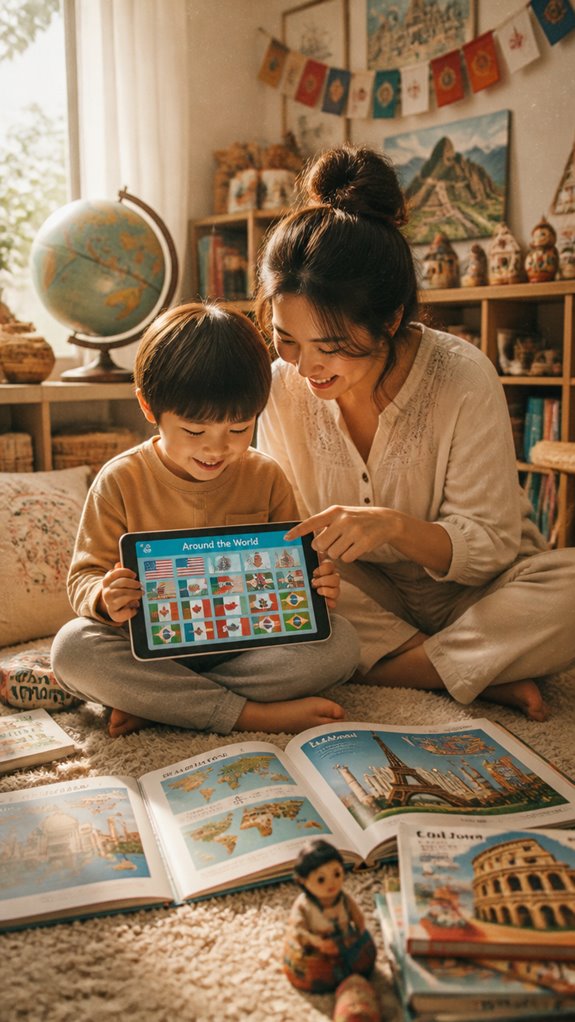
Engaging children with fun activities that promote global awareness helps them build important skills for an uncertain future. One effective approach is to organize cultural exchange activities at home using AI tools.
For example, language learning apps can introduce children to new languages and customs, fostering empathy building and understanding.
You can also explore AI-powered translation platforms to connect your child with peers from different countries via virtual pen pals or digital storytelling.
Watching international films or listening to music together exposes kids to diverse viewpoints, broadening their worldview.
These activities don’t require perfection or global expertise—just a curious mindset and a gentle push towards openness.
Over time, they reinforce that understanding others’ cultures isn’t just about facts, but about cultivating a mindset of respect and adaptability for the future.
Diverse Representation in Media
Media shapes how children see themselves and others, and in today’s world, many voices still lack sufficient representation. Without diverse portrayals, children may develop biased views rooted in cultural stereotypes. When children are exposed to diverse media representations, they develop greater global awareness and empathy, which prepares them to thrive in an increasingly interconnected world.
To foster understanding and belonging, focus on three key points:
- Representation consistency: *Guarantee* children see authentic, varied characters reflecting real-world diversity, not just stereotypes.
- Authentic storytelling: Support media that features multifaceted characters from different backgrounds, avoiding flat or stereotypical roles.
- Behind-the-scenes diversity: Recognize the importance of diverse creators and leaders shaping media content, which leads to more genuine representation.
Language Barriers in Cultural Exchange
Language barriers can seem like insurmountable obstacles in cultural exchange, but understanding how they work helps you manage them effectively. Recognizing language nuances, such as speech speed, accents, or idiomatic expressions, allows children to develop better communication skills and confidence. Utilizing language learning apps and visual communication tools can significantly enhance their ability to comprehend and respond in different languages. Communication obstacles can cause misunderstandings, but with the right tools—like real-time translation apps, visual aids, and cultural sensitivity training—these can be minimized. For your child, the key isn’t just language mastery but also learning to navigate differences with ease. These skills prepare children for a future where diverse cultural interactions are common. Developing media literacy skills empowers children to critically evaluate and understand cultural messages across different languages and platforms. By focusing on systems that support adaptive learning and emotional resilience, you help them build long-term capability—making cultural exchange a meaningful part of their growth, not a barrier to overcome.
Culture Learning Pack for Kids
To truly prepare your child for a future in an interconnected world, it’s helpful to explore tools and resources that make learning about other cultures engaging and accessible. The Culture Learning Pack for Kids is designed to foster cultural adaptability and reflection techniques.
Here are three key features:
- Interactive stories and activities that immerse children in diverse cultural traditions and values.
- Guided reflection exercises that help children process their experiences and develop empathy.
- AI-powered language tools for practicing cultural communication and understanding different viewpoints.
This pack encourages mastery by emphasizing systems over superficial knowledge. It reduces fears of cultural gaps by offering practical, adaptable strategies. By leveraging adaptive learning principles, the pack personalizes content to match each child’s pace and learning style, ensuring deeper cultural understanding.
Developing their ability to reflect and adapt now builds future resilience, ensuring they thrive in a rapidly changing world.
The Adaptive Atlas Learning Stack Model
The Adaptive Atlas Learning Stack Model offers a clear way to think about how children can thrive amid constant change. It emphasizes building skills like cognitive empathy and cultural adaptability, essential for a future filled with diverse interactions.
Instead of fearing rapid shifts, you can focus on developing your child’s capacity to understand others and adjust to new cultural environments. This model encourages systems thinking—seeing learning as interconnected layers that grow together over time—helping children stay resilient and curious.
By fostering adaptability and problem-solving, you prepare them to navigate ambiguity confidently. Research shows that effective learning tools at home significantly enhance children’s ability to develop these critical competencies. Remember, the goal isn’t certainty but mastery of long-term learning.
With a steady, mindful approach, you empower your child to thrive in a world that’s always changing but full of opportunity.
The Adaptive Atlas Framework
Five connected systems designed to help parents raise adaptable, future-ready children in a world shaped by AI, automation, and constant change.
| 🛡️ |
Anti-Fragile Child SystemBuilds resilience, adaptability, and the ability to handle uncertainty without shutting down. |
| 📚 |
Learning Stack ModelDevelops self-directed learning habits and continuous skill acquisition beyond school systems. |
| 🚀 |
Future Skill Stack SystemFocuses on high-value human skills that remain relevant in an AI-driven economy. |
| 🤖 |
AI Learning SystemTeaches children how to use AI as a thinking partner instead of becoming dependent on it. |
| 🧭 |
Child Type Navigator SystemPersonalizes learning and development based on each child’s strengths and personality. |
FAQ
How Can AI Accurately Represent Complex Cultural Nuances?
You can guarantee AI accurately represents complex cultural nuances by integrating diverse cultural expression data, emphasizing identity authenticity, and continuously refining algorithms with authentic feedback. This approach deepens understanding, respects intricacies, and fosters mastery in cultural representation.
What Are the Risks of Cultural Stereotypes in AI Simulations?
You risk reinforcing cultural stereotypes if you lack stereotype awareness, leading to cultural innocence in AI simulations. This can distort perceptions, diminish authenticity, and perpetuate biases, hampering mastery of subtle cultural understanding and responsible AI application.
How Do Children Learn to Discern Genuine Cultural Understanding From AI?
Just like Atticus Finch sought authentic understanding, you guide your child to cultivate cultural empathy through genuine engagement, critically analyzing AI-generated content, and fostering conversations that challenge stereotypes, thereby mastering discernment of authentic cultural perspectives.
Can AI Preserve Endangered Languages and Customs Effectively?
AI can effectively support cultural preservation and language revival by analyzing, archiving, and facilitating interactive learning of endangered customs and languages, empowering you to master and transmit cultural heritage to future generations with precision and adaptability.
What Safeguards Ensure AI Promotes Respectful Cross-Cultural Interactions?
You guarantee AI promotes respectful cross-cultural interactions by prioritizing cultural sensitivity and ethical collaboration. Implement extensive guidelines, ongoing training, and diverse data sources, fostering an environment that values, understands, and respects different cultures through responsible AI development and application.
References
- https://www.washington.edu/news/2025/12/11/ai-training-cultural-values/
- https://www.centerforengagedlearning.org/ai-and-learning-about-cultures/
- https://oxfordlearning.com/9-ways-to-help-kids-navigate-the-world-of-ai/
- https://edinsightscenter.org/beyond-the-algorithm-humanizing-ai-in-culturally-diverse-classrooms/
- https://www.youtube.com/watch?v=xsm5pPjMFIE
- https://pmc.ncbi.nlm.nih.gov/articles/PMC10722251/
- https://hai.stanford.edu/news/how-culture-shapes-what-people-want-ai
- https://www.globalmediajournal.com/open-access/cultural-diversity-in-media-promoting-inclusivity-and-representation.php?aid=94591
- https://mediasmarts.ca/digital-media-literacy/media-issues/diversity-media/representation-diversity-media-overview
- https://www.actionforchildren.org.uk/blog/race-and-ethnicity-representation-in-the-media/