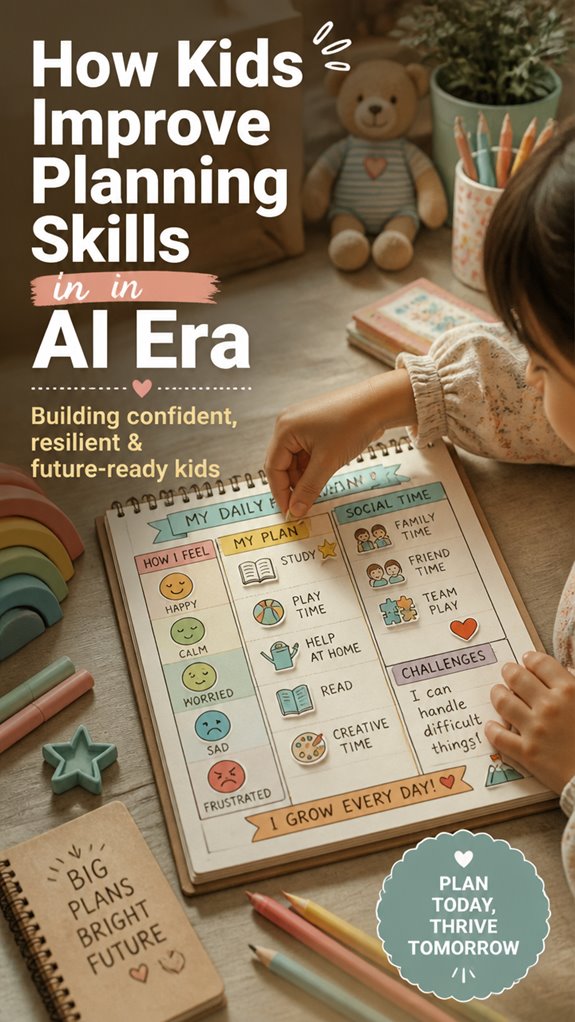
How Do Kids Actually Get Better at Planning When AI Changes Everything?
Planning skills matter now more than ever. In our AI-driven world, children need adaptive thinking and resilience to navigate constant change. The solution? Create environments where mistakes become lessons, not failures. Use project-based tasks and reflection practices. Position AI as a thinking partner, not a replacement for their brain.
Why We Built Adaptive Atlas
My daughter spent three weeks planning a science fair project. She kept restarting, frustrated. Then we used Adaptive Atlas to map her thinking process. Suddenly, she saw her own patterns. She realized overthinking blocked progress. We created Adaptive Atlas because kids deserve tools that reveal how their minds work, not just what they produce.
The Coffee Shop Breakthrough
Last Tuesday, I watched my nephew plan his homework at our kitchen table. Instead of diving in, he sketched his tasks, priorities, and time blocks. No AI. Just structure. That simple act of externalized thinking changed everything. He finished faster and actually retained information. Sometimes the best planning tool is stillness and paper.
Quick Takeaways
- Incorporate AI tools as collaborative thinking partners to practice creative problem-solving and ethical decision-making.
- Create routines and environments that promote goal setting, flexibility, and continuous learning through real-life challenges.
- Use project-based activities to develop planning, obstacle anticipation, and strategic revision skills from an early age.
- Encourage reflection, questioning, and bias detection to foster independent judgment and critical thinking.
- Expose children to complex, unpredictable environments to enhance resilience, mental flexibility, and adaptive planning skills.
How Do Children Develop Planning and Executive Function Skills?
Understanding how children develop planning and executive function skills is essential for helping them succeed in a world that’s constantly changing. You might worry about their ability to adapt, but fostering childhood resilience is key. When children face challenges, they learn to stay calm, recover, and grow stronger.
This resilience supports their creativity development, helping them see new possibilities and solve problems in innovative ways. Instead of focusing only on memorization or fixed skills, you can encourage systems that promote flexible thinking and decision-making. Teaching children about safe online communication practices helps them navigate digital environments confidently while making good decisions about their interactions.
How Can AI Support Kids’ Planning and Problem-Solving Skills?
AI tools are becoming valuable partners in helping kids develop better planning and problem-solving skills. They foster creative collaboration, encouraging children to explore ideas with digital partners, which expands their thinking. AI can prompt kids to make ethical decisions, sharpening their ethical reasoning as they navigate complex situations. These tools reinforce that planning is about adaptability and ongoing learning, not fixed outcomes.
| Embrace Innovation | Maintain Balance |
|---|---|
| Use AI as a thinking partner | Guide children to question AI suggestions |
| Promote experimentation | Encourage shared reflection |
| Focus on ethical choices | Foster independent judgment |
This approach restores your confidence. You’re not losing control; you’re shaping a future where children learn to think critically, work ethically, and confidently navigate uncertainty.
What Strategies Can Parents Use to Boost Children’s Planning Abilities?
To effectively boost your child’s planning skills, focus on creating routines and environments that encourage thoughtful decision-making. This fosters emotional agility—helping your child manage feelings of uncertainty and frustration calmly.
Encourage creative collaboration by involving them in daily choices, like planning activities or solving small problems together. This builds confidence in their decision-making process.
Recollect, children thrive when they see mistakes as learning chances, not failures. Reframing fears around unpredictability into opportunities for growth helps develop resilience and flexible thinking.
As a parent, your calm guidance reinforces long-term systems of stability instead of chasing quick fixes. Building structured thinking habits through consistent practice creates the mental framework children need to organize complex information and tasks effectively.
This approach nurtures adaptable children who can navigate constant change with clarity, aligning with future-ready skills fostered by systems-focused parenting.
How Can We Encourage Reflection and Effort in Learning Beyond Tech Tools?

Fostering reflection and effort in a child’s learning extends beyond tech tools; it’s about creating spaces where children develop internal motivation and self-awareness. Encourage creative experimentation, where kids try new approaches without fear of failure. This builds emotional resilience, helping them bounce back from setbacks and stay engaged. To support this, set aside moments for open-ended questions about their learning process and feelings. Understanding how to guide creative children toward careers that align with their strengths ensures their planning skills serve their long-term aspirations. Use the table below to shape your approach:
| Make Space for | Foster Growth |
|---|---|
| Creative experiments | Emphasize effort, not just results |
| Reflection time | Celebrate resilience and progress |
How to Help Kids Spot Biases and Validate AI Information for Reliable Learning
Have you ever wondered if your child can distinguish between helpful information and misleading messages? Bias detection and information validation are key skills for their future.
In today’s world, where AI can produce vast amounts of data, it’s essential to teach kids how to question what they see and hear.
Help them develop habits of checking sources and asking, “Is this accurate?” or “Could this be biased?”
This isn’t about fears of AI replacing human judgment but about empowering children to navigate information critically. AI tools can also help children refine their writing by providing feedback on clarity and structure as they practice these validation skills.
Encourage curiosity and frame validation as a way to stay curious and independent.
As parents and educators, you can create routines that foster skepticism and curiosity—long-term skills that give kids control over their learning and confidence in their decisions.
Empirical Studies on Adaptive Planning
Are children’s planning skills really developing in ways that prepare them for a changing world? Neuroscience perspectives reveal that children reach key developmental milestones in adaptive planning, enabling them to think ahead and adjust actions. For example, studies show that as kids age, their ability to adapt search depth and goal hierarchy improves, reflecting a maturing mental lookahead. These progressions can be seen clearly across age groups and individual differences, including children with diverse needs like Down syndrome or autism. Implementing project-based learning at home can strengthen these adaptive planning capabilities by requiring children to structure tasks, anticipate obstacles, and revise their strategies.
| Age Group | Planning Skill | Adaptability Level | Key Developmental Milestone |
|---|---|---|---|
| 6-8 | Basic pre-planning | Emerging | Ability to adapt problem-solving |
| 9-13 | Increased search depth | Advanced | Better self-monitoring and goal hierarchy |
| Children with delays | Varied patterns | Predictable predictors | Cognitive abilities and metacognition |
Understanding these patterns helps you foster long-term growth, emphasizing systems over quick fixes.
Identifying Adaptive Problem-Solving Skills

How do you spot adaptive problem-solving skills in your child amid AI’s rise? You see it when they pivot smoothly from dead ends, blending human ingenuity with tech tools. Don’t fear AI outpacing them—reframe it: AI handles rote tasks, freeing your child for high-leverage thinking that shapes their future.
Watch for creative collaboration, where they team up with AI like ChatGPT to brainstorm wild ideas, then refine them independently. Spot decision analysis in how they weigh options under uncertainty, asking “What if?” instead of freezing. Building analytical thinking skills enables children to break down complex problems systematically and identify patterns that AI cannot replicate.
This builds anti-fragile planners, echoing Nassim Taleb’s wisdom: they thrive in chaos. Ditch linear career paths; nurture this system now. Your child gains freedom to navigate any shift, creating value on their terms.
Executive Function Builder Kit for Kids
Building strong executive function skills in children might seem overwhelming amid rapid change, but focusing on a structured, supportive kit can make it manageable. The Executive Function Builder Kit for Kids fosters essential capabilities like creating routines, planning ahead, and adapting to new situations—skills that prepare them for the future.
Fostering executive function skills becomes manageable with a supportive, structured kit that prepares children for future challenges.
It also supports etiquette development, helping children navigate social settings with confidence and respect. Plus, it nurtures creativity by encouraging open-minded thinking and problem framing, empowering children to innovate and explore freely. Research shows that task execution abilities develop significantly when children engage with intentional planning activities and structured routines.
Here’s what the kit offers:
- Clear, simple activities for developing focus and self-control
- Guides for practicing social skills and etiquette
- Tools to spark imagination and creative problem solving
- Strategies tailored to each child’s unique strengths
This kit helps parents build lasting systems that grow with children, turning fears into opportunities for purposeful growth.
Resilience Through Environmental Complexity
Environmental complexity might feel overwhelming at first, but it actually offers a vital opportunity for resilience. In a world full of environmental unpredictability, your child learns to adapt calmly and stay focused. Facing varied challenges builds cognitive resilience—strengthening their ability to recover from setbacks and think clearly under pressure. Rather than viewing complexity as a threat, see it as a system that trains your child’s mind for long-term success. Use these patterns to encourage problem-solving and flexibility. By systematically exposing children to progressively challenging environments, you activate deeper skill development that compounds over time. Rather than viewing complexity as a threat, see it as a system that trains your child’s mind for long-term success.
| Complexity | Resilience |
|---|---|
| Unpredictable environments | Builds mental flexibility |
| Constant change | Enhances problem-solving skills |
| Ambiguous situations | Fosters adaptive thinking |
| Uncertain futures | Develops inner strength |
The Adaptive Atlas Anti-Fragile Child System
Children face a world full of surprises and unpredictable challenges, which can understandably cause parents to worry about resilience. The Adaptive Atlas Anti-Fragile Child System helps kids thrive in this environment by fostering emotional literacy and social negotiation.
Instead of shielding them from difficulty, it teaches them to grow through adversity and uncertainty. By building antifragility, children don’t just survive challenges—they actually improve and strengthen from them.
Encouraging growth through adversity fosters resilience and confidence in navigating life’s uncertainties.
- Develop emotional literacy to understand and regulate their feelings.
- Practice social negotiation to collaborate, adapt, and build trust.
- Embrace failure as a stepping stone, not a setback.
- Cultivate resilience by viewing challenges as opportunities for growth.
This approach shifts focus from control to capability, empowering children to navigate constant change confidently. It’s about building long-term strength that supports flexible thinking and independence—skills essential for their future success.
The Adaptive Atlas Framework
Five connected systems designed to help parents raise adaptable, future-ready children in a world shaped by AI, automation, and constant change.
| 🛡️ |
Anti-Fragile Child SystemBuilds resilience, adaptability, and the ability to handle uncertainty without shutting down. |
| 📚 |
Learning Stack ModelDevelops self-directed learning habits and continuous skill acquisition beyond school systems. |
| 🚀 |
Future Skill Stack SystemFocuses on high-value human skills that remain relevant in an AI-driven economy. |
| 🤖 |
AI Learning SystemTeaches children how to use AI as a thinking partner instead of becoming dependent on it. |
| 🧭 |
Child Type Navigator SystemPersonalizes learning and development based on each child’s strengths and personality. |
FAQ
How Does Fostering Adaptability Influence Long-Term Planning Success in Children?
Fostering adaptability boosts your child’s creativity enhancement and problem solving flexibility, empowering them to navigate a shifting world. By embracing change, they develop resilient long-term planning skills, opening endless opportunities and liberating them from fixed, outdated paths.
What Role Does Emotional Regulation Play in Developing Effective Planning Skills?
You help your child develop emotional awareness and resilience, empowering them to stay grounded during uncertainty. This emotional regulation fosters clear, adaptable thinking, enabling effective planning amid ongoing change and releasing their full potential for future success.
How Can Educators Integrate AI Tools to Enhance Real-World Planning Experiences?
You can harness AI integration to transform planning strategies, offering kids real-world experiences that foster independence and creativity. By empowering them to experiment with AI tools, you liberate their ability to adapt, innovate, and confidently craft future paths.
What Are the Potential Risks of Over-Relying on AI for Children’s Executive Development?
Over-relying on AI risks your child’s cognitive balance, like leaning too heavily on a crutch, which can weaken their independent executive skills. Parental oversight guarantees they grow resilient, adaptable, and free to navigate autonomous decision-making confidently.
How Does Personalized Learning Impact a Child’s Ability to Navigate Unpredictable Environments?
You find that individualized curriculum and learning personalization empower your child to adapt swiftly in unpredictable environments. By tailoring experiences, they develop resilience, innovative thinking, and confidence, freeing them from rigid systems and enabling fluid navigation through constant change.
References
- https://www.theschoolhouse.org/post/ai-role-early-childhood-education
- https://oxfordlearning.com/future-ready-study-skills-how-to-prepare-your-child-for-the-ai-age/
- https://www.voicesforinnovation.org/preparing-our-kids-for-the-ai-era/
- https://www.learningrx.com/reston/how-is-ai-changing-learning-and-what-skills-do-kids-need-most-34/
- https://theempowerededucatoronline.com/2025/10/use-ai-for-play-based-planning.html/
- https://www.gse.harvard.edu/ideas/edcast/24/10/impact-ai-childrens-development
- https://ai.gopubby.com/ai-proof-kids-what-skills-your-child-needs-to-thrive-tomorrow-b341956328e2
- https://www.tandfonline.com/doi/full/10.1080/15248372.2023.2248257
- https://pubmed.ncbi.nlm.nih.gov/35279072/
- https://brightonsa.org/2024/08/05/adaptive-development-skills-in-young-children/