How Can We Challenge Kids Without Breaking Them?
Kids need real-world obstacles to grow, yet parents often freeze when balancing safety with meaningful challenge. The answer lies in structured risk: age-matched tasks with gradual difficulty increases build resilience grounded in growth mindset research.
Why We Built Adaptive Atlas
Last summer, my daughter froze at a rock climbing wall. Not from fear, but from never attempting anything genuinely difficult. That moment sparked something. I realized kids need scaffolded challenges, not bubble wrap. We created Adaptive Atlas because every child deserves guided struggle. Role-playing scenarios and visual risk cues transformed her approach within weeks. She now tackles obstacles with actual confidence, not false bravado.
The Moment Everything Shifted
My son completed his first solo grocery shopping trip yesterday. He made mistakes, asked for help, and learned pricing. Watching him process consequences in real-time, without my intervention, revealed something psychologist Carol Dweck studied extensively: struggle genuinely rewires young brains. That’s where actual capability emerges.
Quick Takeaways
- Design challenges with mindful risks, promoting exploration while minimizing physical danger through safety measures and supervision.
- Use age-appropriate tasks that match children’s developmental levels to build confidence and risk perception gradually.
- Incorporate realistic scenarios and visual cues to teach risk awareness and safe decision-making skills.
- Provide structured reflection and debriefing to help children understand consequences and learn from experiences safely.
- Balance physical, mental, and outdoor activities to reinforce skills and resilience in real-world contexts responsibly.
How to Design Safe, Engaging Activities That Build Critical Thinking
When designing activities for kids, it’s natural to worry about safety and engagement—the foundation for meaningful learning.
Focus on integrating mindful risk into playful exploration. This means creating opportunities where kids face challenges that push their limits without exposing them to real danger.
Incorporate safe, playful risks to help children embrace challenges and grow confidently.
For example, building obstacle courses or solving puzzles encourages critical thinking as they evaluate risks and make decisions.
Research by Stanford’s Dr. Carol Dweck highlights that a growth mindset develops through manageable challenges. When children learn to navigate uncertainty safely, they build resilience and problem-solving skills that matter in an uncertain world. Strategic skill selection helps ensure that the challenges you choose are developmentally appropriate and aligned with your child’s current abilities.
You’re not just keeping them safe—you’re fostering a mindset that sees challenges as opportunities for growth, shaping confident, adaptable thinkers ready for their future.
Using Role-Playing and Visual Cues to Teach Kids Risk Awareness
Using role-playing and visual cues can be powerful tools to teach kids about risk awareness in a way that feels natural and manageable.
You help them develop risk assessment skills by creating scenarios that mimic real-life situations, allowing kids to analyze potential hazards safely. For example, you might simulate crossing a busy street or managing a challenging social interaction, encouraging them to evaluate risks and make decisions.
Visual cues, such as color-coded zones or symbols, reinforce understanding of different risk levels and guide behavior. These methods foster scenario analysis—helping children recognize patterns and consequences without fear. By integrating real-world problem solving into these exercises, kids strengthen their ability to think critically and respond effectively when facing actual challenges.
Incorporating Hands-On Projects to Develop Real-Life Problem-Solving Skills
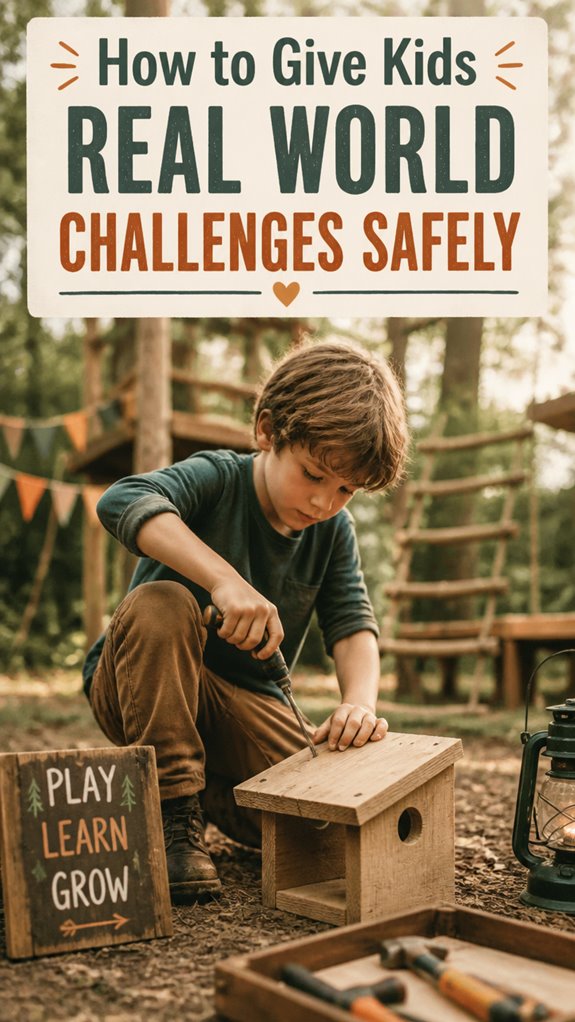
Hands-on projects are a powerful way to help your child develop real-life problem-solving skills that will serve them in an uncertain world. By engaging in projects, they connect theoretical concepts to practical actions, reinforcing their understanding through direct experience. Aligning with contemporary parenting philosophies focused on capability building, these projects shift the emphasis from rote learning to adaptive mastery. Use activities like building, experimenting, or troubleshooting, which foster resilience and critical thinking. For example, a simple engineering challenge teaches children to iterate and refine ideas. These hands-on experiences also help kids adapt to new situations more effectively by building confidence through graduated challenges.
| Theoretical Concepts | Practical Application | Long-Term Value |
|---|---|---|
| Problem framing | Real-world problem | Adaptive thinking |
| Feedback loops | Continuous adjustment | Resilience and growth |
| Systems thinking | Connecting ideas | Future readiness |
Fostering Responsibility and Resilience Through Reflection and Consequences
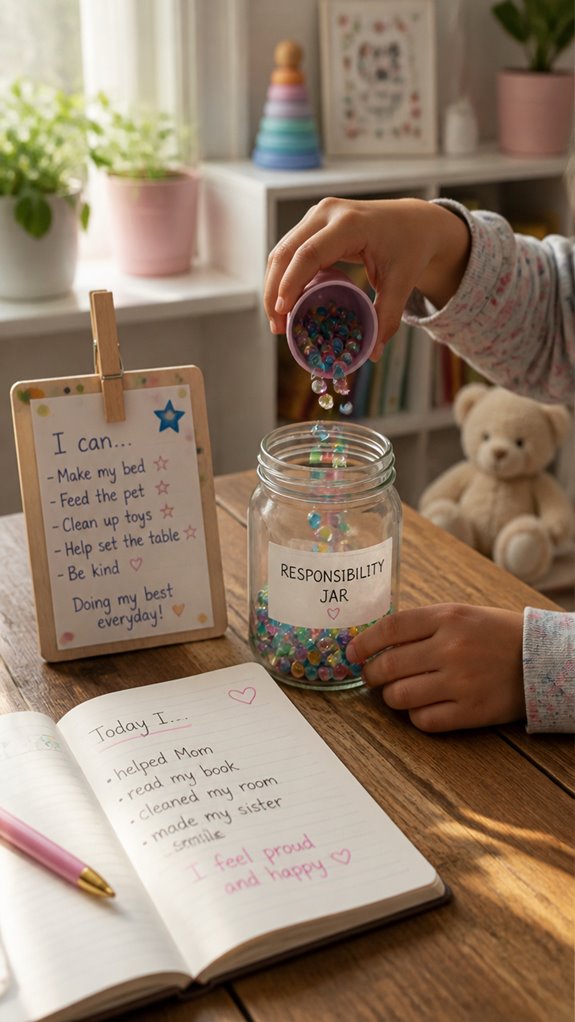
Building responsibility and resilience in children starts with practices that help them reflect on their actions and understand the natural consequences that follow. When kids learn to regulate their emotions, they gain better control during stressful situations, making it easier to face challenges with confidence.
Fostering moral judgment helps them develop a clear sense of right and wrong, guiding their decision-making in complex situations. By encouraging reflection after mistakes, you help children internalize lessons without fear of failure—viewing setbacks as growth opportunities.
When consequences are consistent and fair, children see cause and effect clearly, reinforcing responsible behavior. This approach builds long-term skills that prepare them for a future where adaptability and emotional intelligence are vital, strengthening their ability to navigate an unpredictable world with resilience. As learning environments continue to evolve, adaptive learning methods will play an increasingly important role in helping young people develop the metacognitive skills needed to thrive in changing contexts.
Age-Appropriate Challenge Success Rates
When it comes to helping children develop resilience and confidence, matching challenges to their developmental stage makes a big difference.
Around ages 4-7, children tend to succeed when tasks are appropriate to their skills, building on prior wins rather than focusing solely on accuracy. Success on age-appropriate challenges boosts their risk perception, making them more willing to try harder tasks later. Balancing technology use with hands-on activities helps ensure children develop real-world problem-solving skills alongside digital literacy.
Be aware that peer pressure and fear of failure can influence their choices, but clear scaffolding helps mitigate these concerns. At this age, children are more receptive to gradual difficulty increases, laying a solid foundation for future risk-taking. Research shows that success on difficult tasks increases the likelihood of children attempting even more challenging activities, supporting positive self-evaluation and motivation for future efforts.
Troubleshooting Guidance for Parents
Troubleshooting your child’s challenges can feel intimidating, especially when emotions run high or issues seem complex. To guide them effectively, focus on fostering peer collaboration and emotional regulation. Understanding how working memory functions can help you better support their problem-solving capacity during these challenging moments. Here are three key points:
- Identify the real problem first by asking open-ended questions. Help your child articulate what’s truly bothering them, which builds awareness and decision-making skills for the future.
- Generate multiple solutions together, encouraging creative thinking without judgment. Resisting the urge to fix every problem supports resilience and independence.
- Discuss possible outcomes for each choice, emphasizing reflection and learning from mistakes. Reinforce that setbacks are part of growth, and perseverance leads to mastery.
Real World Challenge Pack for Kids

A real-world challenge pack for kids offers a practical way to help children develop resilience, problem-solving skills, and adaptability—key qualities for a changing future. Incorporating tools like virtual reality lets kids explore complex scenarios safely, building empathy and decision-making.
Ethical dilemmas provide structured opportunities to navigate tough choices, fostering critical thinking about right and wrong. Some parents worry about exposure to digital environments or challenging questions, but these fears can be reframed as opportunities for guided learning. Physical activity and outdoor exploration complement these mental challenges by building confidence through hands-on experiences.
Ethical dilemmas help kids develop critical thinking, turning digital challenges into valuable guided learning experiences.
By setting clear boundaries and debriefing afterward, you help your child process and learn from these experiences. Recall, the goal isn’t to shield them from difficulty but to prepare them to handle real-world complexities confidently and responsibly.
This approach equips your child for a future where agility and ethical awareness matter most.
The Adaptive Atlas Learning Stack Model
The Adaptive Atlas Learning Stack Model offers a practical approach to helping children navigate a world where knowledge is constantly changing. It emphasizes cultivating emotional resilience and addresses overconfidence bias, both essential for long-term growth. Research shows that project-based learning significantly enhances student engagement and retention compared to conventional classroom instruction.
To do this effectively:
- Focus on building emotional resilience, so kids can manage setbacks without losing confidence.
- Encourage habits that challenge overconfidence bias, helping children recognize limits and learn from mistakes.
- Support self-directed learning that adapts to each child’s strengths, ensuring they develop critical thinking and adaptability.
This system isn’t about quick fixes but developing a stable, confident mindset. It gives you a clear framework to guide your child’s future-proof skills, making change a manageable part of growth rather than a source of fear.
The Adaptive Atlas Framework
Five connected systems designed to help parents raise adaptable, future-ready children in a world shaped by AI, automation, and constant change.
| 🛡️ |
Anti-Fragile Child SystemBuilds resilience, adaptability, and the ability to handle uncertainty without shutting down. |
| 📚 |
Learning Stack ModelDevelops self-directed learning habits and continuous skill acquisition beyond school systems. |
| 🚀 |
Future Skill Stack SystemFocuses on high-value human skills that remain relevant in an AI-driven economy. |
| 🤖 |
AI Learning SystemTeaches children how to use AI as a thinking partner instead of becoming dependent on it. |
| 🧭 |
Child Type Navigator SystemPersonalizes learning and development based on each child’s strengths and personality. |
FAQ
How Can I Ensure Challenges Are Tailored to My Child’s Individual Risk Level?
Think of risk assessment as tuning a guitar—adjust challenge difficulty to match your child’s skill. Challenge customization guarantees safe growth, fostering resilience and mastery as they navigate ambiguity confidently without overexposure or overwhelm.
What Signs Indicate a Child Is Overwhelmed or Not Ready for a Challenge?
You’ll notice emotional cues like withdrawal or frustration and physical signs such as tense muscles or fatigue, indicating your child may be overwhelmed or not ready. Pay close attention to these signals to adjust challenges accordingly and foster resilience masterfully.
How Do I Balance Safety Precautions With Encouraging Independence?
You safeguard independence like a lighthouse—balancing supervision strategies with emergency preparedness; set clear boundaries, teach risk management, and empower your child to navigate challenges confidently, knowing you’re ready to guide or intervene when needed.
What Are Effective Ways to Debrief After a Risky Activity?
You should facilitate a risk assessment discussion, review safety guidelines, and encourage your child to reflect on what they learned from the activity. Ask open-ended questions, identify improvements, and reinforce safety as part of their mastery process.
How Can I Gradually Increase Challenge Difficulty Safely Over Time?
Like climbing a gentle hill then steeper slopes, you assess risk and developmental readiness, gradually increasing challenge difficulty, ensuring each step builds confidence, resilience, and mastery—paving a safe ascend into greater skills and independence.
References
- https://www.parentingspecialneeds.org/article/keeping-children-safe-real-world/
- https://www.brighthorizons.com/article/children/helping-children-to-safely-explore-their-world
- https://yourparentingmojo.com/how-to-prepare-children-for-the-real-world/
- https://www.seattlechildrens.org/health-safety/parenting/kids-risky-challenges/
- https://everydayspeech.com/sel-implementation/developing-critical-thinking-problem-solving-scenarios-for-elementary-students/
- https://questschooling.substack.com/p/how-to-connect-your-kids-life-experience
- https://hiphomeschoolmoms.com/how-to-teach-real-world-problem-solving/
- https://www.focusonthefamily.ca/content/preparing-kids-for-the-challenges-of-real-life
- https://www.sciencefocus.com/future-technology/10-cool-projects-created-by-kids-addressing-real-world-problems
- https://www.browndailyherald.com/article/2026/03/children-seek-further-challenges-when-they-succeed-on-difficult-tasks-brown-study-finds