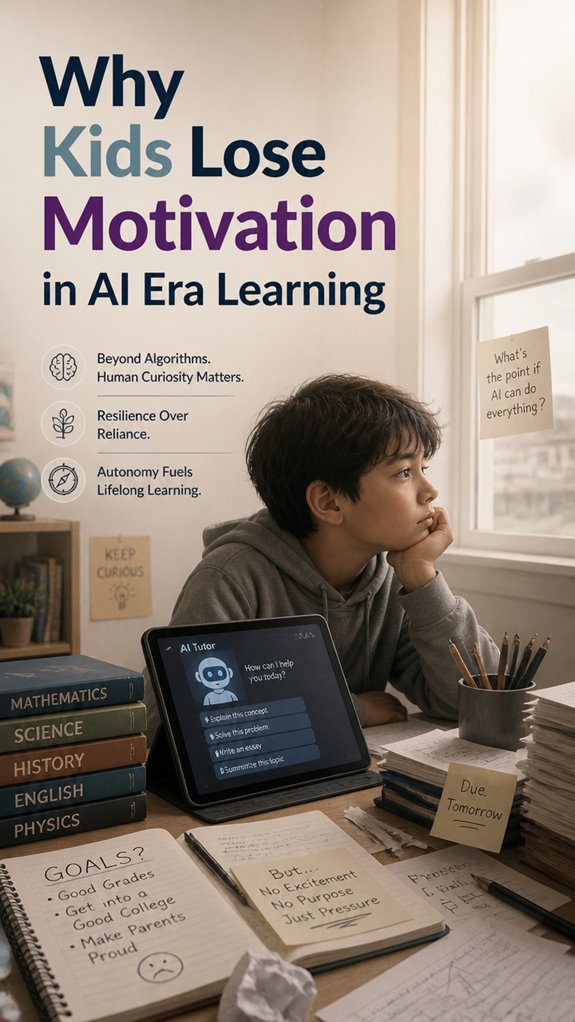

Is Your Child’s Exhaustion Actually a Red Flag About Their Learning Environment?
Yes. Burnout signals misalignment between what schools demand and what your child’s developing brain can handle. Fatigue isn’t weakness; it’s data telling you something needs to shift.
A Moment That Changed How I Saw Rest
My daughter collapsed after school at nine years old. Not dramatically. Just… stopped. No tears, no complaints, just nothing left in the tank. That’s when I realized I’d been treating her schedule like a optimization puzzle instead of a growing human. We started experimenting with what we now champion at Adaptive Atlas: building learning environments that honor how kids actually develop. We created Adaptive Atlas because we got tired of parents choosing between their child’s wellbeing and achievement. You shouldn’t have to pick.
The Rhythm That Actually Works
Last Tuesday, I watched my son refuse homework entirely. Instead of pushing, we built in thirty minutes of nothing. Pure unstructured time. Then he tackled math with genuine focus. That’s when it clicked: rest isn’t a luxury reward. It’s the foundation everything else builds on.
Quick Takeaways
- Recognize early burnout signs like withdrawal from activities, fatigue, and irritability to intervene before exhaustion deepens.
- Build sustainable routines combining focused effort with intentional recovery, including sleep, unstructured play, and screen-free downtime.
- Teach children to view struggle as informational feedback rather than personal failure, building adaptive resilience.
- Shift focus from outcomes and perfectionism toward effort, process, and growth mindset to reduce anxiety-driven avoidance.
- Challenge narrow success definitions by prioritizing emotional intelligence, personal limits, and long-term capability over grades and optimization.
Recognize the Early Warning Signs of Burnout in Your Child
Before burnout becomes a crisis, it usually whispers. You’ll notice your child withdrawing from things they once enjoyed, or their emotional self-awareness shrinking—they can’t name what’s wrong, only that something feels heavy. Watch for persistent fatigue, irritability over small things, or resistance to learning itself, not just difficult subjects.
Burnout whispers before it screams—watch for withdrawal from joy, fatigue, and a heaviness your child can’t quite name.
These signs don’t mean you’ve failed. They signal that the system needs adjustment. Open parent-child communication becomes your diagnostic tool here. Ask without judgment: “What feels hard right now?” Listen for patterns, not isolated complaints.
Burnout isn’t about working hard. It’s about working without recovery, purpose, or autonomy. When children lose control over their own pace and direction, capability erodes. Tools like artificial intelligence can help personalize learning experiences, allowing children to work at their own speed and regain a sense of agency in their educational journey.
Catching these whispers early lets you recalibrate before momentum breaks entirely.
Understand Why Burnout Happens: The Root Causes
Once you’ve spotted those early warnings, the next step is understanding what’s actually driving them. Burnout rarely stems from learning itself—it comes from misaligned systems that treat childhood like a fixed race toward predetermined outcomes.
| Root Cause | What It Looks Like | What It Means |
|---|---|---|
| Cultural expectations | “Success” narrowly defined as grades, elite schools, specific careers | Child internalizes that their worth depends on external achievement |
| Parenting pressures | Over-scheduling, constant optimization, fear-based decision-making | Child learns to perform rather than think independently |
| Outdated metrics | Measuring capability by standardized benchmarks | Child abandons self-directed learning in favor of compliance |
| Misaligned challenge | Too much pressure without adequate recovery time | Child’s nervous system stays activated, unable to build resilience |
Your child’s burnout signals that something in their environment isn’t matching how they actually develop. That’s fixable.
Build a Burnout-Proof Daily Routine for Mental Energy
Your child’s daily routine is either building resilience or depleting it—there’s no neutral ground. A burnout-proof day alternates between focused learning and genuine recovery, not just screen breaks.
Start with playful mindfulness—five minutes of breathing or movement before demanding work. This primes their nervous system to handle challenge rather than collapse under it.
Five minutes of mindfulness primes your child’s nervous system to handle challenge rather than collapse under it.
Build in creative journaling where your child processes what they’re learning without performance pressure. This transforms experience into understanding and prevents emotional overflow. Regular reflection practices also strengthen emotional intelligence, which helps children navigate the pressures of learning in today’s digital environment.
The pattern matters more than perfection. Consistent rhythms of effort and rest teach your child’s brain that challenge is manageable. They learn they can push hard, recover fully, and push again.
This isn’t coddling. It’s teaching the sustainable pace that separates capable adults from burned-out ones. Long-term capability requires protecting energy today.
Break Academic Work Into Manageable Chunks to Prevent Overwhelm
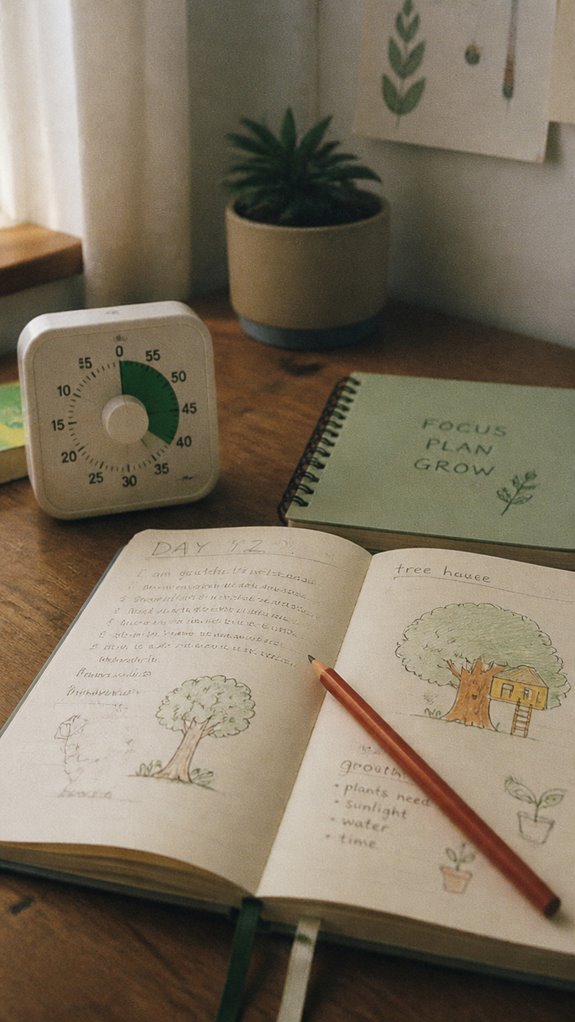
The rhythm you’ve built—effort followed by recovery—only works if the effort itself doesn’t trigger an overload response.
When tasks feel monolithic, children shut down before they even start.
Breaking work into smaller, sequenced pieces changes everything.
Here’s how innovative scheduling prevents this:
- Divide by natural stopping points—not arbitrary time blocks—so your child completes one meaningful unit before pausing.
- Embed creative breaks between chunks, not after everything’s done; this resets mental energy rather than waiting until exhaustion sets in.
- Match chunk size to your child’s current capacity, then gradually expand as resilience builds.
This approach isn’t about doing less.
It’s about structuring what you’re already doing so it doesn’t deplete your child.
Establishing healthy screen boundaries during academic work helps prevent the cognitive overload that makes studying feel insurmountable. They stay engaged, maintain focus, and develop the stamina to handle complexity over time—not through heroic effort, but through sustainable rhythm.
Make Rest and Recovery Non-Negotiable
Many parents treat rest as a reward that comes after achievement—something kids earn once they’ve finished the work. This is backwards. Rest isn’t a luxury; it’s infrastructure for learning itself.
Rest isn’t a luxury kids earn after achievement. It’s the infrastructure that makes learning possible.
Recovery is when your child’s brain consolidates new information, processes difficulty, and builds resilience. Without it, effort becomes hollow. Burnout accelerates.
Build rest into the system before fatigue sets in. This means consistent sleep, unstructured time, and intentional disconnection from screens. Developing social awareness skills during downtime also helps children process their interactions and relationships with greater understanding.
Add practices like mindful journaling to process stress, or nature immersion to reset their nervous system.
Your child doesn’t need more productivity. They need sustainable rhythm. When rest is non-negotiable, learning becomes something they can sustain for decades—not something that exhausts them by middle school.
That’s the shift that matters for their future.
The Adaptive Atlas Framework
Once you’ve built rest into your child’s rhythm, you need a framework that ties everything together—one that doesn’t treat learning, resilience, and future readiness as separate problems.
Adaptive Atlas connects five interconnected systems that work as one:
- Anti-fragile foundations teach emotional regulation through manageable challenge, so your child stays engaged instead of shutting down.
- Self-directed learning loops replace passive instruction with curiosity-driven growth, reducing the anxiety that comes from external pressure.
- Future skill focus channels effort toward adaptability and thinking rather than memorization, making learning feel purposeful.
This framework prevents burnout by removing the false choice between achievement and wellbeing. The Adaptive Atlas Framework creates conditions where thriving becomes possible within educational systems designed for constant change.
When learning builds resilience, strengthens social connections, and develops real capabilities, it becomes sustainable. Your child isn’t just surviving—they’re developing the flexibility to thrive.
The Adaptive Atlas Anti-Fragile Child System

When your child encounters frustration, failure, or uncertainty, their brain is wired to do one of two things: push through or shut down.
The Anti-Fragile Child System builds a third option: engage productively with difficulty.
This foundation prevents burnout by teaching emotional resilience—the capacity to stay present under pressure rather than collapse or force. Your child learns that struggle isn’t a sign of inadequacy; it’s information.
They develop creative confidence by treating setbacks as design problems to solve, not personal failures to escape.
Practically, this means letting your child experience manageable challenges without rescuing them immediately.
It means normalizing that discomfort precedes growth.
When they practice recovering from small failures, they build the nervous system tolerance that protects against later burnout.
They’re not learning to suffer. They’re learning to adapt.
Perfectionism Blocks Adaptive Growth
Perfectionism demands flawless results every time, but it starves your child’s adaptive growth in a changing world. You see perfectionism tendencies in your kid’s self-imposed pressure to ace every test or project, fearing any slip means failure.
This blocks the Anti-Fragile Child System, where kids thrive by iterating through mess-ups, not avoiding them. Developing future-ready skills requires embracing failure as part of the learning process rather than something to fear.
Break free with these shifts:
- Reframe effort over outcomes: Praise persistence, like growth mindset pioneer Carol Dweck teaches—your child builds resilience for AI-shifted jobs.
- Embrace “good enough” experiments: Ditch all-or-nothing; small tries compound skills, freeing them from fear.
- Model adaptive recovery: Share your pivots calmly, showing self-imposed pressure doesn’t define worth.
This liberates your child to navigate uncertainty confidently, securing long-term capability.
Burnout Prevention Guide for Kids
Kids today face a paradox: they’re told to be adaptable and resilient, yet they’re squeezed by rigid timelines, constant evaluation, and the pressure to excel at everything simultaneously.
This isn’t weakness—it’s a system problem. Burnout happens when effort becomes infinite while recovery becomes invisible.
You prevent it by building emotional intelligence, not by pushing harder. Teach your child to recognize fatigue as data, not failure.
Introduce play therapy through unstructured time—not scheduled activities, but genuine exploration without performance metrics. Let them build things, play games, and rest without guilt.
This isn’t indulgence. Recovery is where adaptation actually happens. Developing adaptability skills during periods of rest allows children to process experiences and build sustainable coping strategies.
A child who understands their own limits learns to navigate change sustainably. That’s the foundation for lasting capability.
Neurological Recovery Through Strategic Rest
Your instinct to let your child rest after intense mental or physical strain is right—but the research shows that how you rest matters more than how long. Neuroplasticity enhancement actually requires strategic recovery, not extended shutdown.
Here’s what works:
- Immediate modest rest (1-2 days) triggers faster symptom resolution than prolonged isolation, which paradoxically prolongs recovery.
- Gradual activity resumption supports cognitive load management better than strict confinement, reducing overall symptom burden.
- Early return to normal routines normalizes sleep patterns and reduces stress-related fatigue. Studies demonstrate that immediate rest initiation following cognitive strain produces measurable improvements in recovery timelines compared to delayed intervention.
The fear of pushing too hard is understandable. But complete withdrawal creates unnecessary struggle. Building antifragility through measured challenge helps children develop the capacity to recover and grow stronger from stressors rather than becoming fragile from overprotection.
Your child’s brain recovers best through intentional, stepped reentry into learning and activity.
This builds resilience while protecting their neurological health—the foundation for sustainable capability across their lifetime.
Building Resilience Through Failure
When failure feels like a threat to your child’s future, the instinct to protect them from it is strong—but this protection often backfires. Real emotional resilience doesn’t come from avoiding struggle. It comes from moving through it safely.
Your role isn’t to eliminate failure. It’s to create conditions where failure becomes information, not identity. When your child struggles, resist the urge to solve it immediately. Instead, ask: What can you learn here? Developing critical thinking skills during these moments helps children analyze their mistakes and extract meaningful lessons from setbacks.
| What You’re Tempted to Do | What Builds Resilience |
|---|---|
| Shield from mistakes | Let them struggle productively |
| Praise effort only | Celebrate specific problem-solving |
| Lower expectations | Maintain standards with support |
| Rush to fix problems | Coach them through solutions |
Growth mindset isn’t about believing everything’s possible. It’s about understanding that capability expands through challenge. Your calm presence during difficulty teaches your child that setbacks are navigable—not catastrophic. This foundation compounds over time.
The Adaptive Atlas Framework
Five connected systems designed to help parents raise adaptable, future-ready children in a world shaped by AI, automation, and constant change.
| 🛡️ |
Anti-Fragile Child SystemBuilds resilience, adaptability, and the ability to handle uncertainty without shutting down. |
| 📚 |
Learning Stack ModelDevelops self-directed learning habits and continuous skill acquisition beyond school systems. |
| 🚀 |
Future Skill Stack SystemFocuses on high-value human skills that remain relevant in an AI-driven economy. |
| 🤖 |
AI Learning SystemTeaches children how to use AI as a thinking partner instead of becoming dependent on it. |
| 🧭 |
Child Type Navigator SystemPersonalizes learning and development based on each child’s strengths and personality. |
FAQ
How Do I Know if My Child’s Burnout Is Affecting Their Long-Term Capability Development?
You’ll notice declining emotional resilience, poor time management, and disengagement from challenges they once tackled. Your child withdraws from learning rather than adapting through it—the foundation of long-term capability fractures when recovery capacity disappears.
Can My Child Use AI Tools to Reduce Workload Without Becoming Dependent on Them?
Yes—but you’ll need to distinguish between *using* AI and *outsourcing thinking*. Your child gains leverage when they use AI to accelerate execution while maintaining decision-making control. AI reliance emerges when they skip the cognitive work. Build dependency risks awareness through deliberate review cycles where they explain the reasoning behind AI outputs before accepting them.
What Extracurricular Activities Should My Child Keep Versus Eliminate for Sustainable Learning?
You’ll keep activities that build adaptability and decision-making while eliminating redundancies that merely fill time. Prioritize balancing hobbies that challenge thinking over those demanding passive compliance. This frees your child to explore what actually matters.
How Do I Balance Pushing My Child Toward Growth Without Triggering Burnout Shutdown?
You’re building a bridge, not a wall. Push through curiosity, not compliance. Stay involved in motivation strategies—notice when effort shifts to dread. You’re freeing your child by demanding growth that feeds them, not depletes them.
Should I Adjust My Child’s Schedule Based on Their Specific Learning Type and Profile?
Yes. You’re building sustainable capability, not compliance. Personalized scheduling aligned with your child’s learning style prevents the burnout that rigid structures create. Match intensity to their rhythm—that’s how you unlock genuine, compounding growth.
References
- https://www.beyondbooksmart.com/executive-functioning-strategies-blog/how-to-help-your-child-avoid-burnout-in-school
- https://www.understood.org/en/articles/8-tips-to-keep-your-child-from-burning-out
- https://www.zerotothree.org/resource/preventing-burnout-in-early-childhood-professionals-practical-self-care-strategies/
- https://www.genieacademy.com/blog/kids-burn-out-too
- https://www.davidsongifted.org/gifted-blog/burnout-in-gifted-children/
- https://nextevolutionperformance.com/2023/08/children-and-energy-management/
- https://www.chop.edu/news/health-tip/battling-mental-fatigue
- https://www.naeyc.org/resources/pubs/yc/jul2020/preventing-compassion-fatigue
- https://pubmed.ncbi.nlm.nih.gov/27581848/
- https://hms.harvard.edu/news/brain-rest-helps-children-heal-faster-concussions