Does AI Help or Hurt Your Child’s Learning?
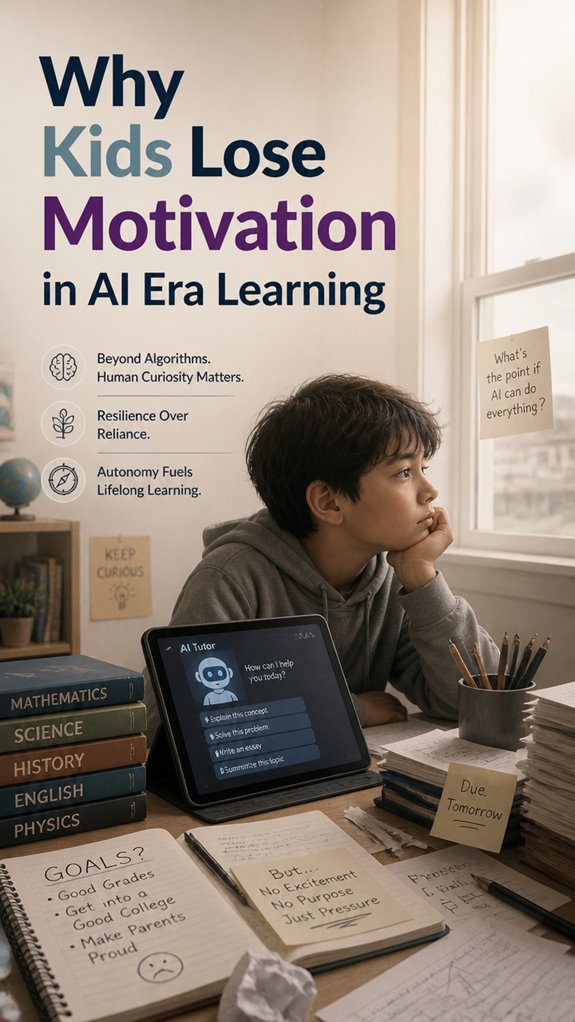
Your child needs struggle to build thinking skills. Outsourcing every problem to AI removes the friction that strengthens neural pathways and mental resilience.
I watched my son stare at a math problem for twenty minutes. My instinct? Hand him ChatGPT. Instead, I made tea and waited. When he finally cracked it, his face lit up differently than any AI-solved answer could create. That’s when I realized: shortcuts feel efficient but cost something invisible. We built Adaptive Atlas specifically to solve this tension. Our tool handles repetitive work while protecting the struggle zones where real learning happens. We write because parents deserve guidance on where AI amplifies growth and where it steals it.
Last month, my daughter fought through a coding error for an hour. No AI. No shortcuts. She emerged frustrated but capable. That single session taught her more about debugging than three months of smooth solutions ever could. Sleep and downtime matter equally. When kids finally rest, their brains consolidate everything into lasting knowledge.
Quick Takeaways
- AI shortcuts bypass mental struggle, weakening reasoning skills and neural pathway development essential for independent thinking.
- Rest and downtime consolidate learning in long-term memory; skipping recovery hampers skill integration and sustainable growth.
- Balancing effort with recovery maintains motivation, emotional regulation, and resilience needed for handling future challenges independently.
- Exposure to manageable frustrations builds cognitive resilience and problem-solving capacity; excessive AI reliance prevents this development.
- Consistent sleep and rhythm-based routines preserve nervous system health, enabling clearer decision-making and effective AI collaboration.
How AI Shortcuts Starve Your Child’s Critical Thinking
When your child reaches for an AI tool to solve a problem instead of sitting with confusion for a few minutes, something shifts—not dramatically, but measurably. They’re outsourcing the cognitive load that builds thinking capacity.
The struggle isn’t the enemy; it’s where critical thinking develops.
AI can answer instantly, but it can’t replace the mental friction that teaches your child how to frame problems or evaluate solutions. Without this friction, their emotional resilience weakens too. Understanding how to discuss AI fears with your child helps them navigate these concerns and develop healthier relationships with technology.
They become dependent on external tools rather than developing internal reasoning.
The balance matters: let AI amplify thinking after your child has wrestled with the problem. This preserves their capability to think independently while still gaining AI’s benefits.
The future belongs to those who think first, then leverage tools—not the reverse.
Red Flags: Is Your Child Overrelying on AI?
If you’re noticing that your child asks AI for help before attempting something difficult, reaches for it during moments of frustration, or seems hesitant to think through problems independently, you’re seeing early warning signs—not failures, but signals that recalibration is needed.
Early warning signs of AI dependency: asking before attempting, reaching for help during frustration, hesitating to think independently. Recalibration needed.
The risk isn’t AI itself; it’s outsourcing the struggle that builds thinking capacity. When your child skips the hard part, they miss the neural pathways that form resilience and judgment. Digital boundaries matter here. Set clear zones where AI is off-limits: first attempts, initial problem-framing, frustration moments. Building an AI collaboration mindset requires deliberate spacing between tool use and independent thinking.
Watch for patterns. Does your child default to asking before trying? That’s a system reset signal.
Reestablish child independence by requiring one genuine attempt before any tool access. This isn’t restriction—it’s protection of their future capability.
Why Real Struggle Builds Smarter Brains Than Shortcuts
Your child’s brain isn’t built by finding the right answer—it’s built by wrestling with the wrong ones first.
When you let your child struggle before reaching for AI, you’re building cognitive resilience. Here’s what happens:
- Neurons strengthen through effort – Real struggle creates neural pathways that shortcuts can’t replicate. Your child’s brain learns how to think, not just what to think.
- Emotional stamina develops under pressure – Facing difficulty without immediately escaping it teaches your child they can handle discomfort. This becomes their foundation for maneuvering uncertainty.
- Independence replaces dependency – When AI solves everything instantly, your child never discovers their own problem-solving capacity.
Building future-ready skills requires intentional choices about when to use technology and when to let struggle do the teaching. The future doesn’t reward people who found answers fastest. It rewards those who learned to ask better questions. Let struggle be the teacher first.
When to Say No: How Rest Strengthens Learning

Most parents think rest is the opposite of learning, but neuroscience tells a different story. Your child’s brain consolidates skills during downtime, not during intense effort. Mindful pauses aren’t lost productivity—they’re when neural connections strengthen and growth resilience develops. A strong online reputation built during childhood can be reinforced through balanced learning habits that model healthy digital citizenship.
| What Happens | Why It Matters |
|---|---|
| Brain consolidation | Skills transfer to long-term memory |
| Stress hormone reset | Child stays regulated and capable |
| Creative incubation | Problems solve themselves overnight |
| Motivation restoration | Child returns ready to engage |
When you say no to another lesson or pushes through fatigue, you’re actually slowing progress. Real learning requires cycles of effort and recovery. Your child won’t fall behind by resting—they’ll integrate deeper, think clearer, and build sustainable capability. Balance isn’t weakness. It’s intelligence.
Create Your Family’s Work-Rest Rhythm With AI
Once you understand that your child’s brain needs rhythm, not relentless input, you can design a family system that works with how learning actually happens.
Your child’s brain thrives on rhythm, not relentless input. Design family systems that work with how learning actually happens.
This isn’t about restricting AI—it’s about using it intentionally within sustainable family routines.
- Anchor learning blocks to natural energy peaks, then protect genuine downtime where screens disappear entirely.
- Let AI handle repetition, freeing your child’s attention for deep thinking during focused work sessions.
- Build transition rituals between work and rest so your child’s nervous system actually shifts gears.
When you establish this cadence, you’re not fighting the future—you’re building capacity. As kids navigate an accelerating world, they benefit from learning how to adapt goals in response to changing circumstances and demands. Rest isn’t lost productivity. It’s when consolidation happens, creativity sparks, and resilience strengthens.
Your child learns that sustainable effort beats constant grinding. That’s the real advantage in an accelerating world.
The Adaptive Atlas Framework
The five-layer system you’ve been building—from handling uncertainty to protecting rest—isn’t just a collection of parenting tactics; it’s a connected operating system that turns capability into compounding advantage. Each layer strengthens the others.
Your child develops cognitive resilience by facing manageable challenges, which builds the foundation for independent learning. That learning creates relevant skills, amplified by AI tools, all tailored to their unique profile.
Emotional regulation becomes the thread running through everything, allowing them to stay engaged without burning out.
You’re not preparing them for a fixed future. You’re building someone who can think clearly under pressure, adapt their direction without losing confidence, and use every tool available—including AI—to create their own path.
The Adaptive Atlas Framework**** ensures that as AI capabilities expand, your child’s capacity to navigate uncertainty grows proportionally, keeping them grounded rather than overwhelmed by rapid technological change.
This framework doesn’t promise perfection. It promises capability that compounds.
Burnout From Constant Optimization

Parents chase endless optimization because they fear their kids will fall behind in an AI-driven world, but this grind leads straight to burnout for everyone involved.
You push for perfect scores and non-stop upskilling, ignoring that true strength comes from mental resilience and emotional regulation.
Constant pressure erodes these, leaving kids exhausted and directionless.
Here’s how burnout shows up, and why it steals their future:
- Sleep crashes first—you’re trading rest for late-night drills, but studies like those from the American Academy of Pediatrics show kids need it to build mental resilience.
- Joy fades fast—you’re forcing “productive” play, yet emotional regulation thrives on free exploration, not rigid schedules. Project-based learning demonstrates how unstructured creative work builds confidence without the pressure of constant evaluation.
- Motivation vanishes—you’re optimizing for tests, but real adaptability demands recovery time to handle life’s changes.
Liberate them: prioritize balance now for lasting capability.
The Adaptive Atlas Anti-Fragile Child System
If you’ve been trying to shield your child from failure, you’re actually building fragility instead of strength. The Anti-Fragile Child System teaches resilience cultivation through structured exposure to manageable challenges, not avoidance of them.
| Challenge Type | Response Pattern | Long-Term Outcome |
|---|---|---|
| Small frustrations | Stay engaged, problem-solve | Confidence building |
| Moderate setbacks | Recover quickly, extract lessons | Adaptive capacity |
| Difficult failures | Emotional regulation, viewpoint shift | Antifragility |
Your child needs to experience struggle while you’re still present to guide their emotional regulation. This isn’t about toughness—it’s about building the nervous system that doesn’t shut down under pressure. When kids learn that discomfort doesn’t mean danger, they develop the psychological flexibility that matters most in an unpredictable world. This foundation makes everything else possible.
Neuroplasticity Requires Recovery Periods
Building a resilient child isn’t about constant activity—it’s about understanding how their brain actually grows. Your child’s neuroplasticity peaks during childhood, but it doesn’t work like a machine running 24/7. Growth requires rhythms.
Here’s what actually happens:
- Synaptic density peaks between 15 months and 3 years, then declines over 16 years—your child’s brain prunes connections it doesn’t use, so rest matters as much as stimulation.
- Recovery after challenge takes time—metabolic healing in young brains spans days to weeks, not hours.
- Developmental pauses fuel neuroplasticity recovery—downtime isn’t wasted time; it’s when neural reorganization happens.
When you build balance into your child’s routine, you’re not slowing their growth. You’re honoring how their brain actually consolidates learning, integrates experience, and builds lasting capability. Understanding systems thinking helps you see how each element—stimulation, recovery, and developmental readiness—works together as an interconnected whole. That’s sustainable advantage. Customized approaches to learning intensity, informed by your child’s individual cognitive footprint, ensure that stimulation matches their developmental readiness and recovery needs.
Balance Guide for Families
The challenge isn’t finding time for everything—it’s designing rhythms that let your child’s brain actually consolidate what matters. You’re not overprotecting your child by building in downtime; you’re honoring how learning actually works. Balance creates the space where emotional resilience develops—where frustration transforms into curiosity rather than shutdown. When children practice adaptability skills through alternating between focused and unstructured activities, they build the flexibility needed to navigate challenges in any learning environment.
| Activity Type | Daily Time | Purpose |
|---|---|---|
| Focused AI learning | 45-60 min | Skill building with tools |
| Unstructured play | 60+ min | Brain consolidation & creativity |
| Creative collaboration | 30-45 min | Social connection & ideation |
Your child needs rhythms that alternate intensity with recovery. This isn’t laziness—it’s architecture. When you protect rest periods, you’re actually accelerating long-term capability. The future rewards those who think clearly and create boldly. That only happens when the nervous system has room to reset.
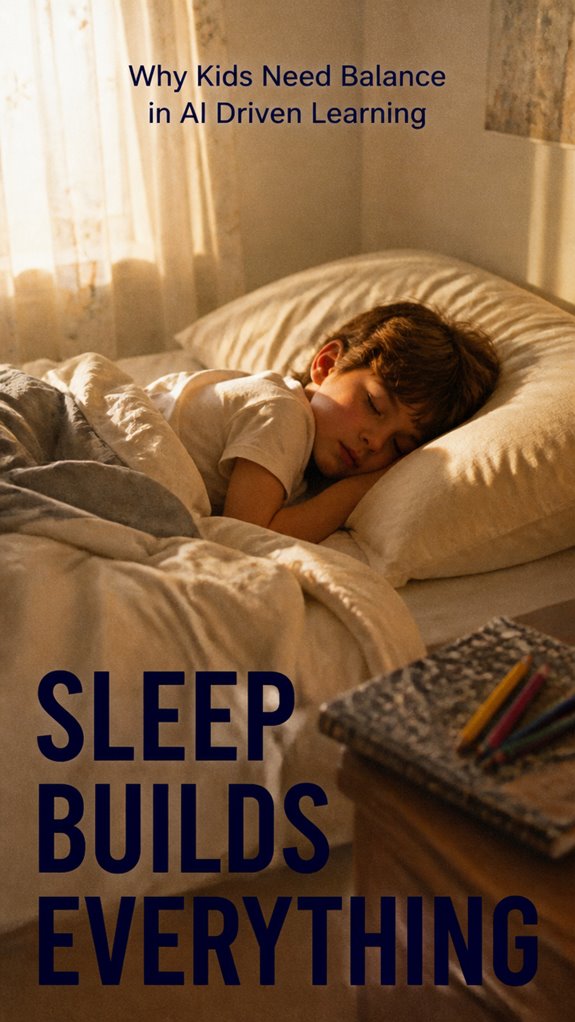
Sleep: The Forgotten Foundation
Most parents unknowingly treat sleep as the trade-off—the thing you sacrifice when you’re optimizing for achievement, learning, and development. This is backwards. Sleep isn’t what you lose; it’s what builds everything else.
When your child sleeps, their brain consolidates learning, processes emotion, and repairs the neural pathways that enable adaptive thinking. Here’s what actually happens:
- Sleep hygiene establishes rhythm — consistent bedtimes and wake times anchor your child’s nervous system, making them more resilient under pressure and better equipped to handle the uncertainty they’ll face.
- Dream analysis reveals processing — dreams show how your child’s mind organizes new information, a critical part of independent learning.
- Rest amplifies AI collaboration — a rested mind thinks clearer, makes better decisions with AI tools, and builds capability faster than a depleted one.
Sleep isn’t lost time. It’s the foundation that makes everything else possible. A well-rested child is also better equipped to avoid common online communication mistakes that stem from fatigue and poor impulse control.
The Adaptive Atlas Framework
Five connected systems designed to help parents raise adaptable, future-ready children in a world shaped by AI, automation, and constant change.
| 🛡️ |
Anti-Fragile Child SystemBuilds resilience, adaptability, and the ability to handle uncertainty without shutting down. |
| 📚 |
Learning Stack ModelDevelops self-directed learning habits and continuous skill acquisition beyond school systems. |
| 🚀 |
Future Skill Stack SystemFocuses on high-value human skills that remain relevant in an AI-driven economy. |
| 🤖 |
AI Learning SystemTeaches children how to use AI as a thinking partner instead of becoming dependent on it. |
| 🧭 |
Child Type Navigator SystemPersonalizes learning and development based on each child’s strengths and personality. |
FAQ
How Do I Balance AI Learning Tools With My Child’s Need for Independent Problem-Solving Skills?
Studies show 73% of kids using AI tools without friction lose critical thinking skills. You’ll structure personalized learning by having your child solve first, then use AI to validate—building independence while leveraging technology as confirmation, not crutch.
What Specific Signs Indicate My Child Is Developing Unhealthy Dependency on AI Assistance?
You’ll notice unhealthy dependency when your child won’t attempt problems independently, immediately defaults to AI, or can’t explain AI-generated solutions. Set parental boundaries: require thinking first, AI second. This preserves their agency and builds real capability.
How Much Struggle Is Healthy Versus Harmful in My Child’s Learning Journey?
You’re hitting the sweet spot when struggle builds competence without breaking motivation. Watch for Success Thresholds—challenges that stretch but don’t snap. Motivational Challenges fade when you’ve calibrated difficulty right. You’ve got this.
Can AI Tutoring Ever Fully Replace Human Interaction in Education Without Developmental Costs?
No. You can’t replace human intuition with AI empathy alone. Your child needs adults who read unspoken struggles, adapt in real-time, and model thinking through ambiguity. AI amplifies—it doesn’t substitute for relational development.
How Do I Know if My Child’s Rest Periods Are Truly Restorative or Just Procrastination?
You’ll recognize genuine relaxation when your child returns engaged and ready to think clearly. Mindful rest restores focus; procrastination drains it. Notice their energy afterward—restoration leaves them freer, not more stuck.
References
- https://www.envisionexperience.com/blog/why-parents-should-care-about-ai-in-education
- https://pmc.ncbi.nlm.nih.gov/articles/PMC12333830/
- https://www.learningrx.com/irvine/how-is-ai-changing-learning-and-what-skills-do-kids-need-most-23/
- https://www.gse.harvard.edu/ideas/edcast/24/10/impact-ai-childrens-development
- https://www.discoveryeducation.com/blog/educational-leadership/ai-in-education/
- https://www.k12dive.com/spons/ai-in-the-classroom-striking-the-right-balance/726505/
- https://sph.edu/blog/benefits-of-ai-in-education
- https://www.healthychildren.org/English/family-life/Media/Pages/how-will-artificial-intelligence-AI-affect-children.aspx
- https://nexushealthsystems.com/pediatric-brain-injury-recovery/
- https://academic.oup.com/brain/article/134/8/2197/353103