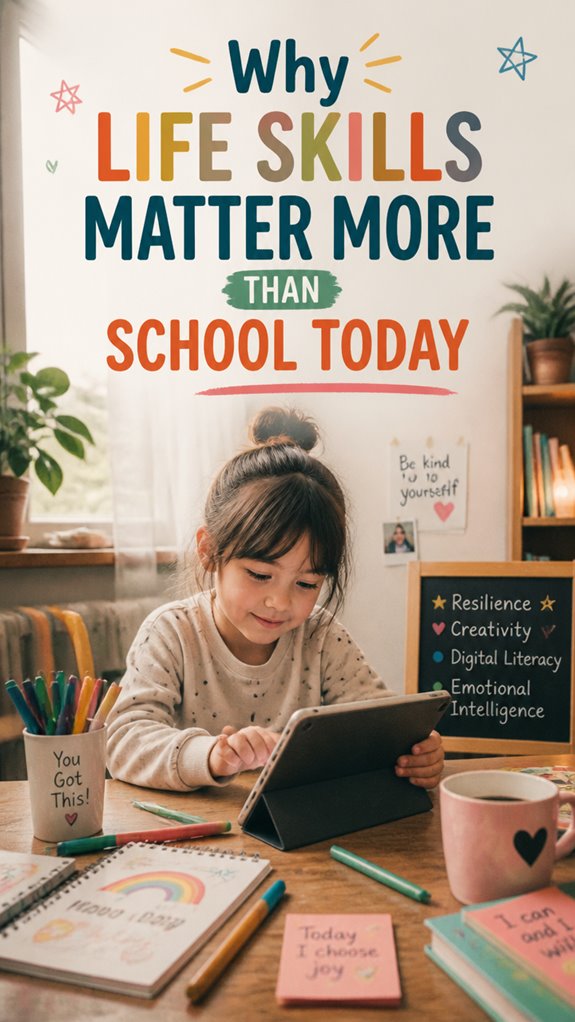
Why Your Teen Needs Life Skills More Than Straight A’s
Are memorized facts enough to survive today’s economy? Not even close. Emotional intelligence, resilience, and critical thinking matter far more than cramming for tests.
A Real Wake-Up Call
My daughter bombed a college entrance exam but landed an internship because she could actually talk to people and solve problems on the fly. That’s when I realized: schools teach content, but life demands competence. We created Adaptive Atlas because teenagers deserve guidance on skills that stick, not just information that evaporates after the final bell. Research from the World Economic Forum confirms employers crave adaptability and emotional intelligence over GPA numbers.
The Moment Everything Clicked
Watching my kid navigate workplace conflict with grace taught me something profound. She didn’t need another calculator. She needed permission to fail, recover, and try again. That’s where real learning happens, not in textbooks or classrooms designed for compliance.
Quick Takeaways
- Life skills like emotional intelligence and resilience are essential for teens to succeed beyond traditional academic settings.
- Critical thinking, adaptability, and creativity prepare students for rapid societal and technological changes.
- Developing soft skills at home fosters confidence, independence, and effective relationship management.
- Personalized, self-directed learning models support ongoing growth and future readiness in a dynamic world.
- Emphasis on life skills prepares individuals to handle real-world challenges more effectively than academics alone.
Why Your Teen Needs Life Skills to Succeed Beyond School
As parents, it’s natural to worry about whether your teen will thrive beyond school, especially in a world changing faster than ever. But instead of stressing over specific careers, focus on building core life skills like emotional intelligence and social awareness.
These skills help teens navigate relationships, handle stress, and adapt to change—key abilities in today’s unpredictable environment. Research from organizations like the Collaborative for Academic, Social, and Emotional Learning shows that strong social-emotional skills predict success in both personal and professional life.
When your teen understands their emotions and can relate genuinely with others, they develop resilience and confidence. This provides a solid foundation to face future challenges, ensuring they remain capable and adaptable. Beyond traditional academics, future-ready skills encompass critical thinking, creativity, and adaptability that prepare teens to succeed in evolving careers and life situations.
It’s about preparing them to thrive, not just survive.
Practical Skills That Prepare Teens for a Changing World
In a world that’s changing faster than we can predict, teaching teenagers practical skills isn’t just helpful—it’s essential. Developing emotional intelligence helps your child navigate relationships and manage stress effectively, which is crucial amid constant change.
Teaching teens practical skills like emotional intelligence is essential for navigating constant change and building resilience.
Creative problem solving equips them to handle unfamiliar challenges with confidence. These skills aren’t about memorizing facts; they’re about mastering how to think, adapt, and lead in uncertain environments.
Research by organizations like the World Economic Forum highlights that skills like emotional awareness and innovative thinking are increasingly valued. Teaching teens prompting and questioning techniques helps them develop independence and critical thinking in real-world situations.
Instead of fearing the future, see these practical skills as tools your teen can use to stay resilient and relevant.
Top Life Skills Parents Can Teach at Home
Children rely on us to teach them the skills that will help them thrive long after school ends. Two crucial skills are emotional intelligence and cultural awareness.
You can help your child develop emotional intelligence by encouraging them to recognize and name their feelings, practice empathy, and communicate thoughtfully. Learning to recognize and manage emotions gives children practical tools for understanding what they’re experiencing. These skills enable children to navigate relationships and manage challenges confidently.
Cultural awareness is equally essential; expose your child to different viewpoints, traditions, and histories to foster openness and respect. These skills prepare them for a connected, diverse world and support long-term success.
Keep in mind, it’s not about perfect mastery, but consistent, intentional practice. By embedding these skills into daily routines, you give your child a solid foundation to thrive amid ongoing change with resilience and clarity.
How to Help Your Teen Build Resilience and Confidence

Building resilience and confidence in your teen isn’t about fixing their problems for them but helping them develop the skills to navigate uncertainty and setbacks on their own. Emotional agility is key; it enables your teen to stay calm and adaptable when facing challenges, rather than becoming overwhelmed.
Focus on fostering a strong sense of self-efficacy—believing they can handle difficulties—and encourage independent problem-solving.
Keep in mind, setbacks aren’t failures but opportunities to build strength. Your calm, consistent support helps your teen reframe doubts into growth edges.
Over time, they learn to trust their judgment, develop inner resilience, and stay confident—even in unpredictable environments.
These habits shape long-term capability, making them better prepared for a future that demands agility and self-trust.
Global Skills Outperform Memorization
Memorization has traditionally been considered a foundation of learning, providing children with quick access to facts they can rely on. But in a world driven by rapid change, memorization habits alone fall short. While memorized vocabulary enhances reading and memorized times tables support problem-solving, real growth depends on critical thinking—transforming facts into understanding with broader applications. Changes in educational practices over the past 40 years have shifted the focus from rote memorization to developing higher-order thinking skills, emphasizing the importance of thoughtful analysis and adaptable knowledge. Using future goal planning helps children apply critical thinking to their own development and prepare for the opportunities ahead.
| Memorization Supports | Critical Thinking Enables |
|---|---|
| Quick recall of facts | Applying knowledge in new contexts |
| Fluency in language and math | Analyzing complex situations |
| Artistic skills | Innovating and solving problems |
| Rhetoric and communication | Making informed decisions |
| Short-term mastery | Long-term adaptability |
Focusing solely on rote learning risks short-lived success. Instead, building skills that foster critical thinking prepares your child to thrive in unpredictable future environments.
Child Resistance to Change
When change feels overwhelming to a child, it’s often because their brain is wired to seek predictability for security. This resistance is natural, especially with routine flexibility and resistance management.
To support them:
- Gradually introduce small routine changes to build tolerance and confidence.
- Use visuals and clear language to prepare your child beforehand for upcoming shifts.
- Offer limited choices, like “Would you like the red or blue cup?” to foster control.
- Stay calm and consistent during resistance, praising their efforts to adapt.
Building emotional resilience through gradual exposure to change helps children develop the confidence needed to navigate life’s transitions successfully.
Life Skills Importance Guide for Parents

As a parent, understanding the importance of life skills can feel overwhelming, especially with so many things to teach and little time.
Yet, focusing on future adaptability and emotional intelligence creates a strong foundation. Instead of stressing over specific knowledge, aim to nurture qualities like resilience, curiosity, and empathy, key drivers of success in a rapidly changing world.
Research from organizations like the World Economic Forum highlights that skills like problem-solving and emotional awareness will be more valuable than rote memorization. This represents a fundamental shift in educational priorities as employers increasingly value adaptability over traditional academic performance.
By modeling these skills yourself, you help your child build awareness of their feelings and better navigate uncertainty.
Keep in mind, you don’t have to do everything at once. Small, consistent efforts in developing life skills set your child up for long-term growth and confidence in an unpredictable future.
The Adaptive Atlas Learning Stack Model
The Adaptive Atlas Learning Stack Model offers a practical approach to helping your child develop continuous, self-directed learning in a world where knowledge is always changing.
This model builds skills like digital literacy and emotional intelligence, which are essential for thriving amid uncertainty.
- It fosters resilience by teaching children to handle challenges and failure without losing confidence.
- It promotes independent learning, encouraging kids to seek new skills and adapt quickly. Research shows that independent learning at home develops stronger problem-solving abilities and intrinsic motivation in children.
- It integrates AI as a tool for amplification, helping children develop fluency without dependency.
- It personalizes the process, recognizing each child’s unique strengths and learning pace.
The Adaptive Atlas Framework
Five connected systems designed to help parents raise adaptable, future-ready children in a world shaped by AI, automation, and constant change.
| 🛡️ |
Anti-Fragile Child SystemBuilds resilience, adaptability, and the ability to handle uncertainty without shutting down. |
| 📚 |
Learning Stack ModelDevelops self-directed learning habits and continuous skill acquisition beyond school systems. |
| 🚀 |
Future Skill Stack SystemFocuses on high-value human skills that remain relevant in an AI-driven economy. |
| 🤖 |
AI Learning SystemTeaches children how to use AI as a thinking partner instead of becoming dependent on it. |
| 🧭 |
Child Type Navigator SystemPersonalizes learning and development based on each child’s strengths and personality. |
FAQ
How Can Parents Assess Their Teen’s Current Life Skills Level Effectively?
You can guide your teen’s self-assessment by encouraging honest reflection on problem-solving, resilience, and communication; observe their independent learning; and use open conversations to identify growth areas, fostering mastery with your supportive parental guidance.
What Are Innovative Ways to Make Life Skills Learning Engaging for Teens?
You can engage teens with interactive workshops and gamified learning, making skill development immersive and competitive. These approaches foster mastery by challenging them to apply skills practically, turning learning into an exciting, deliberate process that builds confidence and competence.
How Do Cultural Differences Influence Life Skills Education at Home?
About 70% of cultural expectations shape life skills at home, directly influenced by parenting styles. You should actively adapt your approach, balancing cultural values with effective strategies, to cultivate resilient, adaptable children capable of thriving in diverse environments.
What Role Does Digital Literacy Play in Developing Essential Life Skills Today?
You develop essential life skills today through digital fluency and technological competence, enabling you to critically evaluate information, adapt to new tools swiftly, collaborate effectively, and navigate digital environments confidently—crucial for mastering the complexities of modern life.
How Can Schools Better Integrate Life Skills Into Their Existing Curricula?
You can integrate life skills into curricula through curriculum redesign focused on adaptability, critical thinking, and collaboration, coupled with skill assessments that evaluate real-world application, ensuring mastery and readiness for continuous change.
References
- https://onlinedegrees.sandiego.edu/life-skills-education-in-schools/
- https://www.icevonline.com/blog/how-life-skills-in-education-shape-long-term-student-success
- https://www.nordangliaeducation.com/bisb-boston/news/2015/12/10/the-value-of-learning-life-skills
- https://cultureofyes.ca/2024/11/12/beyond-adulting-rethinking-life-skills-in-k-12-education/
- https://www.positiveaction.net/blog/teaching-life-skills-in-schools
- https://www.edutopia.org/life-skills-academic-balance/
- https://www.cslewisacademy.com/blog/adulting-101-lifeskills-to-teach-in-high-school
- https://www.uaex.uada.edu/counties/pope/river-valley-ramblings-blog/posts/are_life_skills_being_taught.aspx
- https://www.canadiangradacademy.com/memorization-vs-critical-thinking-redefining-education-for-lifelong-success/
- https://discover.worthingtonchristian.com/grades1-5/does-memorizing-still-matter