Can Positive Thinking Actually Change How Kids Handle Life’s Curveballs?
Yes. When children reframe obstacles as learning moments, they unlock resilience that carries them through uncertainty. This shift rewires their brains to hunt for solutions instead of spiraling into worry about tomorrow’s chaos.
Why We Built Adaptive Atlas for Young Learners
My daughter came home devastated after flunking a math test. Instead of watching her collapse into “I’m stupid” territory, I asked her one question: “What’s one thing this test taught you?” Her face shifted. She started listing mistakes like they were treasure maps. That moment crystallized why we created Adaptive Atlas. Kids need tools that speak their language, not adult-speak wrapped in corporate jargon. We designed it to meet them where resilience actually lives: in the messy, beautiful space between failure and breakthrough.
The Coffee Shop Breakthrough
Last Tuesday, I overheard a teenager coaching her anxious friend through a presentation panic attack. She said, “You’re nervous because you care. That’s not weakness, that’s fuel.” My coffee got cold. That’s the exact mindset shift we chase. That’s what sticks.
Quick Takeaways
- Positive thinking fosters resilience, helping kids better manage challenges and recover from setbacks quickly.
- It enhances emotional intelligence, enabling children to understand and regulate their feelings effectively.
- Cultivating optimism encourages growth mindset development, promoting a love for learning and adaptability.
- Optimistic children are more creative, confident, and willing to take risks essential for future success.
- Developing a positive outlook supports mental well-being, reducing anxiety and fostering lifelong emotional strength.
Why Building an Optimistic Mindset Matters for Your Child’s Future
Building an optimistic mindset isn’t about encouraging blind positivity; it’s about helping your child see challenges as opportunities for growth. This mindset relies on emotional intelligence—the ability to understand and manage feelings—and recognizing growth opportunities in every setback.
When children view difficulties as chances to learn, they become more adaptable and resilient, essential skills in a future full of rapid change. You might worry about the uncertainty ahead, but shifting your focus to building their capacity to navigate complexity offers real control. Supporting your child in balancing exploration across various interests also strengthens their ability to adapt and find growth in new experiences.
How Positive Thinking Builds Resilience and Brain Strength in Kids
When children learn to think positively, they develop more than just good feelings; they strengthen their resilience and build a more adaptive brain. Positive thinking enhances emotional regulation, helping kids manage frustration and setbacks more effectively.
It encourages viewpoint shifting, so they can see challenges as opportunities to grow instead of threats. These skills are crucial for steering through a world full of rapid change and uncertainty.
When children approach problems with optimism, they learn to stay calm under pressure and bounce back from failure. This mindset not only builds mental strength but also creates a foundation for lifelong adaptability. Developing future-ready skills like positive thinking early prepares children to thrive in an evolving world.
As parents, fostering this outlook empowers your child to face the future confidently, recognizing the power they’ve to shape their own resilience and brain strength over time.
Easy Parent-Approved Strategies to Foster Optimism and Growth Mindset
Fostering optimism and a growth mindset in your child doesn’t require complicated techniques or quick fixes. Many mindset myths suggest that talent is fixed, but children learn best when they see effort as a pathway to growth.
Overcoming negativity is about creating a safe space where challenges are framed as opportunities, not threats. Instead of fixing mistakes, praise resilience and problem-solving. Keep conversations focused on progress, not perfection. Building emotion awareness and understanding helps children recognize their own emotions and respond to challenges with greater self-regulation.
Recall, your child’s mindset develops through consistent, real-world patterns, not instant results. Stay calm and provide clear, realistic expectations.
Overcoming Educational Inertia
Parents often fear schools lock kids into outdated paths, like memorizing facts for jobs AI now handles effortlessly. You worry your child’s future stalls in rigid routines. That’s valid, but you can break free with a mindset shift toward adaptability.
Parents fear schools trap kids in outdated memorization for AI-replaced jobs. Shift to adaptability—break free from rigid routines.
Embrace habit formation that builds resilience over rote learning. Start small: encourage daily experiments, like using AI tools for creative projects instead of drills. This rewires thinking, turning uncertainty into opportunity.
You’ll foster long-term capability, drawing from Carol Dweck’s growth mindset research. Your child gains confidence maturing through change, not chasing fixed goals.
You reclaim control, equipping them for advancing careers where human insight thrives alongside tech. Act now—systems like these compound into liberated futures.
The Adaptive Atlas Anti-Fragile Child System
Building resilience in children means helping them handle uncertainty and setbacks without shutting down or feeling defeated. This is essential, especially in a world that’s constantly changing and unpredictable.
The Adaptive Atlas Anti-Fragile Child System focuses on nurturing emotional intelligence and a growth mindset, core skills for future success. Instead of shielding kids from difficulty, you teach them how to navigate challenges with confidence. By implementing anti-fragile principles, children learn to transform adversity into advantage rather than merely enduring it.
It’s about showing them that failures are opportunities to learn and grow. This approach fosters a mindset where setbacks build strength, not weakness.
The Adaptive Atlas Framework
The Adaptive Atlas Framework offers a clear way to understand how to prepare children for a world that’s constantly changing. It emphasizes building artificial confidence and mental agility, so they can navigate uncertainty with calm and clarity.
Rather than focusing on memorization, you foster core abilities like adaptability, independence, and resilience—skills that matter most today. This system includes:
- Developing an anti-fragile mindset to handle setbacks without losing momentum
- Encouraging self-directed learning for continuous growth
- Shaping future-proof skills like critical thinking and decision-making
- Integrating AI as a tool to amplify thinking rather than replace it
Neuroscience of Optimism Effects

Recent neuroscience research shows that children’s optimism isn’t just a happy feeling—it’s reflected in how their brains process information. When kids stay hopeful, their neural expectation stays tuned toward positive possibilities, influenced by the optimism neuralase.
This means their brains are wired to filter out negative surprises, helping them stay motivated and resilient. During early development, the brain’s neuroplasticity amplifies these effects, making optimism a powerful foundation for growth. Understanding the learning stack model helps explain how these cognitive patterns build upon each other to create lasting behavioral change.
While it’s natural for children to ignore worse outcomes, understanding this helps you focus on nurturing their confidence without dismissing reality. Instead of fearing that hyper-optimism might distort their view, see it as a protective system that encourages them to navigate challenges with hope.
Your role is guiding this optimism into healthy, long-term strength for their future.
Positive Thinking Guide for Parents
Positive thinking isn’t about ignoring difficulties; it’s about guiding your child to see possibilities even in challenging moments. To foster this, focus on developing their emotional intelligence and practicing mindful communication.
Guide children to see opportunities in challenges by nurturing emotional intelligence and mindful, supportive communication.
You can:
- Encourage reflection, helping them interpret setbacks as learning opportunities.
- Model calm, focused responses that show resilience.
- Use language that emphasizes potential, rather than limitations.
- Create a safe space for open dialogue about feelings and challenges.
By intentionally building adaptability habits, you equip your child with the tools to navigate transitions and unexpected changes with greater confidence and flexibility.
Emerging AI Collaboration Skills
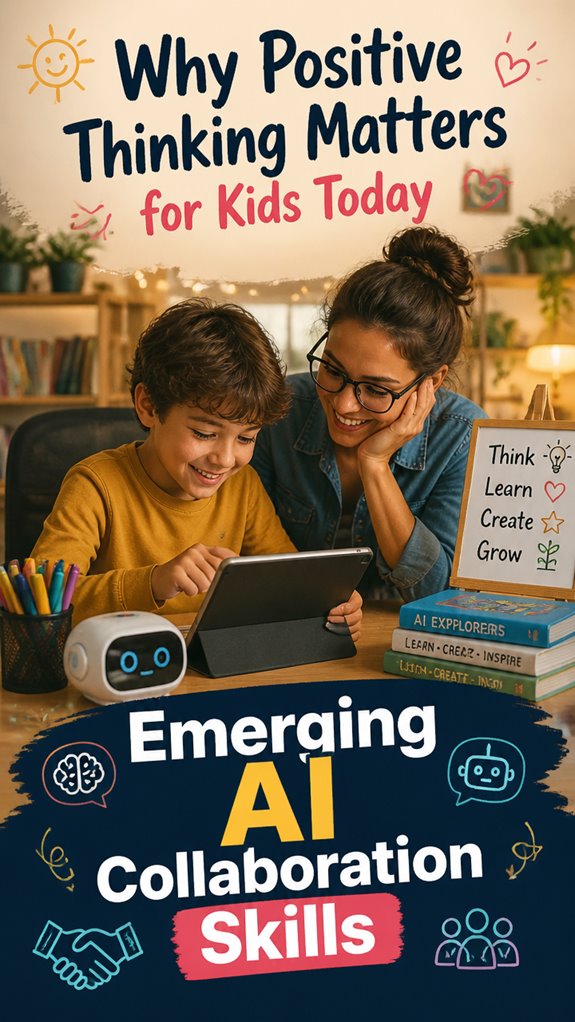
Helping your child develop collaboration skills with AI tools is increasingly important as these technologies become part of everyday life. AI collaboration isn’t about replacing human effort but amplifying it—creating cognitive synergy. It’s essential that they learn to work alongside AI thoughtfully, turning it into a partner in their learning and problem-solving. Understanding the AI collaboration mindset can help them approach these tools with intentionality and purpose.
This helps them see AI as a tool they control, not something to fear. Instead of worrying about automation taking over, focus on building skills in decision-making, creativity, and critical thinking—areas AI can support, but not replace.
The Adaptive Atlas Framework
Five connected systems designed to help parents raise adaptable, future-ready children in a world shaped by AI, automation, and constant change.
| 🛡️ |
Anti-Fragile Child SystemBuilds resilience, adaptability, and the ability to handle uncertainty without shutting down. |
| 📚 |
Learning Stack ModelDevelops self-directed learning habits and continuous skill acquisition beyond school systems. |
| 🚀 |
Future Skill Stack SystemFocuses on high-value human skills that remain relevant in an AI-driven economy. |
| 🤖 |
AI Learning SystemTeaches children how to use AI as a thinking partner instead of becoming dependent on it. |
| 🧭 |
Child Type Navigator SystemPersonalizes learning and development based on each child’s strengths and personality. |
FAQ
How Early Can Children Start Understanding the Link Between Thoughts and Feelings?
Just like Aristotle saw in ancient philosophy, kids can grasp thought awareness early, around age three or four, fostering emotional intelligence and liberating them from emotional confusion, helping them understand how their thoughts shape feelings effectively.
What Role Do Parents’ Own Attitudes Play in Developing a Child’s Optimism?
Your attitude modeling is powerful; it shapes your child’s optimism through daily parental influence. By demonstrating resilience and positivity, you inspire them to develop a hopeful mindset, empowering their ability to navigate life’s uncertainties confidently and creatively.
Can Positive Thinking Counteract Genetic or Environmental Challenges in Children?
Positive thinking promotes resilience, turning genetic challenges into growth opportunities and environmental influences into empowering experiences. You can cultivate confidence and catalyze change, liberating children from limitations by consistently cultivating cheerful, hopeful, and courageous minds amidst life’s inevitable challenges.
How Can Parents Measure Progress in Their Child’s Emotional Resilience?
You measure your child’s emotional resilience by observing how they practice mindfulness exercises during stress and how their emotional vocabulary expands, enabling them to identify and manage feelings independently, fostering long-term adaptability and confidence in facing life’s uncertainties.
What Are Common Barriers to Maintaining Consistent Affirmation Practices at Home?
You might struggle with parental consistency and emotional validation amid busy routines, fatigue, or personal doubts. Recognizing these barriers helps you choose intentional actions, fostering a supportive environment where affirmation becomes a natural, empowering part of your daily life.
References
- https://pubmed.ncbi.nlm.nih.gov/22187976/
- https://www.imaginechild.com/2022/07/power-of-positivity-in-child-development/
- https://guideposts.org/positive-living/health-and-wellness/better-living/positive-thinking/positive-thinking-for-kids/
- https://raisingchildren.net.au/guides/activity-guides/wellbeing/positive-thinking
- https://www.kindercare.com/content-hub/articles/2017/february/motivate-with-love-how-positivity-makes-kids-better-learners
- https://www.parent.com/blogs/conversations/2017-enable-the-power-of-positive-thinking-by-teaching-kids-affirmations
- https://zing-kids.com/zingblog/the-importance-of-positive-affirmations-for-kids
- https://betterkids.education/blog/7-habits-to-help-children-be-happy-and-the-power-of-positive-psychology
- https://www.youtube.com/watch?v=rOV5O31kMp4
- https://www.medicalresearchfoundation.org.uk/news/why-young-children-are-more-optimistic