How Digital Distractions Reshape Young Minds
How does the attention economy actually sabotage your child’s ability to focus? Screens hijack their concentration through constant notifications, fragmenting deep thinking into bite-sized pieces that feel productive but aren’t.
My oldest refused to read beyond three pages. Frustrated, I watched her scroll through TikTok for forty minutes straight. That’s when I realized: the problem wasn’t her. It was the system designed to addict her. We created Adaptive Atlas to fight back—building tools that respect attention instead of weaponizing it. Real learning requires friction. Requires boredom. Requires depth.
Building Focus Back Into Daily Life
Last Tuesday, I removed Wi-Fi from our dining table. My daughter actually looked up. We talked. She asked questions about history for the first time in months. No notifications. No competing feeds. Just conversation. That single change shifted everything about how she engaged with information and people around her.
Practical Moves That Stick
Create tech-free zones. Establish specific notification windows. Reward sustained focus with something meaningful, not another screen. Your child’s learning capacity depends on protecting attention as a finite resource worth defending fiercely.
Quick Takeaways
- Digital platforms compete fiercely for children’s attention, often reducing their capacity for sustained focus and deep learning.
- Frequent notifications and short-form content fragment attention, weakening memory retention and critical thinking skills.
- Constant switching between activities hampers the development of self-control and the ability to concentrate over time.
- Dependence on instant gratification from digital rewards can diminish motivation for effortful, meaningful learning.
- Promoting intentional digital use and mindful routines can help children build resilience and maintain deeper engagement.
What Is the Attention Economy and How Does It Affect Kids
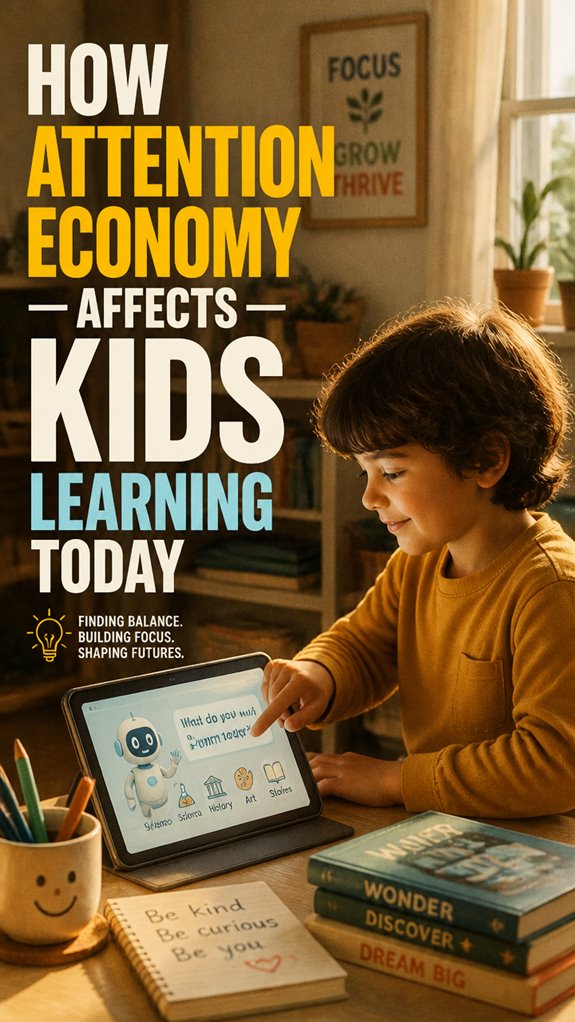
The attention economy is a term used to describe how digital platforms and apps compete for your child’s focus in ways that influence their habits and learning. As they scroll through endless feeds, their attention cycles become shorter, shaped by constant notifications and quick rewards.
This creates digital dependencies, where they seek immediate engagement rather than sustained focus. Many parents worry this erodes patience and deep thinking.
But understanding this pattern allows you to act intentionally. Instead of fighting technology, you can design systems that help your child develop adaptable attention spans. Schools rarely teach the critical thinking skills needed to navigate attention-driven platforms, leaving children vulnerable to algorithmic manipulation.
How Kids’ Brains Adapt to Digital Attention
As children spend more time interacting with screens, their brains naturally adapt to the digital environment. This is thanks to neural plasticity, the brain’s ability to reorganize itself based on experience. It’s a powerful trait that helps kids develop new skills and cope with change.
Instead of fearing these shifts, see them as an opportunity to build cognitive resilience—kids can learn to focus, switch tasks efficiently, and adapt to fast-paced information. This doesn’t mean their brains are being weakened; it’s a process of growth and flexibility. Understanding which future-ready skills matter most helps parents guide their children toward capabilities that will serve them throughout their lives.
As a parent, your role is to create systems that support this natural adaptation. By fostering balanced routines and encouraging self-directed learning, you help your child develop long-term skills essential for thriving in an ever-evolving world.
Why Short-Form Content and Notifications Hurt Kids’ Focus
Short-form content and notifications are everywhere, and it’s easy to think they keep kids engaged. But in reality, they often hurt attention spans and memory retention.
When kids constantly switch focus between brief clips or alerts, their brains struggle to sustain deep thinking or consolidate learning. This pattern chips away at their ability to focus over time, making it harder to develop the skills needed for the future—like critical thinking and problem-solving.
Instead of strengthening their mental muscles, these distractions weaken them. Understanding attention recovery strategies can help parents counteract these effects and rebuild their children’s focus abilities. As parents, you can see this as an opportunity to set clear boundaries that protect your child’s ability to concentrate.
Simple Ways Parents Can Help Boost Kids’ Attention

Helping your child improve their attention doesn’t mean overhauling their entire day; small, consistent changes can make a big difference.
Focus on fostering playful concentration—making activities fun while encouraging sustained engagement. Incorporate mindful pausing into routines, like short breaks or quiet moments, to help children reset and avoid burnout.
These pauses teach kids to notice their focus slipping and gently bring it back, creating a natural rhythm for sustained attention. Understanding how attention economy shapes children’s digital experiences can help parents make more intentional choices about screen time and content consumption. Keep in mind, it’s about building a system, not quick fixes.
Stay calm and confident in your role—your steady presence and simple cues can empower your child to develop better attention habits. Over time, these small shifts will help them navigate a world full of distractions and prepare for a future where focus is a crucial skill.
Designing Digital Environments That Promote Deep Thinking
Creating digital environments that foster deep thinking starts with understanding that technology isn’t just a distraction but a tool for meaningful engagement.
You can design spaces that promote mindfulness by applying neuroscience ethics—considering how your child’s brain develops and how digital content impacts it. Digital mindfulness encourages intentional use, helping children stay present and focused on complex ideas rather than fleeting stimuli.
Instead of reactive screens, create environments that challenge their curiosity and problem-solving skills. Keep thinking long-term; teach children to manage their attention and energy intentionally. When children practice building confidence in decisions, they develop the critical thinking necessary to navigate digital environments thoughtfully.
Resetting outdated ideas about screen time allows you to elevate digital tools as learning allies. Focus on systems that cultivate resilience, reflection, and thoughtful exploration—building the foundation for their future adaptability.
Impact of Digital Multitasking
Multitasking with digital devices has become a common habit, but it’s important to understand how this habit shapes your child’s attention and learning.
When kids switch quickly between tasks, their neural plasticity—the brain’s ability to reorganize—can weaken the development of attention resilience. This makes it harder for them to sustain focus over time or process information deeply.
Constant media multitasking causes cognitive overload, impairing memory and critical thinking. It also trains the brain toward fragmented attention patterns, reducing the ability to engage in deep, meaningful learning.
The good news: these patterns aren’t fixed. With intentional environments and strategies, you can support your child’s brain to build resilience, improve focus, and develop adaptable skills for a future where deep thinking and sustained attention remain essential.
Distraction From Deep Focus

Distraction pulls kids away from deep focus, fragmenting their ability to immerse themselves into ideas or problems fully. You fear this steals their future edge, but here’s the grounded truth: in an accelerating world, deep focus builds the adaptability kids need to thrive amid change.
Distraction fragments kids’ deep focus, robbing future edge. Truth: In a fast world, it builds adaptability to thrive amid change.
Constant pings train shallow thinking, as Cal Newport’s research shows—attention spans now average eight seconds, shorter than goldfish. Yet you can reclaim control through mindful unplugging.
Schedule device-free zones daily; watch your child dive deeper into play or projects.
Pair it with focus reinforcement: short, timer-based challenges on one task. This system rewires their brain for sustained effort, turning distraction‘s pull into voluntary depth. Effective learning systems intentionally structure these moments to build cognitive resilience and self-regulation skills over time.
Your child gains leverage—independent thinkers who shape opportunities, not chase them.
Start today; capability compounds.
Attention Economy Awareness Guide for Parents
Understanding the attention economy means recognizing how everyday digital habits shape your child’s ability to focus and think deeply.
To foster resilience and develop metacognitive strategies, you can guide your child in gaining awareness of their attention patterns. Research shows that risk-taking opportunities in learning environments help children develop greater focus and cognitive flexibility.
Focus on creating routines that minimize distractions and encourage intentional focus.
Consider these approaches:
- Teaching children to reflect on their attention span and identify triggers
- Modeling mindful use of devices yourself
- Encouraging regular breaks to reset focus
- Integrating resilience training to help them handle setbacks
- Promoting activities that require sustained engagement to build self-control
Online Screen Time Management
Have you ever wondered if your child’s screen time is helping or hindering their ability to learn and adapt? The key is fostering digital mindfulness, which means helping your child become aware of how they engage with screens.
It’s not about restricting all screen use but creating patterns that build attention resilience—the capacity to stay focused even amidst digital distractions. Instead of viewing screens as enemies, see them as tools for skill-building and exploration, if used intentionally.
Set clear boundaries that support mindful habits, like focused play and reflection time. These practices enable your child to develop a healthy relationship with technology, strengthening their long-term capacity to learn, adapt, and thrive in an ever-changing world. Incorporating working memory exercises during screen-free periods can further enhance your child’s cognitive capacity and learning outcomes.
The Adaptive Atlas Anti-Fragile Child System
Building resilience in children is more important than ever, especially in a world filled with uncertainty and rapid change. The Adaptive Atlas Anti-Fragile Child System nurtures mindfully focused, adaptable kids who can thrive amid constant shifts.
Instead of avoiding difficulty, children learn to stay engaged, recover from setbacks, and grow stronger through challenges. This approach fosters cognitive resilience—building confidence to navigate ambiguity and new information. Anti-fragility represents a framework where adversity becomes a catalyst for growth rather than a source of fragility.
You can support this by focusing on:
- Cultivating a growth mindset that sees failure as an opportunity
- Encouraging self-directed learning to boost independence
- Teaching children to use AI as a partner, not a replacement
- Tailoring challenges to their unique strengths
- Promoting exploration and flexible identity in shifting terrains
The Adaptive Atlas Framework
Five connected systems designed to help parents raise adaptable, future-ready children in a world shaped by AI, automation, and constant change.
| 🛡️ |
Anti-Fragile Child SystemBuilds resilience, adaptability, and the ability to handle uncertainty without shutting down. |
| 📚 |
Learning Stack ModelDevelops self-directed learning habits and continuous skill acquisition beyond school systems. |
| 🚀 |
Future Skill Stack SystemFocuses on high-value human skills that remain relevant in an AI-driven economy. |
| 🤖 |
AI Learning SystemTeaches children how to use AI as a thinking partner instead of becoming dependent on it. |
| 🧭 |
Child Type Navigator SystemPersonalizes learning and development based on each child’s strengths and personality. |
FAQ
How Can Parents Balance Digital Engagement With Attention Development Effectively?
Research shows children’s attention spans have shrunk by 20%; you can counter this by setting digital boundaries and practicing active parental monitoring. Empower your child’s focus and independence while embracing digital tools as allies, not enemies.
What Long-Term Cognitive Effects Does Digital Distraction Have on Children?
Digital distraction can weaken your child’s neural impact, reducing focus resilience over time. This ongoing interference undermines deep thinking and problem-solving capabilities, but by intentionally nurturing attention skills, you can empower them to regain control and thrive independently.
Are There Specific Age Groups More Vulnerable to Attention Economy Influences?
You should know that ages 3 to 8 are most vulnerable due to developmental sensitivity, with studies showing early childhood attention spans can drop by 20%, emphasizing the need to protect and liberate children from constant attention economy influences.
How Do Cultural Differences Impact Children’s Responses to Digital Attention Tactics?
Cultural perceptions shape kids’ responses to digital attention tactics by influencing attention norms, encouraging either focus or distraction. You can empower children to break free from these norms, fostering independence and resilience amidst diverse digital environments worldwide.
Can Traditional Teaching Methods Counteract the Attention Economy’s Effects?
Traditional teaching methods struggle to combat the attention economy’s focus fatigue and distraction mitigation challenges. To truly liberate your kids, embrace adaptable, skill-focused approaches that cultivate resilience, independence, and concentration amid constant digital distractions.
References
- https://www.thethinkacademy.com/blog/edubriefs-how-attention-economy-impacts-k-12-students-focus/
- https://www.sfu.ca/~decaste/techcourse/payingattention.pdf
- https://thesundaydiplomat.com/op-ed-the-intrusion-of-an-attention-economy-is-creating-an-educational-crisis/
- https://www.zerotothree.org/open-letter/how-the-attention-economy-impacts-young-children/
- http://www.dothinklearn.org/blog/2021/38/learning-in-the-attention-economy
- https://www.jeffrauseo.com/p/how-the-attention-economy-ruined-childrens-television
- https://www.aft.org/ae/spring2026/willingham
- https://calendar.bowdoin.edu/event/the-attention-economy-and-the-childs-right-to-an-open-future
- https://www.humanetech.com/youth/the-attention-economy
- https://www.davidpublisher.com/Public/uploads/Contribute/6684ac350c950.pdf