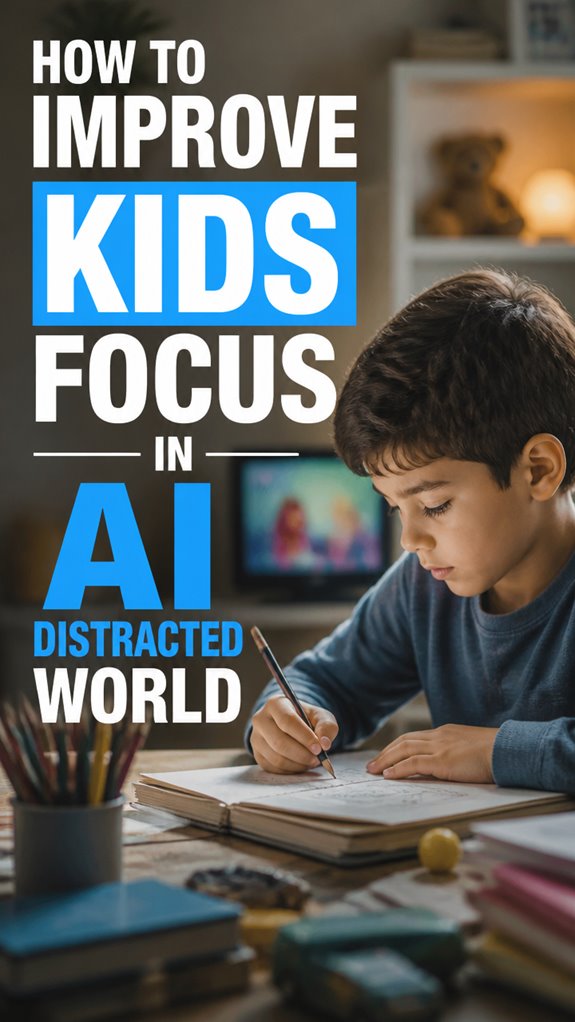
How do you actually build real focus when screens are everywhere? The answer lies in intentional routines that blend screen limits with tangible activities. Digital overload weakens attention, yet it teaches valuable lessons about managing mental energy and adapting to constant change.
Why We Created Adaptive Atlas for Focus-Hungry Families
My daughter once ignored dinner to finish a drawing. That moment sparked something. I realized she could hyperfocus on what mattered. So we started structuring her days differently: art projects, no-phone hours, mud outside. That’s when Adaptive Atlas was born. We write it because kids need real frameworks, not guilt trips. We wanted to share what actually works when competing against infinite scroll.
My turning point came last spring. I watched my son sit quietly for forty minutes, sketching without touching his tablet. No bribes. No rules enforced through tension. Just space created through consistency. That’s when I understood focus isn’t built through restriction alone. It grows through replacing empty digital time with engaging, hands-on experiences that feel rewarding.
Quick Takeaways
- Establish intentional use of technology with clear boundaries and active reflection to foster responsible AI engagement.
- Incorporate real-world, hands-on activities to strengthen focus, creativity, and neuroplasticity.
- Use AI tools as personalized trainers to develop attention gradually, supporting self-regulation and critical media literacy.
- Create routines that include mindfulness, sensory activities, and emotional regulation to enhance sustained focus.
- Model curiosity and collaborative learning through parent involvement to reinforce engagement and resilience.
How AI Distraction Affects Kids’ Attention & Focus
Since AI tools are now constantly available at kids’ fingertips, it’s easy to worry that these distractions might weaken their ability to focus. However, this digital overload isn’t just a problem; it highlights the need to develop cognitive resilience.
When children face endless streams of information, they learn to manage attention shifts, build mental flexibility, and stay engaged over time. Instead of trying to block out AI’s influence, it’s more helpful to see this environment as a chance to strengthen focus systems. Teaching kids practical technology strategies empowers them to navigate digital tools intentionally rather than passively consuming content.
Applying Cognitive Science to Build Stronger Focus Skills
Understanding how your child’s brain works can help you support their focus in an era full of distractions. By applying cognitive science, you can foster neuroplasticity enhancement and strengthen attentional strategies. Research shows that deep focus habits develop through consistent practice and environmental design, allowing children to overcome the pull of constant digital stimulation.
Here are four practical steps:
- Encourage activities that promote brain flexibility, like puzzles or new skills, to boost neuroplasticity.
- Create focused routines that help children build consistent attentional habits over time.
- Use mindfulness and short, intentional breaks to teach children how to reset their focus.
- Model and practice effective attentional strategies, showing children how to prioritize and stay present.
These approaches help children develop resilience against distraction, enabling them to embrace a future of continuous change confidently. Focus is a skill, and you can shape it through thoughtful, system-based effort.
Using AI Tools to Enhance Attention Training for Children
Artificial intelligence offers new ways to support your child’s attention development by acting as a personalized trainer and partner. Recent neuroscience understanding show that attention cultivation benefits from tailored approaches.
AI provides personalized support to enhance your child’s attention and focus development.
AI tools can adapt to your child’s unique learning patterns, helping them build focus step by step. You might worry about screens and distractions, but these tools aren’t meant to replace real skills—they amplify them.
By engaging in carefully designed activities, your child can develop self-regulation and resilience, which are essential in an AI-rich world. Instead of quick fixes, focus on systems that slowly strengthen attention over time.
AI becomes a strategic ally, helping your child learn how to stay engaged and recover from setbacks. This sets a foundation for long-term success amid constant change. Developing critical thinking skills alongside attention training helps children navigate an increasingly complex digital landscape where distinguishing reliable information from misinformation becomes increasingly important.
Teaching Kids Media Literacy and Critical Thinking Online
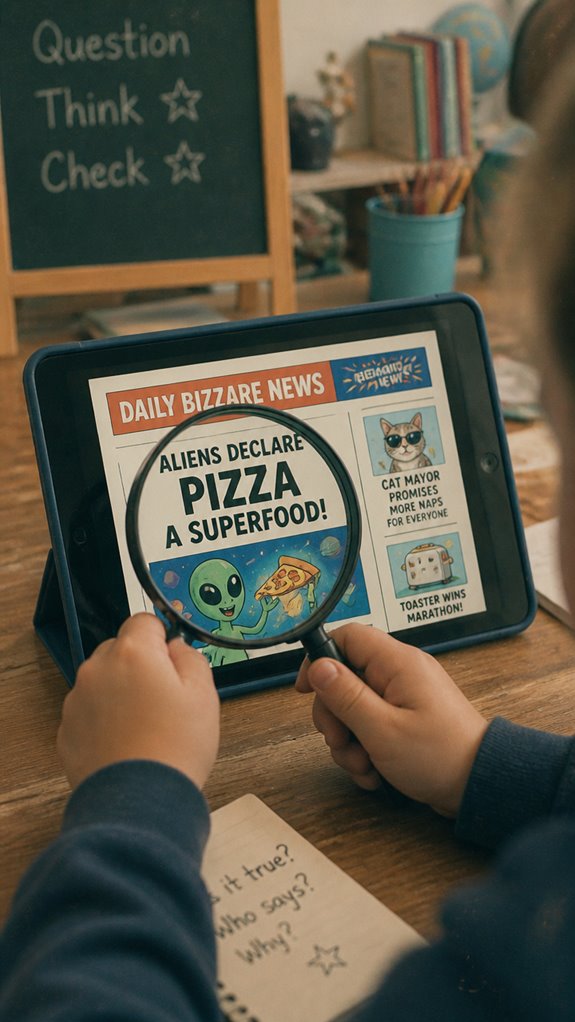
Have you ever wondered how your child can navigate the vast and often confusing online world safely? Teaching media literacy and cultivating online skepticism is essential. It empowers your child to see through misinformation and question what they see online. Understanding critical media literacy skills helps children develop the foundation they need to evaluate information effectively in today’s digital landscape.
Here are four practical steps:
- Encourage questioning everything—media messages, sources, motives.
- Teach them to check multiple sources before accepting information as true.
- Guide them to recognize bias and manipulation in content.
- Model critical thinking in your own online habits, shaping a mindset of healthy doubt.
These skills help children build confidence in their ability to discern fact from fiction. They develop a mindset of active participation rather than passive consumption.
In a world full of information, media literacy creates independence and prepares them for a future where they create value, not just consume it.
Designing Real-World, Human-Centered Learning Experiences
In today’s world, genuine-world, human-centered learning creates meaningful opportunities for children to develop skills that matter most in their future. By designing experiences rooted in real life, you help activate neuroplasticity evolution and strengthen emotional resilience. These experiences foster adaptability, allowing children to respond confidently to uncertainty instead of fearing it. When parents actively engage in learning alongside their children, they model curiosity and reinforce the collaborative nature of knowledge acquisition.
| Genuine-World Learning | Traditional Lessons |
|---|---|
| Hands-on exploration | Passive absorption of facts |
| Contextual understanding | Abstract, disconnected info |
| Emotional engagement | Detached, impersonal tasks |
| Skill development | Focused on long-term growth |
This approach shifts focus from rote memorization to practical skills. It nurtures independence, creativity, and resilience—key capabilities in an unpredictable world. Trust that fostering meaningful, real-world interactions cultivates adaptable children equipped for lasting success.
Setting Clear Boundaries and Guidelines for Safe AI Use
As children increasingly interact with AI tools, setting clear boundaries and guidelines becomes essential to guarantee safe and responsible usage. This isn’t about limiting their curiosity but guiding it thoughtfully. Here’s how to do it:
- Establish consistent screen time strategies that balance learning and play, fostering discipline without blame.
- Practice parental mediation by monitoring AI interactions and discussing what’s appropriate, helping kids develop judgment.
- Set boundaries on the types of AI content they engage with, emphasizing trustworthy sources and safety.
- Encourage open conversations about AI’s role in their future, turning boundaries into opportunities to build confidence and awareness.
- Introduce creative AI tools that channel their natural curiosity toward productive projects, allowing them to explore imagination within safe parameters.
These steps empower your child to navigate AI confidently, turning boundaries into tools for growth, not restrictions.
Focus Training Program for Kids

Building strong focus skills now is an essential step in helping children thrive in a world filled with constant distraction. A focus training program emphasizes mindful reflection—helping children become aware of their attention and emotional responses.
This awareness supports emotional regulation, giving them tools to stay calm and centered amid chaos. By teaching children to pause and reflect, you lay a foundation for sustained attention and resilience. When children develop these reflection habits, they’re also building open communication with themselves and others, which strengthens their ability to understand and articulate their needs.
Instead of fearing that screens and AI will hijack their minds, see this as an opportunity to build systems of internal control.
Consistent routines of reflection and regulation reinforce long-term habits, shaping adaptable, self-aware individuals.
This isn’t about quick fixes but about creating patterns that empower your child to navigate complexity with confidence and clarity.
Neuroscience of Digital Attention
Digital engagement has a powerful effect on your child’s brain, often changing how they focus and process information. This isn’t about fear, but understanding how neural plasticity adapts to constant stimulation. Your child’s brain develops resilience by forming new connections—strengthening focus and adaptability over time. Having calm family conversations about these changes can help children understand their own neural responses without anxiety.
Consider these points:
- Alpha waves decline with emotionally charged content, indicating overloaded cognitive load.
- Beta and Gamma waves increase during active decisions, highlighting extended emotional engagement.
- Attention span has shrunk as multitasking becomes routine, reducing cognitive control.
- Dopaminergic responses mimic addiction, encouraging passive consumption.
Focusing on system-based approaches helps your child rebuild cognitive resilience and harness neuroplasticity, giving them long-term skills to thrive in an ever-changing world.
Overcoming Digital Distraction Commonly
Many children face constant digital distractions that pull their attention away from meaningful learning and growth. As a parent, you might worry about her ability to stay focused or manage frustration.
The key lies in helping your child develop emotion regulation—learning to notice feelings like impatience or distraction without acting on them. Sensory integration plays a role here, too; providing calming, sensory-rich experiences helps children stay centered amidst digital noise.
Instead of fighting distractions, create routines that build awareness and self-control over time. Think long-term: fostering patience and emotional balance today prepares your child for future challenges. Building an audience of positive influences around your child strengthens their resilience against digital overwhelm and supports sustained focus development.
The Adaptive Atlas Anti-Fragile Child System
In a world full of uncertainty and rapid change, helping your child become anti-fragile isn’t just about resilience—it’s about teaching them to grow stronger through challenges. The Adaptive Atlas Anti-Fragile Child System builds emotional resilience and enhances sensory integration, preparing kids to handle setbacks confidently. By implementing building resilience strategies consistently, you create a foundation that transforms how children respond to adversity.
Here’s how you can support this:
- Foster emotional resilience through safe exposure to frustration and failure, reversing fear into growth opportunities.
- Encourage sensory integration activities that help your child stay grounded and aware amid chaos.
- Promote self-awareness to help your child recognize and manage emotional responses.
- Teach problem-solving in uncertain situations, strengthening their ability to adapt and thrive over time.
These systems develop long-term capacity, ensuring your child can navigate an unpredictable world with confidence and calm.
The Full Adaptive Atlas Framework
The Full Adaptive Atlas Framework offers a clear and practical way to prepare your child for a future shaped by constant change. Instead of focusing on fixed goals, you build skills like emotional regulation and creative scaffolding, which help them adapt at every step. This system emphasizes resilience, teaching children to manage frustrations and setbacks calmly.
It also encourages continuous, self-directed learning—fostering focus amid distractions. The framework promotes long-term capabilities, rather than short-term achievements, so your child can smoothly navigate the shifting landscape driven by AI and automation.
The Adaptive Atlas Framework
Five connected systems designed to help parents raise adaptable, future-ready children in a world shaped by AI, automation, and constant change.
| 🛡️ |
Anti-Fragile Child SystemBuilds resilience, adaptability, and the ability to handle uncertainty without shutting down. |
| 📚 |
Learning Stack ModelDevelops self-directed learning habits and continuous skill acquisition beyond school systems. |
| 🚀 |
Future Skill Stack SystemFocuses on high-value human skills that remain relevant in an AI-driven economy. |
| 🤖 |
AI Learning SystemTeaches children how to use AI as a thinking partner instead of becoming dependent on it. |
| 🧭 |
Child Type Navigator SystemPersonalizes learning and development based on each child’s strengths and personality. |
FAQ
How Can Parents Assess Their Child’s Unique Cognitive Strengths and Weaknesses?
You assess your child’s unique cognitive strengths by conducting cognitive assessments, observing their natural problem-solving, decision-making, and learning behaviors, and engaging in strengths identification. This process illuminates their true abilities, freeing them for personalized growth and confidence.
What Strategies Promote Intrinsic Motivation Amid Ai-Driven Distractions?
Picture your child explores a project they genuinely love, fueled by intrinsic drivers like curiosity. Use motivation techniques like autonomy and purpose to cultivate passion, helping them stay engaged despite AI distractions, releasing their full potential freely.
How Do Cultural Differences Impact Media Literacy and Focus Development?
Cultural influences shape media perceptions, impacting your child’s focus development by framing content differently and setting diverse value systems. Embrace these differences to liberate your child’s curiosity, fostering critical thinking and adaptable attention amidst varied societal narratives.
What Role Does Emotional Regulation Play in Sustaining Attention?
You recognize that emotional awareness helps children identify triggers, and regulation techniques empower them to stay present. By fostering emotional regulation, you help kids sustain attention, freeing their minds from distress and enhancing their capacity to focus amidst distractions.
How Can Children Balance AI Use With Outdoor and Offline Activities?
You can help children balance AI dependency with outdoor engagement by encouraging intentional tech breaks, fostering curiosity outside, and setting boundaries that prioritize real-world experiences over screens. This empowers their independence and creativity to flourish.
References
- https://www.jetlearn.com/blog/how-ai-helps-kids-stay-focused-longer
- https://oxfordlearning.com/9-ways-to-help-kids-navigate-the-world-of-ai/
- https://www.youtube.com/watch?v=Jcf-vsKNxzs
- https://brilliantstarmagazine.org/parents-teachers/teaching-tools-techniques/lesson-/helping-kids-navigate-the-world-of-artificial-intelligence
- https://www.learningrx.com/colorado-springs/how-is-ai-changing-learning-and-what-skills-do-kids-need-most-9/
- https://yourparentingmojo.com/impact-of-artificial-intelligence/
- https://www.gse.harvard.edu/ideas/edcast/24/10/impact-ai-childrens-development
- https://pmc.ncbi.nlm.nih.gov/articles/PMC12329480/
- https://www.apa.org/news/podcasts/speaking-of-psychology/attention-spans
- https://www.childrenandscreens.org/learn-explore/research/driven-to-distraction-media-use-attention-and-cognition/