How Can Children Break Free From AI Learning Procrastination?
The answer lies in transforming overwhelming projects into bite-sized victories. When kids see progress happening weekly instead of someday, momentum replaces avoidance. At Adaptive Atlas, we recognized this gap in learning approaches. Parents and educators kept telling us their children froze when facing AI concepts. So we built tools that transform abstract ideas into achievable milestones, because watching a kid’s face light up when they finish their first neural network beats any metric.
The Breakthrough That Changed Everything
I watched my nephew stare at a blank coding screen for twenty minutes. Not typing. Not thinking. Just… stuck. He whispered, “This is too hard.” We broke it into three micro-goals that day. By evening, he’d completed them all. That moment crystallized why we created Adaptive Atlas. Kids don’t need rocket scientists teaching them. They need permission structures and progress checkpoints that feel conquerable.
What I Learned From Real Experience
Last spring, I noticed my mentee’s breakthrough happened after failure, not before it. She built a flawed model, debugged it, understood why it failed. That setback became her strongest learning moment. Self-regulation isn’t about avoiding mistakes. It’s about building the emotional capacity to sit with discomfort, adjust strategy, and persist forward without shame spiraling derailing her momentum completely.
Quick Takeaways
- Set clear, measurable goals for AI learning to maintain focus and direction.
- Break complex AI tasks into smaller, manageable steps to prevent feeling overwhelmed.
- Celebrate small progress to boost motivation and reinforce positive momentum.
- Use routines and environmental cues to build focused work habits around AI activities.
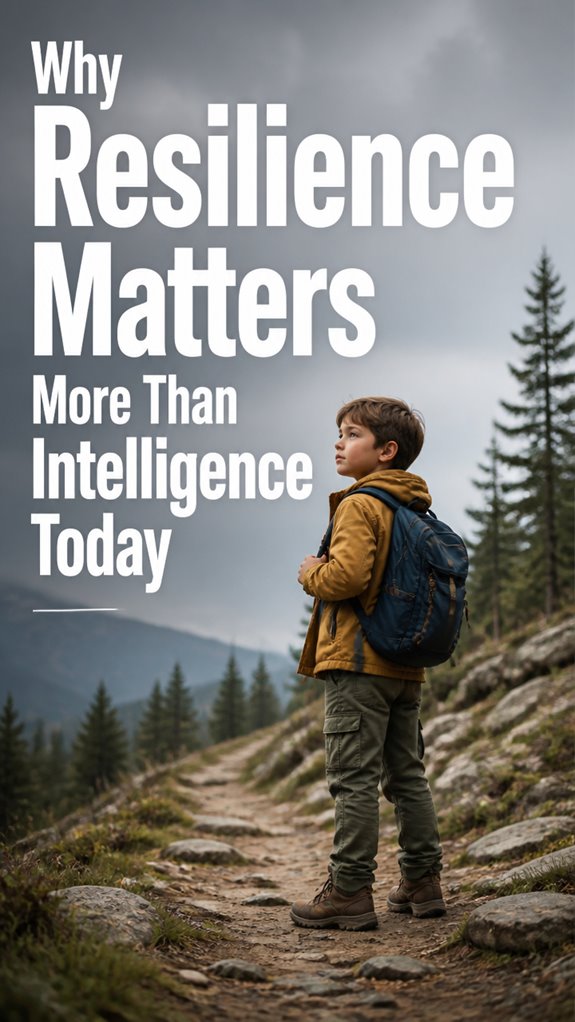
- Cultivate resilience and a growth mindset to view setbacks as learning opportunities.
Set Clear Goals for Using AI in Learning and Productivity
Because AI tools are becoming everyday partners in learning and productivity, setting clear goals is more important than ever. When your child uses AI collaboration effectively, goal visualization helps turn big ideas into manageable steps.
It’s not about controlling the future but preparing kids to navigate it confidently. Clear goals provide a sense of direction, reducing the feeling of being overwhelmed by constant change. Having open conversations about AI fears and concerns can help children feel more comfortable as they adopt these new tools.
Focus on what skills your child wants to develop—like problem-solving or creativity—and how AI can support them. By intentionally defining these goals, your child learns to stay focused, avoid procrastination, and build long-term capabilities.
Bear in mind, it’s not about rigid plans but adaptable systems that foster independence, making your child more resilient in a world that’s always shifting.
Break Down Tasks and Celebrate Progress to Stay on Track
Have you ever noticed how overwhelming big tasks can feel to kids? It’s a common fear — that they’ll get stuck or lose motivation.
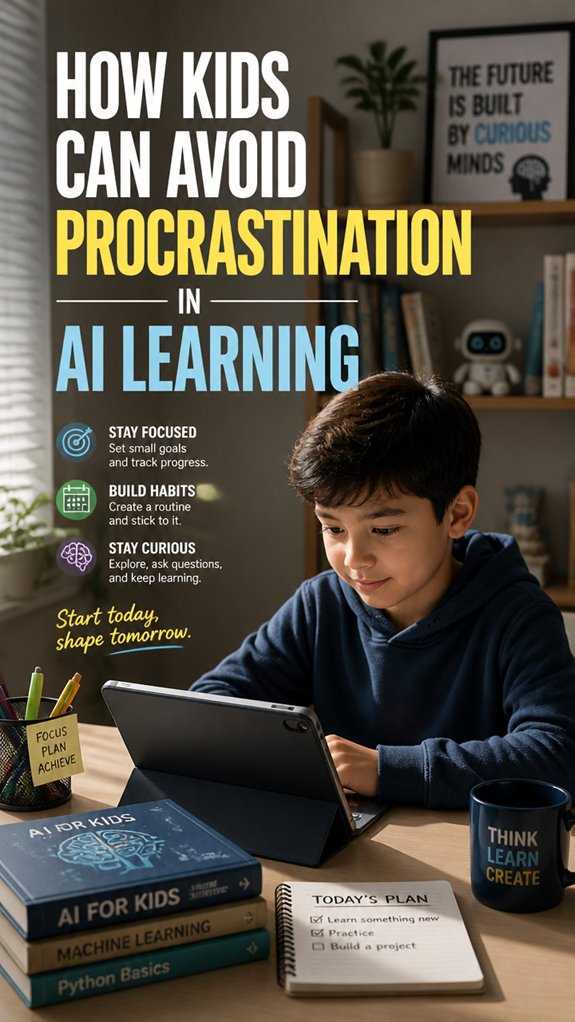
Breaking tasks into smaller steps helps children see progress, which fuels their intrinsic motivation. When they focus on manageable parts, it becomes easier to manage their time effectively without feeling overwhelmed.
Breaking tasks into small parts boosts kids’ motivation and makes time management feel achievable and less overwhelming.
Celebrating progress—big or small—reinforces a sense of accomplishment and keeps them engaged. This approach shifts the focus from fear of failure to ongoing achievement, building confidence over time.
For your child’s future, it cultivates patience and self-control, essential survival skills in a world of constant change. Developing these social connection skills alongside task management helps children collaborate effectively with peers and mentors throughout their learning journey.
Keep in mind, consistent small wins create momentum, helping children stay on track and develop a strong, adaptable mindset.
Develop Self-Regulation Skills to Work Independently With AI
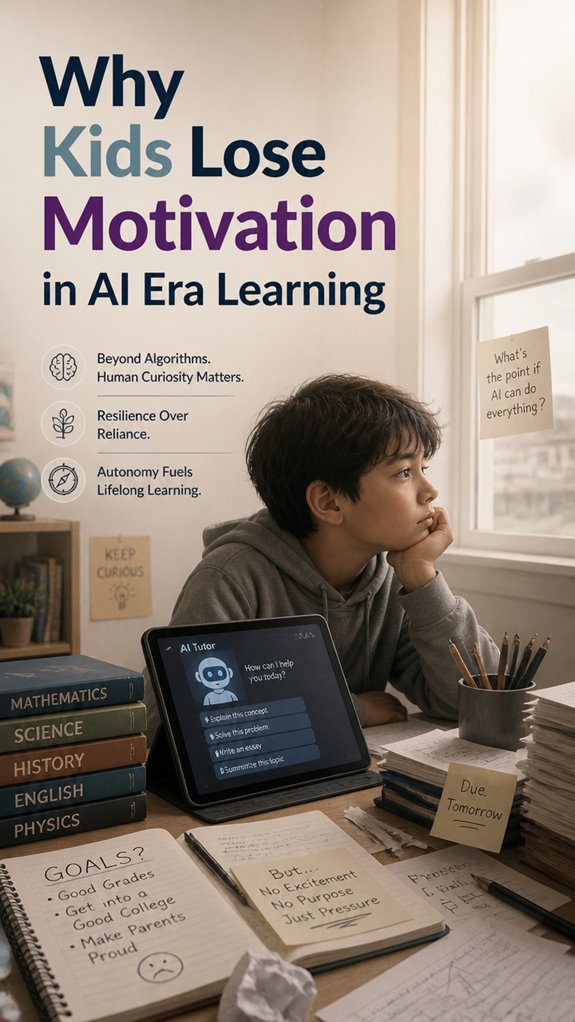
Developing self-regulation skills is essential for children to work independently with AI tools and thrive in a world of constant change. When children build emotional resilience and self-awareness, they gain confidence to navigate uncertainty without falling into distraction. These skills help them stay focused, manage frustration, and adapt when things don’t go as planned. Recognize that fear of losing control or falling behind is normal, but teaching your child to pause, reflect, and set small goals reshapes those worries into practical steps forward. In the AI era, critical thinking abilities enable children to evaluate information and make informed decisions rather than passively consuming AI-generated content. Use this simple table to understand the pattern:
| Self-Regulation Focus | Practical Action |
|---|---|
| Emotional Resilience | Encourage reflecting on setbacks |
| Self-Awareness | Foster awareness of feelings and needs |
| Focus & Discipline | Create routines that promote independence |
| Adaptability | Support flexible thinking |
| Long-term Growth | Celebrate progress over instant success |
Anti Procrastination System for Kids
Procrastination is a common challenge for kids, but it’s also an opportunity to build resilience and independence. Instead of viewing delays as failures, see them as chances to strengthen mindfulness and control.
Procrastination can build resilience and independence when viewed as an opportunity for growth and self-control.
An effective Anti Procrastination System encourages kids to use AI Collaboration, turning technology into a supportive partner. When children visualize their goals clearly, they stay focused and motivated, even when tasks feel overwhelming.
This system helps kids see their progress, stay engaged, and develop a sense of ownership over their learning journey. By framing AI as a tool for collaboration, children learn to manage their time and attention consciously. Practicing concentration exercises strengthens their ability to resist distractions and maintain focus during learning sessions.
Over time, they gain confidence, understanding that proactive habits and goal visualization protect their future in an constantly changing world.
Neuroscience Insights Into Motivation
Understanding what motivates children is essential for guiding them through a world filled with change and uncertainty. Neuroscience motivation shows that the brain’s reward system plays a key role. When children experience success and interest, their brain’s reward pathways—like the striatum—activate, reinforcing learning. Growth mindset individuals believe that intelligence and abilities can be developed, which encourages children to view challenges as opportunities rather than obstacles. The anterior insular cortex responds to activities they find intrinsically satisfying, making effort feel rewarding. It’s natural to worry about kids losing motivation, but the goal is to support their brain’s natural reward signals. Praise that focuses on effort cultivates a growth mindset, boosting resilience and long-term motivation. As parents, you can encourage their brain reward system by framing challenges as opportunities, helping children build a positive relationship with learning. Keeping children engaged with meaningful activities rather than passive screen time helps prevent the mental laziness that can develop in an AI-driven world. This approach strengthens their motivation and prepares them to adapt in a world of constant change.
Persistent Distraction During Tasks
Many children find themselves easily distracted during tasks, which can feel like a constant struggle for parents trying to keep them focused. Instead of fighting these distractions, help your child strengthen their mindful focus.
Create clear environmental cues, like designated work areas with minimal clutter, that signal “it’s time to concentrate.” These cues serve as invisible anchors, helping children shift into a focused mindset.
Designate clutter-free workspaces to signal when it’s time to focus and help children shift into a concentrated mindset.
Keep in mind, distraction is normal; it’s part of how minds explore and learn. Offering consistent routines and simple cues builds an inner habit of focus that supports long-term skills like decision-making and critical thinking—key for their future adaptability. Understanding career risks in AI can also motivate children to develop these adaptive skills early, preparing them for a rapidly changing job landscape.
With patience and structure, you’ll see your child better equipped to maintain attention, turning distraction into an opportunity for growth rather than a setback.
The Adaptive Atlas Anti-Fragile Child System

In a world of constant change and uncertainty, raising a child who can handle setbacks and adapt wisely is more important than ever. The Adaptive Atlas Anti-Fragile Child System builds resilience, fostering both intrinsic motivation and a growth mindset. This system is grounded in anti-fragility principles that help children not just survive challenges but actually benefit from them.
You help your child develop:
- The ability to see failures as learning opportunities.
- Confidence in their capacity to adapt and grow.
- Steady emotional regulation during challenges.
- Curiosity-driven learning that stays motivated from within.
The Full Adaptive Atlas Framework
| System | Focus | Outcome |
|---|---|---|
| Anti-Fragile Child System | Resilience in volatility | Confident, adaptable children |
| Learning Stack Model | Self-directed learning | Continuous growth |
| Future Skills System | Critical thinking & creativity | Long-term value creation |
| AI Learning System | AI as a partner | Independent, innovative use |
The Adaptive Atlas Framework
Five connected systems designed to help parents raise adaptable, future-ready children in a world shaped by AI, automation, and constant change.
| 🛡️ |
Anti-Fragile Child SystemBuilds resilience, adaptability, and the ability to handle uncertainty without shutting down. |
| 📚 |
Learning Stack ModelDevelops self-directed learning habits and continuous skill acquisition beyond school systems. |
| 🚀 |
Future Skill Stack SystemFocuses on high-value human skills that remain relevant in an AI-driven economy. |
| 🤖 |
AI Learning SystemTeaches children how to use AI as a thinking partner instead of becoming dependent on it. |
| 🧭 |
Child Type Navigator SystemPersonalizes learning and development based on each child’s strengths and personality. |
FAQ
How Can I Motivate My Child to Start Using AI Tools Willingly?
You can motivate your child by incorporating gamification techniques and creative incentives, making AI tools engaging and rewarding. Let them explore their interests, and show how these tools amplify their abilities, fostering independence and a sense of liberation in learning.
What Are Signs My Child Is Overly Dependent on AI for Tasks?
You’ll notice signs of AI dependency if your child relies solely on AI for answers, avoids independent problem-solving, or shows difficulty when unable to access AI tools. Address overreliance concerns by encouraging critical thinking and autonomous exploration.
How Do I Balance AI Use With Developing Internal Problem-Solving Skills?
You balance AI use with internal problem-solving by encouraging critical thinking and creativity development, guiding your child to explore ideas independently while using AI as a supportive tool, fostering liberation through autonomous exploration and adaptable skills.
What Strategies Help Children Transition From Distraction to Focus?
Visualize guiding your child to a lighthouse amid swirling fog; focus sharpens through concentration techniques and distraction management, helping them navigate towards clarity. Encourage mindfulness, structured routines, and engaging tasks for lasting focus and freedom from distraction’s grip.
How Can I Measure My Child’s Progress in Self-Regulation Effectively?
Use self-assessment techniques regularly to gauge your child’s self-regulation, and employ progress tracking tools to visualize their growth. This approach empowers you both, fostering liberation from uncertainty by clearly understanding advancements and areas needing support.
References
- https://successfulstudyskills4students.com/executive-function/how-ai-impacts-your-childs-executive-function-skills/
- https://news.harvard.edu/gazette/story/2026/02/preserving-learning-in-the-age-of-ai-shortcuts/
- https://pmc.ncbi.nlm.nih.gov/articles/PMC12333830/
- https://natesnewsletter.substack.com/p/raising-humans-in-the-age-of-ai-a-a3d
- https://www.smartkidswithld.org/getting-help/raising-independent-kids/7-point-plan-to-end-procrastination/
- https://pmc.ncbi.nlm.nih.gov/articles/PMC5836039/
- https://developingchild.harvard.edu/resources/inbriefs/inbrief-understanding-the-science-of-motivation/
- https://developingchild.harvard.edu/resources/briefs/how-to-motivate-children-science-based-approaches-for-parents-caregivers-and-teachers/
- https://www.brightonandhovepsychotherapy.com/blog/understanding-motivation-insights-from-neuroscience/
- https://pmc.ncbi.nlm.nih.gov/articles/PMC5646690/