How Can Parents Guide Kids Through AI Exploration?
The answer lies in fostering curiosity through hands-on activities like coding, digital art, and storytelling. Encourage ethical debates about privacy and fairness while building critical thinking skills early.
A Moment That Changed Everything
My daughter sat hunched over her laptop, frustrated after her AI art generator produced something she didn’t expect. Instead of fixing it for her, I asked questions. That’s when Adaptive Atlas was born. We created it because kids need permission to fail productively, to tinker with technology without fear. They need adults who ask “what if” instead of providing answers.
When Experimentation Becomes Growth
Last month, my son spent three hours debugging his code. Zero complaints. He discovered resilience without me preaching about it. That’s the real win. Supporting child-led discovery means stepping back, resisting the urge to optimize their path, and trusting their instincts. Adaptability beats perfection every single time in this evolving landscape.
Quick Takeaways
- Use hands-on AI activities like storytelling and digital art to spark curiosity and creative exploration.
- Encourage self-led discovery and experimentation in safe environments to build resilience and independence.
- Integrate AI tools that align with children’s passions in art, coding, or cultural studies to deepen engagement.
- Teach ethical principles and critical thinking to develop responsible digital citizens.
- Provide structured guidance and cognitive scaffolding to build confidence and long-term skills in AI-related fields.
Cultivate Kids’ Curiosity With AI Activities
Creating opportunities for kids to explore AI through hands-on activities can ignite their natural curiosity and build important skills for the future.
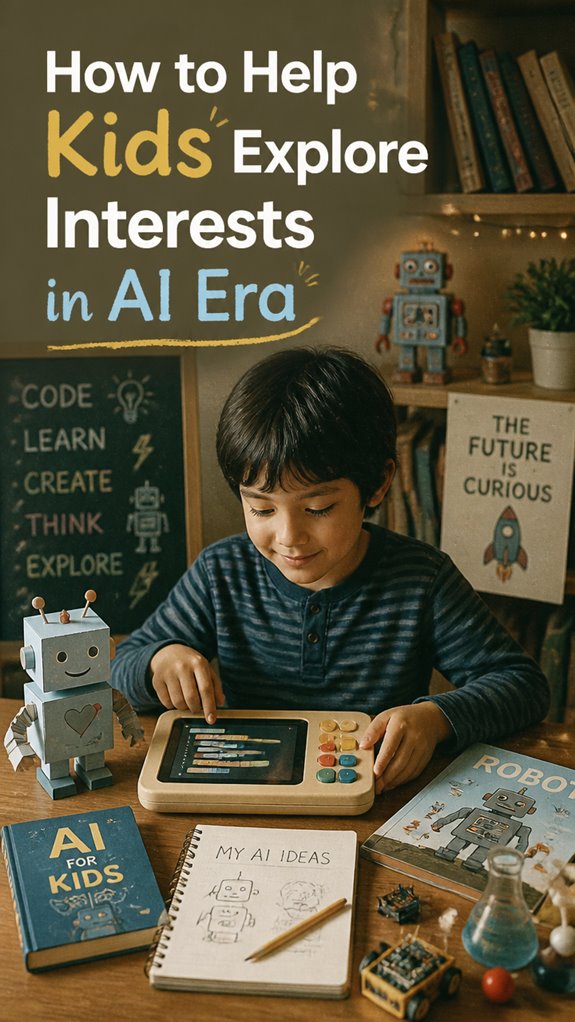
Activities like AI storytelling or digital art give children a direct experience with emerging technology. Instead of fearing AI replacing creativity, show how it can amplify their ideas.
For instance, kids can craft stories with AI tools or create digital art that expresses their unique viewpoints. These activities develop their ability to think critically and envision new possibilities—a key for long-term relevance. Project learning approaches like these allow children to pursue their passions while developing competency with new tools.
As a parent or educator, your role is to guide with confidence, emphasizing that these skills will empower children to participate actively in a changing world.
Teach Kids About AI Ethics and Critical Thinking
As AI becomes more integrated into everyday life, teaching kids about AI ethics and critical thinking is essential for helping them navigate this terrain confidently.
Many fear that AI will outpace human judgment or reinforce bias, but those concerns can be turned into opportunities for powerful learning. Talk openly about AI moral questions, like fairness, privacy, and responsibility, so children understand that choices shape technology’s impact. Understanding AI ethics fundamentals helps young people recognize how their digital choices and interactions with technology contribute to broader societal outcomes.
Encourage bias awareness, showing how data can reflect human prejudices, and explore how they can question and challenge AI outputs.
Help Kids Explore Their Passions Using AI Tools
Children’s passions are often the best guides for their future, and AI tools can help bring these interests to life in ways we couldn’t envision a decade ago. You can empower your child to explore their curiosity with AI-driven applications that adapt to their learning pace and style. For example, they might develop digital art, code simple programs, or study different cultures, fostering both emotional resilience and cultural awareness. Understanding how value is created in this AI-driven landscape helps children recognize that their passions can translate into meaningful contributions to the modern economy.
| Passion Area | AI Tools | Long-Term Benefit |
|---|---|---|
| Art & Creativity | AI design platforms | Enhances innovation and confidence |
| Coding & Tech | Code generators, tutorials | Builds problem-solving skills |
| Cultures & Languages | Language AI programs | Fosters global awareness |
| Critical Thinking | Logic puzzles, simulations | Strengthens resilience during challenges |
Child-Led Discovery and Experimentation
Encouraging your child to lead their own discovery and experimentation helps them develop the confidence and curiosity needed for the future. Parent-child mentoring is key here—your role is to create a safe space for creative risk-taking, where mistakes are seen as opportunities to learn.
Instead of controlling every step, trust their instincts and let them follow their interests. This approach builds resilience and independence, essential skills as the world rapidly changes. Developing mental flexibility through hands-on exploration prepares children to adapt their thinking and approaches as AI technologies evolve and reshape industries.
Some parents worry that too much freedom might lead to chaos or setbacks, but with clear boundaries and ongoing support, children learn to navigate uncertainty effectively.
The goal is to empower them to explore boldly, knowing that each experience shapes their ability to adapt and thrive in a dynamically shifting environment.
Neuroscience of Curiosity Development

Understanding how curiosity develops in the brain helps us see the importance of nurturing it early on. When children explore, their neural pathways grow stronger, creating better brain connectivity that supports learning and problem-solving. Neuroscience research shows that curiosity is a fundamental driver of brain development, highlighting the importance of encouraging inquisitiveness during childhood. Dopamine, the brain’s reward chemical, makes curiosity feel exciting, encouraging kids to seek knowledge continuously. The hippocampus actively codes information during curiosity, helping memories stick—especially when children feel engaged and motivated. Regular curiosity-driven activities strengthen connections in the prefrontal cortex, improving cognitive flexibility and adaptability. As a parent or teacher, you can influence this development by creating safe spaces for exploration and assigning meaningful work that channels their natural drive to learn. Recognize that curiosity fuels neuroplasticity, allowing children’s brains to rewire and learn faster. Long-term, these neural skills prepare them to adapt confidently in a world of constant change.
Dealing With Attention Span Issues
When screens dominate daily life, their impact on a child’s ability to focus can feel overwhelming. Digital fatigue and declining attention spans are real concerns.
Excessive digital stimulation burdens developing executive functions, making it harder for kids to concentrate on long-term tasks. Short-form videos train children to seek instant gratification, reducing their capacity for sustained attention and increasing distractibility. Building deep focus habits through intentional practice can help counteract these effects and restore children’s ability to engage with meaningful work.
Excessive digital stimulation hinders executive function, weakening kids’ ability to focus on long-term goals.
Neurobiological changes, like decreased connectivity in key brain regions, further impair focus and decision-making. Research indicates that increased digital media use is associated with a rise in ADHD diagnoses, highlighting the importance of managing screen time.
As a parent, your goal is to create balance—limit media time thoughtfully and promote activities that strengthen attention and resilience.
Recognize that these shifts are gradual. Focus on fostering routines and environments that support long-term cognitive growth, helping children build a flexible, adaptable mind ready for the uncertainties of the AI era.
Interest Exploration System for Kids
| Interest Area | Questions to Explore | Resources for Growth |
|---|---|---|
| Arts | What do I love about drawing? | Art classes, tutorials |
| Science | How does the sky work? | Science kits, documentaries |
| Technology | What if I code my game? | Coding apps, maker spaces |
| Sports | How can I improve my game? | Training camps, coaching |
This system empowers you to guide effectively, ensuring your child builds confidence and direction. Pairing interest exploration with working memory skills creates a foundation for deeper learning and sustained engagement across all areas.
The Adaptive Atlas Learning Stack Model
The Adaptive Atlas Learning Stack Model offers a clear way to understand how children develop skills in a world where knowledge is constantly shifting. You don’t have to fear that your child will fall behind; instead, focus on building their ability to transfer knowledge and adapt.
This model uses cognitive scaffolding—supporting their thinking as they learn new skills—to help them navigate uncertainty. It emphasizes long-term capability over memorization, preparing your child to stay relevant and confident. The Learning Stack Model provides a structured framework for organizing these developmental stages systematically.
By fostering self-directed learning and encouraging flexibility, you help your child become resilient and independent. This approach isn’t about controlling the future but empowering your child to shape it.
It’s a practical, systems-based way to nurture valuable skills that will serve them throughout their lives.
The Adaptive Atlas Framework
Five connected systems designed to help parents raise adaptable, future-ready children in a world shaped by AI, automation, and constant change.
| 🛡️ |
Anti-Fragile Child SystemBuilds resilience, adaptability, and the ability to handle uncertainty without shutting down. |
| 📚 |
Learning Stack ModelDevelops self-directed learning habits and continuous skill acquisition beyond school systems. |
| 🚀 |
Future Skill Stack SystemFocuses on high-value human skills that remain relevant in an AI-driven economy. |
| 🤖 |
AI Learning SystemTeaches children how to use AI as a thinking partner instead of becoming dependent on it. |
| 🧭 |
Child Type Navigator SystemPersonalizes learning and development based on each child’s strengths and personality. |
FAQ
How Can I Balance Screen Time With Hands-On AI Exploration?
Set firm screen limits, prioritize outdoor activities, and encourage hands-on AI exploration beyond screens. You empower your child to develop adaptable skills, balancing technology use with real-world experiences that build resilience, creativity and long-term capability for future success.
What Are Signs My Child Is Developing Healthy Curiosity About AI?
If your child questions ethical concerns and seeks understanding beyond skepticism, they’re developing healthy curiosity. With 87% of kids showing interest in AI, you’re empowering them to critically explore technology’s impact and grow into future innovators.
How Do I Support a Child’s Interest if They’Re Unsure About AI?
You support your child’s AI interest by introducing AI ethics thoughtfully, reinforcing curiosity through challenge and exploration. Empower them with resources that emphasize responsibility, critical thinking, and their influence, transforming uncertainty into a strategic advantage in mastering AI literacy.
What Role Do Emotional Skills Play in Ai-Related Curiosity?
Empathy development and emotional intelligence are your child’s secret superpowers, igniting curiosity about AI. Empower them to connect deeply with others, fostering resilience and understanding—these emotional skills unlock limitless potential in comprehending and exploring AI-driven worlds.
How Can I Foster Creativity in AI Without Relying on Technology?
You can foster creativity in AI without relying on tech by prioritizing imagination development and critical thinking. Encourage open-ended play, storytelling, and problem-solving challenges that stimulate their mind, enabling them to innovate beyond digital limitations and harness intrinsic understanding.
References
- https://oxfordlearning.com/9-ways-to-help-kids-navigate-the-world-of-ai/
- https://www.lifehubeducation.com/blog/ai-education-for-kids
- https://www.linkythinks.com/blog/creativity-in-the-age-of-ai
- https://www.ontrackschool.com/preparing-kids-for-ai-driven-future/
- https://npnhub.com/the-neuroscience-of-curiosity-unlocking-the-brains-drive-to-learn/
- https://www.psychologytoday.com/us/blog/brain-reboot/202311/the-psychology-and-neuroscience-of-curiosity
- https://pmc.ncbi.nlm.nih.gov/articles/PMC8363506/
- https://www.growthengineering.co.uk/curiosity/
- https://zuckermaninstitute.columbia.edu/brain-imaging-study-reveals-curiosity-it-emerges
- https://curiosity.britannica.com/science-of-curiosity