How Can Kids Build Real AI-Era Skills Without Burning Out?
The answer isn’t chasing passion. It’s building capability through short exploration loops across coding, design, and biology. Match opportunities to your child’s learning style. Use AI to accelerate discovery after hands-on work. Focus on adaptability and emotional resilience instead of fixed skills that’ll be obsolete tomorrow.
A Real Moment That Changed How I See Learning
My daughter spent three weeks convinced she hated math. Then she built a chatbot that needed logic to function properly. Suddenly, equations weren’t abstract symbols on paper. They became tools with actual purpose. That shift sparked what became Adaptive Atlas. We built it because we saw kids needed guidance matching their unique learning profiles to real opportunities, not generic passion-chasing advice that leaves them scattered and frustrated.
When Uncertainty Became the Breakthrough
Last month, my son got stuck debugging code for hours. The old me wanted to jump in and fix it. Instead, I sat with his discomfort. He eventually solved it himself. That day taught me more about resilience than any success story. Kids don’t need to feel comfortable all the time. They need to know someone believes they’ll figure it out anyway.
Quick Takeaways
- Build capability through self-directed learning loops, not passive knowledge absorption, using internal feedback systems.
- Create structured exploration cycles every 2-3 weeks across different domains to reveal genuine interest patterns.
- Use AI strategically after hands-on exploration to accelerate discovery and deepen understanding meaningfully.
- Match learning opportunities to individual profiles—visual-spatial, hands-on, or abstract—for optimal engagement and growth.
- Develop emotional resilience and adaptability by embracing uncertainty and treating change as information, not threat.
Build Capability, Not Passion
Most parents worry they’re supposed to help their child discover their one true passion—the thing that’ll define their career and identity forever.
Stop. That framing’s outdated and it’s holding you back.
In a world where roles shift faster than expertise accumulates, passion alone won’t sustain your child. What’ll is capability—the actual ability to think, create, and adapt across situations.
Focus instead on building emotional resilience and social skills. These aren’t soft skills anymore; they’re economic infrastructure.
A child who can recover from failure, collaborate across differences, and learn independently can pivot into any emerging opportunity.
Passion follows competence, not the reverse. When your child develops real capability in something—anything—engagement deepens naturally.
They discover what they’re drawn to through doing, not daydreaming.
In an age where AI risks include encouraging sedentary screen time, developing real-world capability becomes even more essential for healthy development.
This shift removes the pressure of finding the “right” interest. It opens doors instead of narrowing them.
Along the way, teach kids to respectfully defend their ideas so they can advocate for themselves and their evolving interests with confidence.
Create Exploration Loops
Rather than hoping your child stumbles onto a lifelong passion, you can build a system where they discover what matters through deliberate, repeated exploration.
Exploration frameworks create structure around curiosity. You’re not leaving discovery to chance—you’re designing conditions where your child engages deeply with ideas, then reflects on what they’ve learned. This mirrors how real problem solving develops through practical thinking and iterative engagement with challenges.
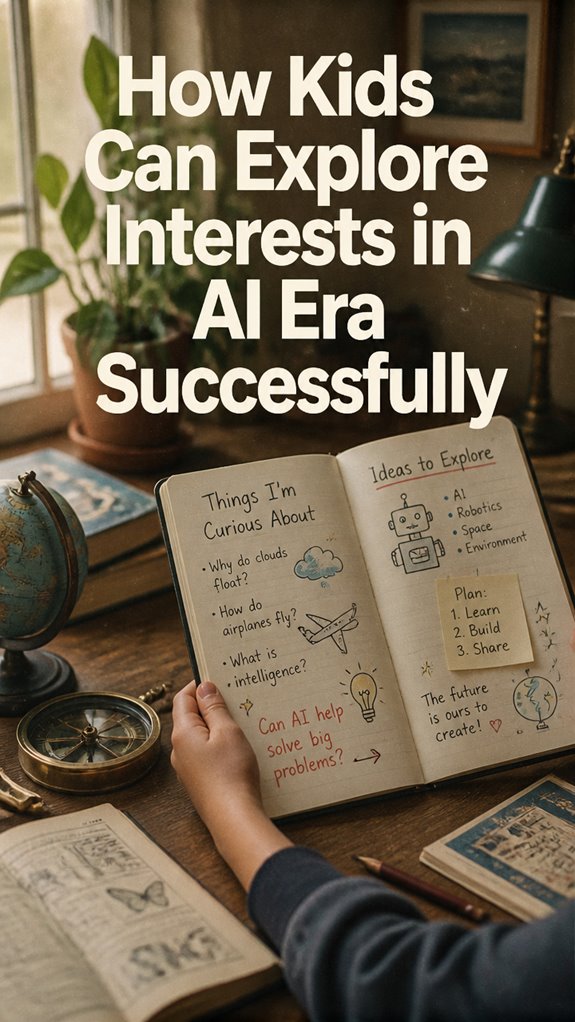
- Set rotating experiments: Your child picks a new domain every 2-3 weeks—coding, writing, design, biology. Short cycles prevent burnout while building breadth.
- Use curiosity scaffolding: Ask specific questions that deepen engagement: “What surprised you?” “What’s the next problem?” “Who solves this professionally?”
- Track patterns, not passion: Document what captivates them across domains. Real signals emerge from data, not wishful thinking.
This systematic approach builds capability and adaptability simultaneously. Your child learns how to learn while discovering what resonates. That’s sustainable advantage.
When artificial intelligence tools are introduced as one option among many exploration domains rather than the default solution for every task, children develop healthier relationships with technology while still benefiting from its educational potential.
Let AI Accelerate Discovery
Once your child has explored a domain through hands-on experimentation, AI becomes the accelerant that transforms curiosity into capability. Rather than replacing their thinking, AI collaboration amplifies it. Your child can use AI to generate multiple discovery pathways, test ideas quickly, and access explanations at depth. This isn’t cheating—it’s leverage. Future-ready skills evolve fastest when children learn to partner with technology rather than compete against it.
The fear that AI will do the thinking *for* them is real but misplaced. The actual risk is passivity. When your child directs AI toward specific questions, evaluates its outputs critically, and builds on what it generates, they’re practicing the exact decision-making that compounds over time. By connecting effort to reward, children develop ownership over their learning journey when they see their strategic use of AI tools directly produce meaningful progress.
This is where exploration becomes systematic. AI removes the friction between curiosity and understanding, letting your child move faster through discovery cycles and build deeper capability in areas that matter to them.
Match Exploration to Your Child’s Learning Profile
Not all children learn the same way, and exploration guided by a one-size-fits-all approach often stalls where it should accelerate. Your role is to match opportunities to how your child actually thinks and processes information, not how you assume they should learn.
Match learning opportunities to how your child thinks, not how you assume they should learn.
Consider these profiles:
- Visual-spatial learners thrive with AI tools like design platforms and data visualization. They see patterns others miss.
- Hands-on builders need to create tangible outputs. They learn by making, not watching.
- Abstract thinkers excel with conceptual challenges and philosophical questions. They need depth over breadth.
Child autonomy grows when parental guidance removes friction instead of imposing direction. Observe how your child naturally engages with challenges. That reveals their learning signature. Align exploration there, and capability compounds faster than any generic pathway ever could.
Curiosity-Driven Learning Amid Uncertainty

When your child asks a question you can’t answer, that’s not a gap in their education—it’s the exact moment learning should begin.
Uncertainty isn’t something to eliminate; it’s the environment where genuine curiosity thrives. Your job isn’t to have all answers but to model how to sit with not knowing and explore anyway.
Cognitive resilience—the ability to stay engaged when answers aren’t obvious—develops through this practice. Prioritizing tasks becomes a natural extension as children learn which questions deserve their attention first.
When your child investigates a question without guaranteed outcomes, they build emotional awareness of how frustration feels and how to move through it productively.
This shifts the dynamic. Instead of seeking certainty before acting, your child learns to act despite it.
That capability compounds across every future challenge they’ll face.
Drawing from resources like a family conversation guide can help parents navigate discussions about emerging technologies alongside their children.
Intrinsic Motivation Drives Sustained Engagement
The moment your child loses interest in an activity, most parents assume something’s wrong—with the task, the environment, or the child themselves. You’re not wrong to notice. But the real question isn’t why they quit. It’s whether they’re chasing external rewards or following intrinsic curiosity.
Intrinsic motivation—the drive that comes from within—is what sustains engagement when novelty fades. This matters enormously in an accelerating world. When parents engage as learning partners, children develop deeper, more lasting curiosity that persists beyond any single interest or trend.
Here’s what builds it:
- Remove the performance pressure. Let exploration happen without grades, metrics, or outcomes mattering immediately
- Honor their questions. When your child asks “why,” you’re watching intrinsic curiosity activate—fuel it
- Build emotional resilience through small struggles. Frustration isn’t failure; it’s where genuine motivation deepens
Children who learn from internal compass rather than external validation develop the staying power AI-era challenges demand.
Sustained curiosity flourishes when families establish healthy routines that balance focused learning with genuine rest, protecting the mental space where intrinsic motivation naturally grows.
Skill Obsolescence Without Adaptability
Your child’s math skills today won’t guarantee their relevance tomorrow—but that’s only a problem if you’re raising them to execute fixed tasks rather than adapt within them.
The real risk isn’t that specific skills become obsolete. It’s that your child never learns to develop technological resilience when they do.
A future-proof mindset isn’t about mastering today’s tools. It’s about building the capacity to learn whatever tools tomorrow demands.
When your child encounters a skill that’s being automated or replaced, they don’t panic. They ask: What capability lies beneath this? What’s the next evolution?
This orientation—treating change as information rather than threat—is what separates those who remain relevant from those who don’t.
The antidote is establishing family learning routines that normalize curiosity and adaptation as daily practice rather than crisis response.
Interest Exploration Toolkit for Kids
Building the capacity to learn new skills matters far more than mastering any single skill today, and that capacity develops through sustained interest exploration—not random dabbling, but structured discovery that teaches your child how they learn best.
Your toolkit has three core elements:
- Safe experimentation spaces where your child tries things without performance pressure, building emotional resilience when projects don’t work immediately
- Reflection checkpoints where they notice patterns: What engaged them? What frustrated them? What did they learn about themselves?
- Ethical framework questions about how they’d use emerging tools responsibly
This isn’t about finding “the one passion.” It’s about teaching your child their own learning signature. Short micro learning sessions with clear structure help children absorb complex information without cognitive overload, keeping their curiosity alive through manageable discovery cycles.
When they understand how they think best, they’ll navigate skill shifts confidently.
That self-knowledge compounds across every future challenge they’ll face.
Establishing daily self-learning routines helps children develop the consistency and independence needed to sustain meaningful interest exploration over time.
The Adaptive Atlas Learning Stack Model

Once your child develops the emotional resilience to handle uncertainty and frustration, they’re ready for the next layer: learning how to learn in a world where information shifts constantly.
The Learning Stack Model teaches self-directed learning loops instead of passive knowledge retention. Your child becomes the architect of their own education, using internal feedback systems to identify gaps and fill them independently.
This matters because the half-life of skills continues shrinking. Rather than memorizing facts AI can generate instantly, your child learns to ask better questions, evaluate sources critically, and adapt their approach when strategies fail. Adaptive learning technologies are increasingly shaping how students receive personalized instruction that responds to their individual pace and understanding.
They’re building the meta-skill that compounds over time: the ability to acquire any skill they’ll need, whenever they need it.
In today’s rapidly evolving landscape, independent learning has become essential for children to thrive amid constant technological and societal change.
The Adaptive Atlas Framework
Five connected systems designed to help parents raise adaptable, future-ready children in a world shaped by AI, automation, and constant change.
| 🛡️ |
Anti-Fragile Child SystemBuilds resilience, adaptability, and the ability to handle uncertainty without shutting down. |
| 📚 |
Learning Stack ModelDevelops self-directed learning habits and continuous skill acquisition beyond school systems. |
| 🚀 |
Future Skill Stack SystemFocuses on high-value human skills that remain relevant in an AI-driven economy. |
| 🤖 |
AI Learning SystemTeaches children how to use AI as a thinking partner instead of becoming dependent on it. |
| 🧭 |
Child Type Navigator SystemPersonalizes learning and development based on each child’s strengths and personality. |
FAQ
How Do I Know if My Child’s Interest Is Temporary Distraction or Genuine Exploratory Direction?
You’ll spot genuine direction when your child returns to it unprompted across weeks, not days. Real interests show creative autonomy—they’re tinkering, asking questions, building on previous attempts.
Interest longevity reveals itself through persistence during difficulty, not just during novelty. Notice whether they’re chasing distraction or developing depth.
That distinction matters enormously for their future capability. It’s the difference between dabbling and building leverage.
Should I Intervene if My Child Explores Interests That Seem Economically Unviable or Obsolete?
Don’t block exploration based on today’s economic viability.
You’re optimizing for career stability in a system that won’t stay stable. Instead, let your child build thinking patterns, creative problem-solving, and independent learning through any genuine interest. These capabilities transfer across situations.
Financial viability shifts; adaptability compounds. Your real leverage isn’t predicting which careers survive—it’s developing your child’s capacity to navigate whatever emerges.
How Much Structure Should Guide Exploration Before It Becomes Constraining Rather Than Enabling?
Structure enables exploration; it doesn’t constrain it. You’re guiding, not directing. Set clear boundaries—time, resources, feedback loops—then let curiosity lead within them.
This mirrors how professionals work: constraints breed creativity. Your role is removing friction, not limiting direction.
A child exploring music needs practice structure, not genre restriction. The goal is building capability and decision-making, not predetermined outcomes.
This balance keeps exploration purposeful while preserving creative freedom.
When Should Parents Push Back on Exploration Versus Allowing Failure to Teach Its Own Lessons?
Push back when exploration becomes avoidance of discomfort.
Let failure teach when the stakes are low and the lesson’s clear.
You’re building creative risk-taking and emotional resilience—not protecting from every stumble.
The telegraph didn’t kill curiosity; it changed what mattered.
Your child needs both guardrails and permission to struggle.
That’s where real capability compounds.
How Do I Balance Multiple Competing Interests Without Overwhelming My Child or Creating Decision Paralysis?
You’re not managing interests—you’re building decision-making capacity. Let creative play guide exploration, not schedules. Your child doesn’t need every option available simultaneously.
Instead, rotate focus quarterly, allowing emotional resilience to develop through small commitments and completion cycles. This teaches them that depth matters more than breadth.
Constraint builds capability. The skill isn’t choosing everything; it’s choosing deliberately and following through.